



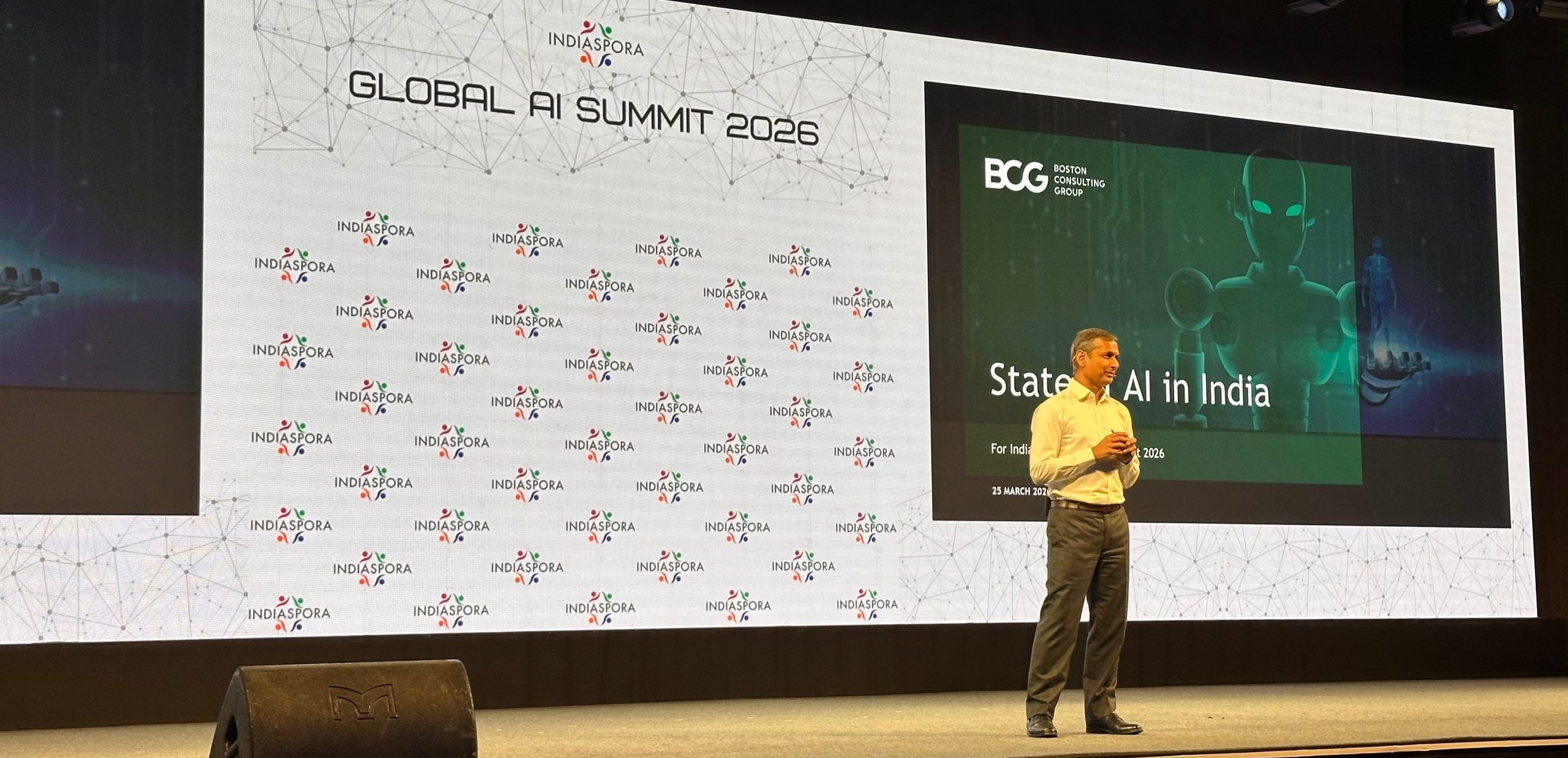
As artificial intelligence reshapes economies and industries worldwide, Neeraj Aggarwal, Managing Director and Senior Partner at BCG (Boston Consulting Group), delivered a comprehensive keynote at the Indiaspora Global AI Summit 2026, offering a grounded, structured view of India’s position in the evolving AI landscape.
Aggarwal stressed that AI is still in a state of extreme uncertainty while framing his comments with a combination of caution and optimism. “I think AI is on the stage of enormous change. And anybody, at least I for one, start by saying that anybody claims they know about the subject is likely going to be wrong,” he said, setting the tone for a keynote that sought to balance hype with realism.
Aggarwal opened with the parable of the blind men and the elephant, suggesting that AI, much like the elephant, is being interpreted differently depending on perspective. “Somebody’s touching the leg, somebody’s touching the trunk… somebody says it’s a tree, somebody says it’s a rope,” he said.
He reinforced the idea that periods of technological disruption often bring “new parameters” and “half-truths,” urging the audience to adopt a more holistic view of AI’s trajectory.
Breaking down his analysis into three pillars: foundation, sentiment, and opportunity, Aggarwal first addressed India’s positioning relative to global AI leaders such as the United States and China.
He noted that the U.S. model is “market-driven” and “private-sector-led,” but also heavily supported by government demand, while China’s progress has been the result of a long-term, state-driven strategy to repatriate top talent and build domestic capabilities.
READ: In conversation with Ray Wang: ‘You have to decide what not to do’ in the AI era (March 27, 2026)
Against this backdrop, Aggarwal described India’s approach as hybrid: “My view is, we are market-driven. But the good news is, we are genuinely state-supported… but it’s also industry-led… and it’s in the open market.”
He highlighted initiatives such as the India AI ecosystem and sovereign AI stack as key enablers, while also pointing to India’s unique characteristics, including its “voice-first market” and diverse datasets.
Aggarwal identified three critical layers shaping AI’s evolution, applications, models, and infrastructure, each progressing along multiple “S-curves” of innovation.
On applications, he pointed to growing momentum in India’s startup ecosystem. “I do think with the injection of money… that there is momentum,” he said, adding that while India may not yet be at the “cutting and bleeding edge” of Silicon Valley, he is “more energized by the possibilities here than I was till last year.”
In the Large Language Models’ space, he acknowledged that global frontier models remain ahead, estimating a gap of “12 to 18 months.” However, he highlighted emerging Indian efforts, particularly in areas such as text-to-speech, real-time translation, and document processing, as encouraging signs of progress.
Infrastructure, however, remains a challenge. “India consumes about 20% of data in the world, but our data centers are roughly 3%,” he noted, underscoring the need for significant investment in capacity.
Turning to sentiment, Aggarwal drew a distinction between consumer enthusiasm and enterprise readiness.
On the consumer side, he described India as “very bullish about AI,” with high adoption rates driven in part by the country’s young demographic profile. This, he said, is “good news for innovators” and signals openness to technological change.
READ: War, diaspora and India’s growth: Gita Gopinath outlines global outlook at Indiaspora Forum 2026 (March 24, 2026)
Enterprise adoption, however, tells a more measured story. Citing a study of 1,250 global companies, including around 100 Indian firms, Aggarwal noted that “there is really only 5% companies which I today say are generally AI future built.” This represents only a marginal increase from 4% the previous year.
“Enterprise diffusion takes a long time,” he said, adding that many organizations remain in early or “nascent” stages of AI adoption. Yet, he sees this as a transitional moment. “I think the shift to the right will happen in a big way this year.”
Importantly, he highlighted that Indian companies are not lagging behind their global peers. “They are neither ahead but not behind,” he said, contrasting this with earlier waves like digital transformation, where India typically trailed by 18 months.
One of the central questions Aggarwal addressed was the future of India’s IT services sector, a cornerstone of the country’s economy.
He described a structural shift underway, driven by both increasing technology spending and rising productivity enabled by AI. “If I’m a bank… chances are in the next two to three years that 8, 9% is going to grow to 10, 12, 13%,” he said, pointing to expanding budgets.
At the same time, he noted that enterprises continue to face significant “tech debt,” with more problems to solve than resources available, creating further demand for services.
However, this growth will not be evenly distributed. “There is going to be newer opportunities with tech… but this does mean there will be some true winners and there will be some real losers,” he cautioned.
The traditional model, where IT firms focused heavily on maintaining existing systems—will be disrupted. Companies that adapt will thrive, while others may struggle. “When winds are blowing, you need to build windmills,” Aggarwal said.
Beyond IT services, Aggarwal highlighted sectors where AI could enable India to leapfrog traditional development pathways, particularly healthcare.
He contrasted India’s low healthcare spending — “between 2 to 3% of its GDP”— with significantly higher levels in countries like the United States, but suggested that AI could help bridge this gap.
“I think AI creates a once in a multi-decade opportunity” to address the long-standing “iron triangle” of access, affordability, and quality, he said. However, he cautioned that technology alone is not enough. “Just because AI is there, you cannot imagine these things will get solved. There’s some real work needed to reimagine this as models.”
Similar opportunities, he noted, exist in education and agriculture, where scalable, AI-driven solutions could transform outcomes.
Aggarwal also pointed to the emergence of entirely new industries driven by AI, from robotics to defense and drug discovery.
“Robotics will be over a period of time a $10 trillion industry,” he said, emphasizing the scale of opportunity. These sectors, he argued, present India with “a one-time opportunity to punch above its weight historically.”
However, capturing this opportunity will require sustained effort and strategic clarity.
Perhaps the most complex aspect of AI’s impact, Aggarwal noted, lies in its implications for jobs and the workforce.
With 20 to 25 million people entering India’s working-age population each year, the stakes are high. He described a spectrum of outcomes based on “agency” and “transition risk,” warning particularly about those with low agency and high exposure to disruption.
“This is what I call the curing trap,” he said, referring to the risk that AI could both assist and erode human capability.
At the same time, he acknowledged the lack of clear answers. “It’s a difficult question… it’s part of the big unknown,” he said, particularly in relation to employment pathways and skill development.
What remains critical, he suggested, are human qualities that AI cannot easily replicate. “Judgment and taste I think will remain hugely relevant,” he said, advocating for a combination of breadth and depth in education, as well as adaptability. “You’ll have much more zigzags… you’ll not do one job for a long period of time.”
In closing, Aggarwal outlined what he sees as India’s AI playbook: a foundation of “frugal decentralized innovation,” strong consumer sentiment, and opportunities rooted in both reinvention and leapfrogging.
He also called for India to take a leadership role in shaping the global conversation around AI’s societal impact. “India both has a need and a responsibility to lead this dialogue… on what does it mean for human flourishing in the age of AI,” he said.