



Editor’s note: This article is based on insights from a podcast series. The views expressed in the podcast reflect the speakers’ perspectives and do not necessarily represent those of this publication. Readers are encouraged to explore the full podcast for additional context.
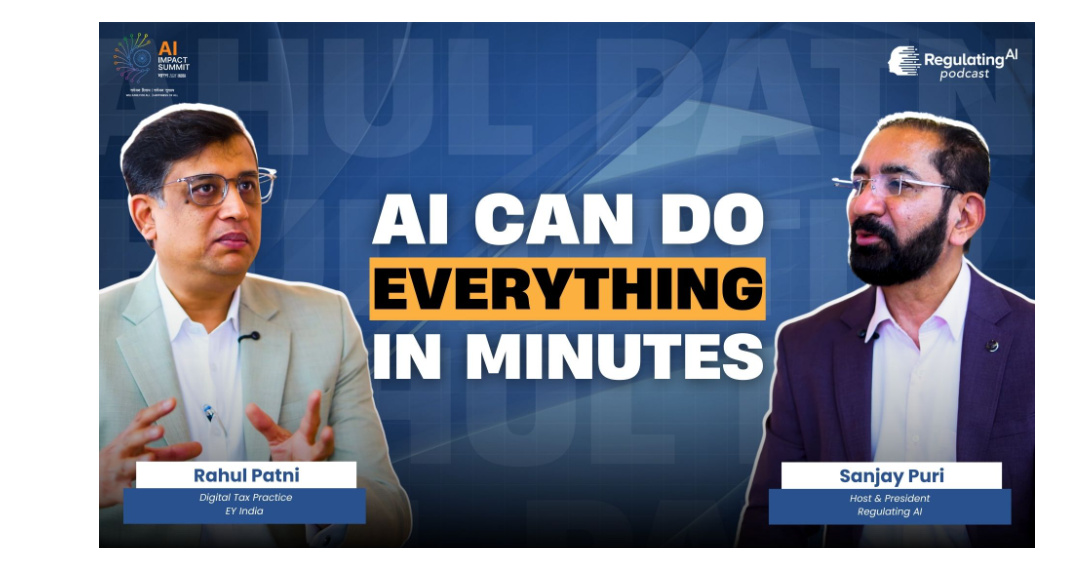
On the “Regulating AI” podcast with Sanjay Puri, Rahul Patni, Partner and Digital Tax Leader at EY India, delivers a clear and urgent message: “There has to be a framework which is monitoring the responsible AI framework within an organization.”
At the India AI Impact Summit, Patni talks about why AI is no longer a side project for tax, governance, or finance departments, it’s becoming more ingrained in enterprise operations. But without structure, oversight, and accountability, organizations could lose control.
Historically, tax has been considered a back-office process, but it actually has one of the most valuable data sets within any organization. Patni said that AI is now unlocking this value at scale.
For CFOs, audit committees, and chief risk officers, AI brings about greater governance and assurance. Rather than testing samples, AI systems can examine the entire data set, including millions of ledger lines.
He said that when audit committees realize that every single line item in a million-entry general ledger has been examined, it’s a game-changer. It’s not just about efficiency. It’s about confidence. Boards get better data, and regulators can get greater assurance.
READ: ‘If you don’t control AI, it will control you,’ ServiceNow’s Amit Zavery on balancing AI (April 20, 2026)
AI touchpoints will soon be ubiquitous in most business processes, Patni affirms. This is a fact that requires structured management. A responsible AI governance structure must have board-level responsibility, roles, and boundaries. What happens if not? Errors compound rapidly.
Patni describes actual cases of lawyers submitting hallucinated content to courts simply because the output hadn’t been checked.
But what does responsible AI actually entail?
Patni provides a blueprint:
- Policies on approved models
- Employee awareness
- IT security controls
- Disclosure practices
- Confidentiality safeguards
At EY India, proprietary solutions are developed in such a way that client data never leaks into public large language models. It all happens in a controlled environment.
In the tax and law sectors, confidentiality is paramount.
One of the most interesting aspects of this episode is the discussion of AI agents.
Patni identifies three pillars of tax:
- Planning
- Compliance
- Defense
In each of these areas, AI agents are revolutionizing the way things are done.
Research agents are able to search through enormous document repositories in minutes. Compliance agents help with complicated filings. Defense agents write responses to notices from regulatory bodies.
However, there is a very important provision here: human judgment is still required. Patni said that in a subject like tax and law, there is nuance. Human-in-the-loop is critical. AI can produce the first cut. Humans have to hone, interpret, and use judgment.
READ: Brian Poe on how Philippines is building AI governance for growth, not just regulation (April 10, 2026)
Young professionals worry that AI will make their jobs obsolete. Patni has a different take on the subject.
AI, according to him, is a companion—not a competitor.
Young chartered accountants will not have to wait years to do grunt work when they can begin with an AI assistant on their first day. That’s not a replacement. That’s acceleration.
However, there is a warning to be heeded: “They should know what is responsible AI. And they have to not make this mistake of being a postman or taking the AI-generated knowledge and passing it on to someone. If they do it, then that’s a problem,” he said.
When asked whether companies should go back and retrofit AI into their existing processes or think about them in a completely different way, Patni has a clear answer: this is a time to think about processes in a different way.
The implementation of AI is no longer a years-long process. It can happen in weeks or months.
The final words of Patni on the podcast sum up the opportunity saying that AI is here. It’s not going away and its potential is vast, “You are only limited by your imagination,” he noted.
The question is no longer whether to use AI. It’s whether you’ll use it responsibly and start now.