



Editor’s note: This article is based on insights from a podcast series. The views expressed in the podcast reflect the speakers’ perspectives and do not necessarily represent those of this publication. Readers are encouraged to explore the full podcast for additional context.
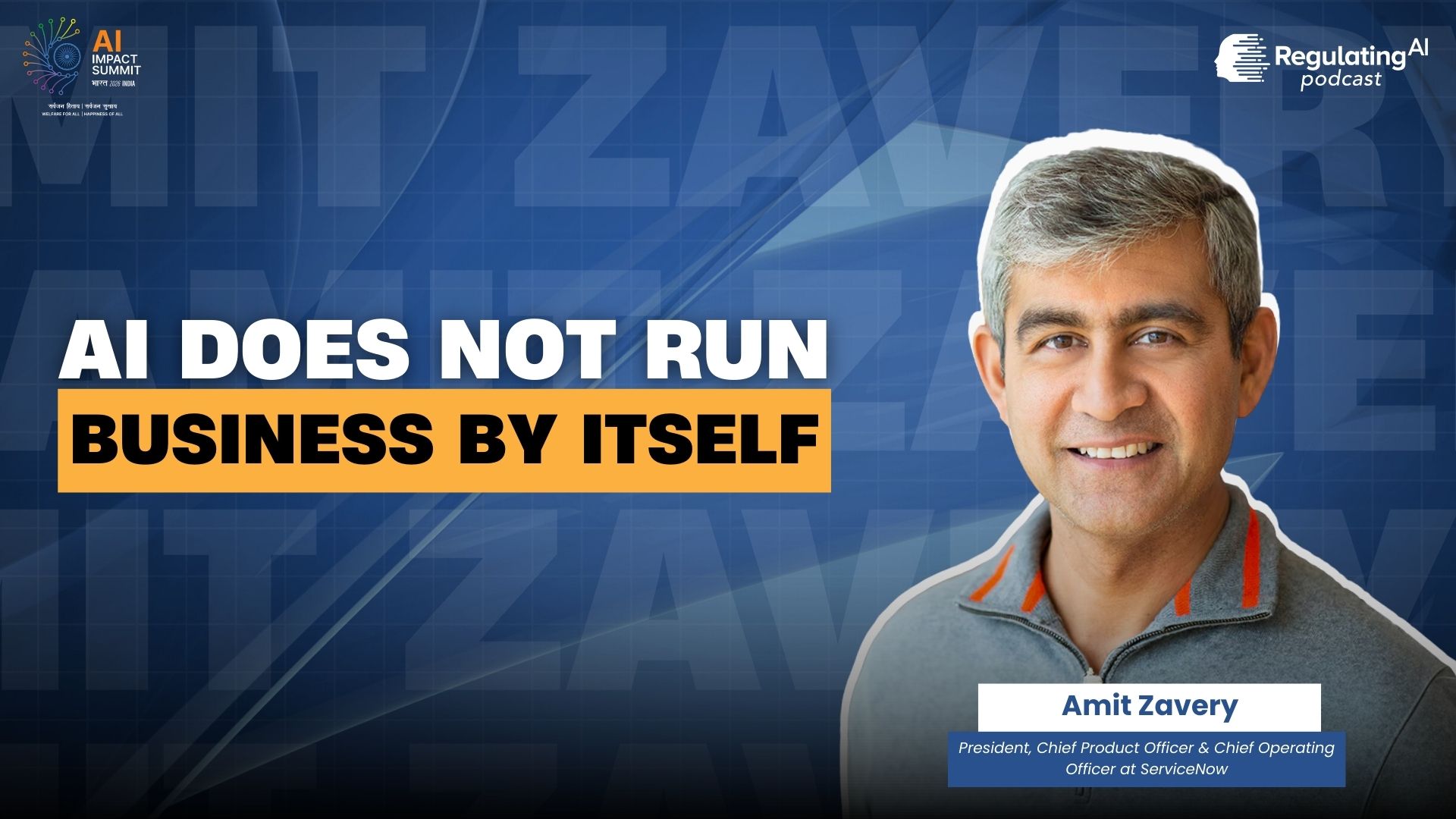
In an insightful discussion on the “Regulating AI” podcast with Sanjay Puri, Amit Zavery, the President, Chief Product Officer, and Chief Operating Officer at ServiceNow, said something that gets through the AI noise: “If you go to production and start using all this AI technology without control, AI will control you.”
With more than three decades of experience in enterprise tech, from Oracle to Google Cloud and now, ServiceNow Zavery is not guessing what the future of AI holds. He’s creating it. And in this episode, he tells us why most companies are still doing it wrong.
One of the most common misconceptions, according to Zavery, is that AI can be a standalone solution, “I think this AI is a good technology foundation, but it does not run the business by itself… you need a lot of context to use inside an enterprise. And AI is just one part of a technology, but you have to wrap it around with a lot of security, governance, audit, compliance, but also the context for business operations… And they (people) ignore that part thinking that it’s just a replaced business.”
Otherwise, AI will become an experimentation theater rather than an operational transformation.
Those organizations that don’t understand this reality are likely to face confusion at best and chaos at worst. Organizations are stuck in pilot mentality like testing tools, conducting proof of concepts, and participating in innovation workshops.
READ: Brian Poe on how Philippines is building AI governance for growth, not just regulation (April 10, 2026)
Experimentation does not drive business value. Production does. The companies that are actually realizing returns are the ones that are using AI in a controlled environment, with oversight and business metrics.
They begin with one or two use cases and then scale. This is the difference between experimenting with AI and transforming with AI.
Rather than reacting to inputs, agentic systems make decisions and perform end-to-end tasks with little human involvement. For businesses, this means transitioning from personal productivity enhancements to automating operations at scale.
This is where autonomous workflows can help, not only assisting workers in their tasks but also changing the way work is done.
While the headlines are fixated on which large language model or chip is currently at the forefront of the competition, the Chief Product Officer at ServiceNow has a clear message: customers simply don’t care about the plumbing. They care about the results.
Enterprises are looking for growth, for efficiency, and for ROI. They don’t want to worry about model updates or track release cycles. The smart approach is to abstract away the complexity to give customers control, visibility, and flexibility without having to become experts in AI.
As he says, “just because you can grow vegetables doesn’t mean you become a farmer.”
Zavery has a balanced perspective. Technological change will, by definition, displace certain jobs. But it will also create new ones, “Whenever a new technology wave happens, everybody loves this idea. I’ll experiment, I’ll learn from it and they’ll lose control. Happened with (the) cloud, happened with (the) web and now people eventually realize people are specialists better to use their solution than do everything by yourself.”
READ: Bharat Prabhakaran on reinventing education with AI at University of Cincinnati (April 9, 2026)
At ServiceNow, the adoption of AI brought substantial cost savings but the company still hired more people and entered new markets in security, CRM, and employee engagement. He expressed, “At ServiceNow, we have got benefit around $350 million of savings by using AI, but we have not displaced anybody. Our growth, our number of people inside ServiceNow has grown.”
The secret to success? Stop doing low-value, repetitive work and apply those skills to something more meaningful. Upskilling is not optional. It is essential.
Looking back at his decision to return to India, the president of ServiceNow spoke proudly of the change that has occurred in the country and its evolution into an innovation leader.
The adoption of AI is a top-down process. The excitement is palpable. The reality is there.
This is a moment in a generation for India and other emerging innovation leaders.
If given two minutes with every world leader, Zavery’s question is simple: “So my thing with world leaders is make sure you are investing, are you reskilling people and really appreciating the opportunity it creates for you as a country.”
And for young professionals? Use AI tools but don’t surrender your critical thinking. Read. Write. Question. Verify.
Because in a world moving at AI speed, what will differentiate people isn’t access to tools. It’s judgment.
AI isn’t just about adoption; it’s about control. And the organizations that understand that distinction will define the next decade.