



By Dr. Subhash Datt Jha, Dr. Aarti Jha, Dr. Sarvesh Pathak, Smt. Sangita Ji & Prabhat Datt
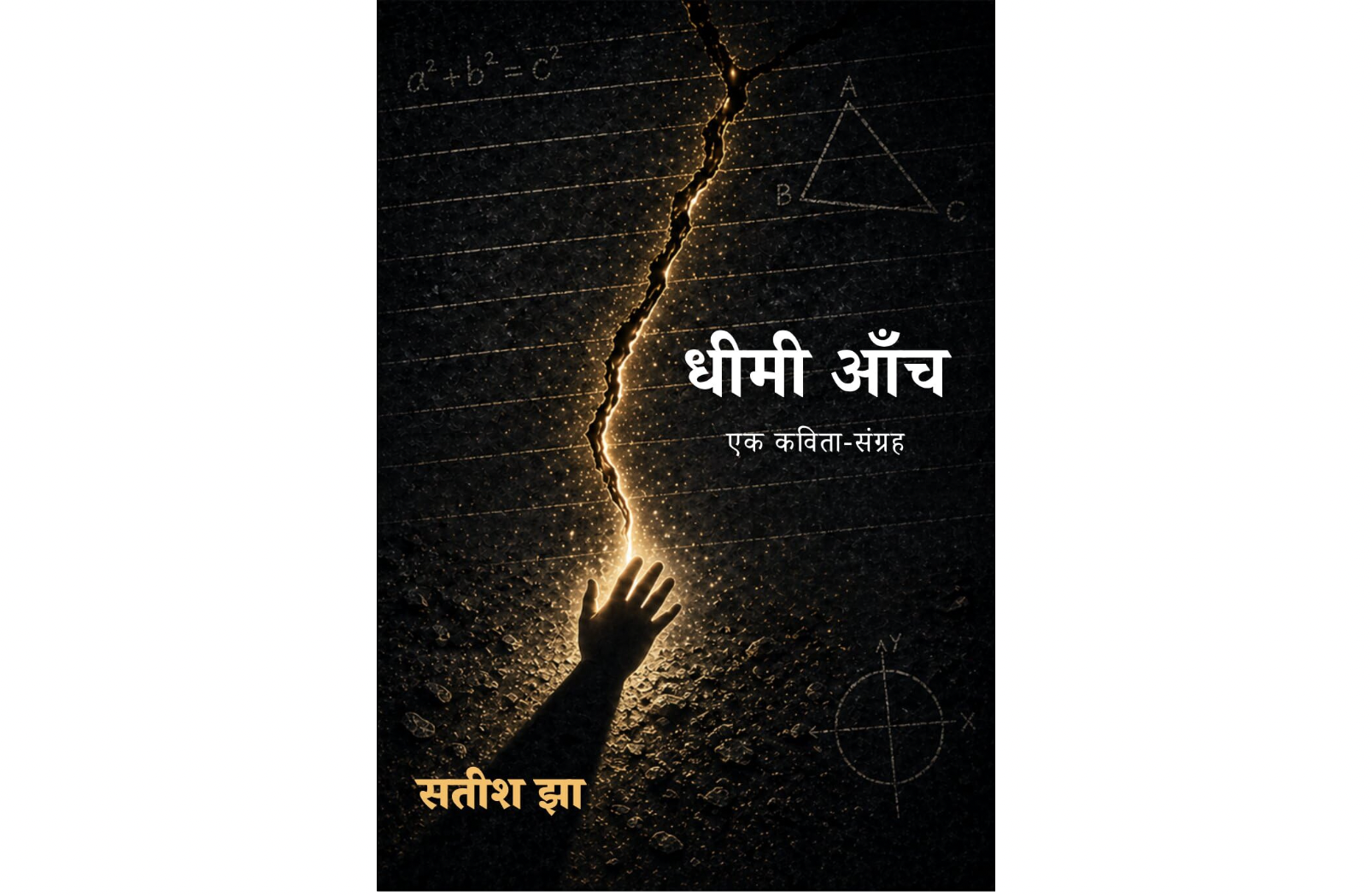
The review that follows is structured as a literary symposium — five distinct voices, each approaching “Dhimi Aanch,” meaning “Slow Flame,” from a different vantage point, yet all arriving, finally, at the same fire. The five voices belong to Dr. Subhash Datt Jha, historian and retired principal, Manendragarh; Dr. Aarti Jha, retired professor of Hindi literature, Shahdol; Dr. Sarvesh Pathak, educationist and published poet; Smt. Sangita Ji, poet, activist and advocate for the dispossessed; and Prabhat Datt, journalist and social-economic analyst. Together, their readings form not a verdict but a conversation — the kind this collection itself invites and deserves.
I. Through the Eyes of a Historian
Dr. Subhash Datt Jha — Retired Principal, Manendragarh, Chhattisgarh
When a historian reads a poem, he reads time. He reads the sediment beneath the surface — the slow accumulation of choices, silences, sacrifices and omissions that, taken together, constitute what we call history. Reading “Dhimi Aanch,” I found myself reading not a poetry collection but a counter-archive — an archive of everything that India’s five decades of education policy left unrecorded.
READ: Why India’s future hinges on education: Satish Jha’s The Full Plate explores the stakes (March 27, 2026)
History is most commonly written in the language of the state: policies enacted, budgets allocated, percentages achieved. It lives in white papers and red-dot maps. What it rarely captures is the woman who hung her saree in place of a classroom door for thirty-one years and kept teaching. It has no column for the father who set aside a laborer’s wage, every evening, without a word to anyone, so that his daughter might one day read what he never could. These lives exist outside the ledger. Satish Jha brings them inside literature — which is, perhaps, the only archive generous enough to hold them.
The title itself is a historian’s phrase. “Dhimi Aanch” — slow flame — describes the only kind of transformation that is real and lasting. Grand declarations produce grand photographs. Slow flames produce literate generations. The collection understands this with the patience of someone who has watched both kinds of change, and knows which one endures.
What strikes the historian most forcefully is Jha’s restraint. He does not editorialize. He does not argue. He places facts before you — spare, human, specific — and steps aside. That restraint is the highest form of historical writing. It trusts the evidence. It trusts the reader. And the evidence, when it is this human, needs no argument.
II. Through the Eyes of a Hindi Literary Scholar
Dr. Aarti Jha — Retired Professor of Hindi, Shahdol, Madhya Pradesh
Hindi poetry has a long memory. It remembers Kabir’s irreverence, Mirabai’s longing, Nirala’s wounded dignity, Muktibodh’s unanswerable questions. A scholar of its forms and traditions reads a new collection asking, always, the same quiet question: where does this belong? Dhimi Aanch belongs to the lineage of Muktibodh — not in imitation but in spirit. It carries the same conviction that the question which cannot be answered is more honest than the answer that cannot be questioned.
The imagery of this collection is its greatest craft. Jha’s symbols are not invented; they are discovered — lifted from ordinary life and placed on the page with such precision that they become permanent. The saree is not a garment; it is a woman’s dignity, a teacher’s resolve, a thirty-one-year act of faith conducted without audience. The “four feet” between teacher and child is not a measurement; it is the entire philosophy of education compressed into a spatial metaphor. The “corridor” is not a hallway; it is the bureaucratic labyrinth that keeps intention forever distant from action. These images, once read, do not leave.
The language is deliberately, studiously simple — and this simplicity is the hardest achievement. Jha writes in the language of a tired teacher thinking alone, of an illiterate father calculating in the dark, of a child speaking for the first time in her own voice. To reach that register demands not less craft but more. Consider the three words: “chay achhi thi” — the tea was good. Three words that carry more satirical weight than paragraphs of polemic. This is what the best Hindi poetry has always known: compression is not reduction. It is concentration.
The collection’s formal architecture — sixteen sections, each a distinct voice and angle — creates a kind of polyphonic whole, the way a classical raga accommodates multiple melodic threads within a single emotional frame. Each poem could stand alone. Together, they constitute an indictment and a prayer.
III. Through the Eyes of a Poet-Educationist
Dr. Sarvesh Pathak — Educationist and Author of Two Poetry Collections
There is a particular kind of reading that only another poet can do — a reading that is also, quietly, a reckoning. You read and you ask yourself: why didn’t I write this? And sometimes the answer is courage. Reading “Dhimi Aanch,” I found what I had been circling in my own work but had not dared to approach directly: the truth of the teacher — not as hero, not as martyr, not as a figure for admiration — but as a human being who returns, every morning, to an impossible task, carrying a tiredness that runs deeper than love and has no name.
The poem titled “Shikshak: Ek Asambhav Vyavsay Ka Gaan” — “The Teacher: A Song for an Impossible Profession” — may be the finest contemporary Hindi poem written about pedagogy. The image of a farmer who does not grow the grain but prepares the soil is not merely beautiful; it is philosophically exact. Teaching is not the delivery of knowledge. It is the preparation of conditions in which knowledge might arise. Jha has said, in one image, what volumes of educational theory have labored to explain.
READ: ‘The Full Plate’ and the kindness of readers (March 26, 2026)
The poem on the child who cannot yet speak is equally remarkable. Jha understands that hesitation is not ignorance — it is comprehension in formation, a thing still finding its shape. He does not rush it. He gives it time. And in a collection about education, that patience is itself the lesson.
As a poet, I am drawn to the triplet that closes one of the central verses: “Itna hi kaafi hai. / Itna hi kaafi tha. / Itna hi kaafi hoga” — “This much is enough. / This much was enough. / This much will be enough.” The repetition is not rhetorical. It is temporal — past, present, future collapsed into a single sufficiency. It is the most hopeful grammar I have encountered in recent Hindi poetry.
IV. Through the Eyes of an Activist-Poet
Smt. Sangita Ji — Writer and Voice for the Marginalised
Those of us who have spent years writing for the dispossessed — and marching for them — know one thing about literature: its value is not aesthetic. Its value is truth. A poem is worth nothing if it flatters. It is worth everything if it witnesses. “Dhimi Aanch” witnesses.
The poem “Hisaab” — “Arithmetic” — is, for me, the heart of this collection. An illiterate father understands that his daughter’s education is the only inequality in his favor — the one thing that cannot be inherited from him, the one thing therefore worth everything. He hides a day’s wage every evening. Without telling anyone. Without any scheme, any application form, any bureaucratic permission. He acts from the arithmetic of survival: the knowledge of what must not be lost.
This is what five decades of education policy never understood — that the real engine of this country’s educational aspiration has never been the state. It has been this father. This mother who leaves a little light in the washing water. This teacher who stays after the last footstep fades. Satish Jha understands where the power actually lives. And in naming it, he honors it.
The teacher in “Saari” — who never appeared in any list, whose medicines were not covered by any pension, who taught eleven hundred children over thirty-one years using her saree as a door — she is this country’s true educational infrastructure. She did not wait for a system that did not come. She did not apply for a door. She used what she had. Satish Jha has given her the only monument she will ever receive: a poem that will outlast every report that failed to mention her.
V. Through the Eyes of a Social-Economic Analyst
Prabhat Datt — Journalist and Analyst of Social and Economic Affairs
An analyst reading poetry looks for what the poem knows that the data does not. “Dhimi Aanch” knows a great deal that the data does not. It knows, for instance, that the central failure of Indian education policy has never been technical. It has been human. We have designed systems that forget the people inside them.
The poem “Kaagaz Aur Zameen Ka Purana Jhagda” — ‘The Old Quarrel Between Paper and Ground” — identifies the structural fault-line with an economist’s clarity. Paper says: this is how it will be. Ground asks: for whom? That question has hung in the air since the first education policy was drafted by one set of people for another set of people’s children. The distance between policy intent and lived reality is not a management problem. It is a proximity problem. Those who design have never stood in the four feet that matter.
The father in “Hisaab” is, from an economic perspective, the most sophisticated investor in the collection. He invests without expectation of personal return. He invests without formal instruments. He invests without being asked and without being counted. His capital is invisible to any national account. And yet his investment — multiplied across millions of such fathers and mothers across this country — is the actual foundation on which whatever educational progress India has made has been built. Jha’s poem is, among other things, a demand that we finally account for this invisible capital.
The two-country metaphor of Section IX — one country that appears in reports and speeches, one that does not — is perhaps the collection’s most powerful political insight. The seen country produces data. The unseen country produces human beings. We have spent fifty years measuring the wrong country.
A Convergence: Five Voices, One Flame
“That which cannot be recorded is, in the end, what is most real.” — Dhimi Aanch
When these five readings are placed alongside one another, a single truth emerges with force: “Dhimi Aanch” is a collection that belongs to everyone who has ever stood inside the education system — as teacher, student, parent, policymaker — and felt the distance between what is and what should be. It does not flatter any of these positions. It asks each of them a question they cannot evade.
Satish Jha’s central achievement is this: he has returned education to its human center at precisely the moment when that center was being most aggressively displaced by data, dashboards, delivery frameworks and the language of measurement. He does not argue against measurement. He simply holds up what measurement cannot reach — the trembling hand, the hidden wage, the saree in the doorway, the child at the edge — and asks: is this not also real? Is this not, in fact, more real?
The recurring question of the collection — “Koi hai?”— “Is anyone there?” — is deceptively simple. It is not a question about presence. It is a question about attention. It asks whether the child who stands at the threshold of literacy stands there alone, or whether someone has chosen, against all institutional inertia, to remain. The question does not demand a program. It demands a person. And that demand is the most radical thing in the book.
READ: The Full Plate: A powerful argument for grassroots change in India’s classrooms (March 25, 2026)
In terms of craft, the collection earns its place in contemporary Hindi poetry through the sustained intelligence of its imagery, the moral seriousness of its attention, and the hard-won simplicity of its language. These are not poems written quickly. They carry the weight of decades — of meetings attended and meetings survived, of red dots on maps that were once living classrooms, of reports filed over the lives they were meant to describe.
The collection’s final movement — the “Upsanhar,” or afterword in verse — refuses closure with remarkable honesty. It does not resolve. It does not console. It asks its question one final time and leaves it standing in the air, where it belongs, where it must remain until the answer is no longer theoretical.
A nation that does not teach its children to read, Satish Jha writes on the back cover, does not deprive them of their future — it deprives them of themselves. “Dhimi Aanch” is the fullest elaboration of that sentence: ninety pages of evidence that the deprivation is real, the flame is real, and the people tending it — without recognition, without adequate support, often without a door — are among the most important people this country has produced.
This flame burns slowly. But it burns deep. And it burns true.