


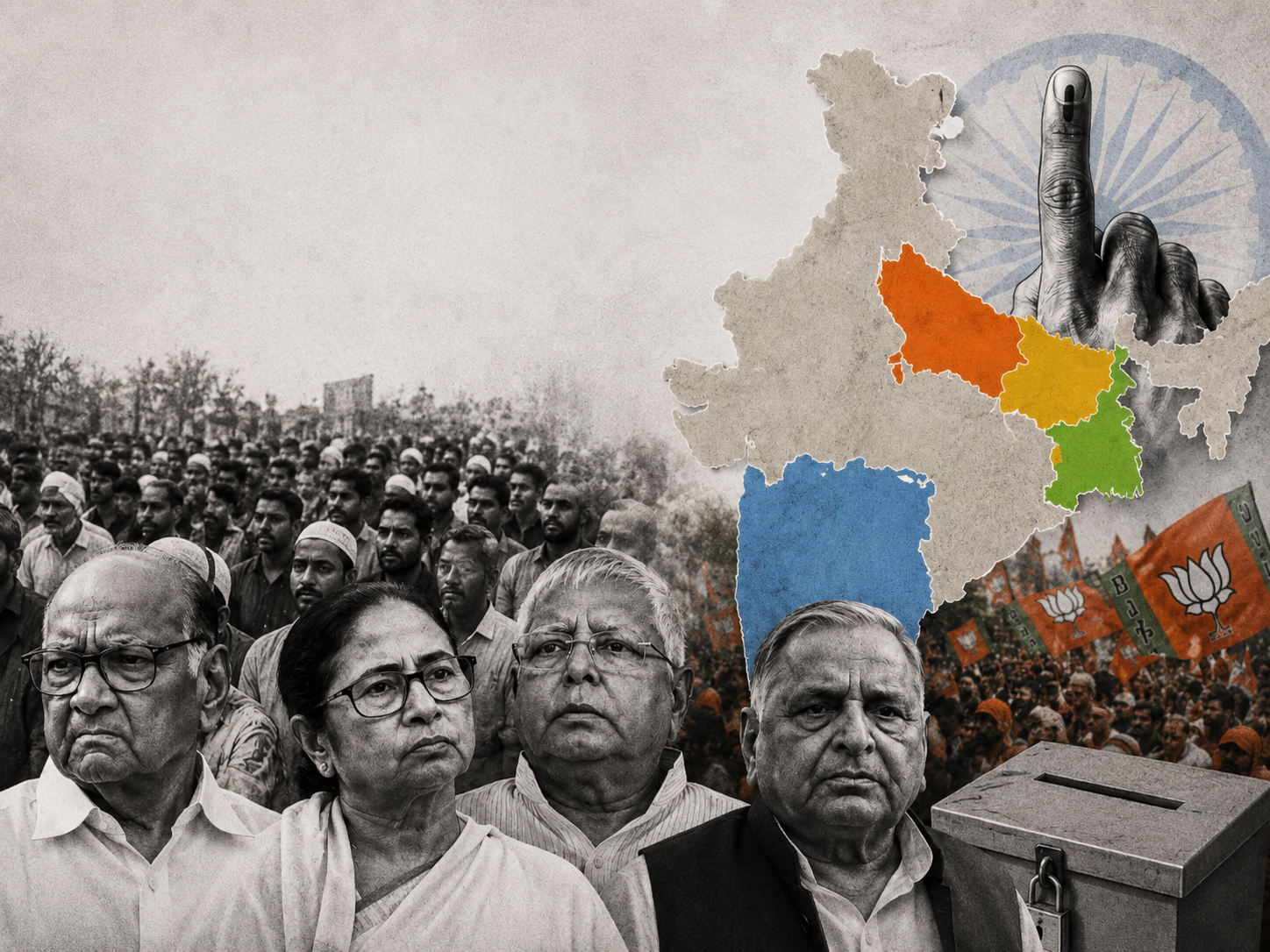
In the world’s largest democracy, a quiet administrative process has triggered one of the most consequential debates about electoral integrity in modern Indian history. The Special Intensive Revision (SIR) of electoral rolls — a nationwide exercise conducted by the Election Commission of India beginning in mid-2025 — has resulted in the net deletion of over 5.2 crore names from voter lists across twelve states. To understand the scale: that figure is comparable to India’s entire electorate during its very first general election in 1951.
The stated purpose of the SIR is legitimate and necessary. Electoral rolls accumulate errors over time — deceased voters remain listed, migrants are double-counted, and in border states like Assam and West Bengal, concerns about undocumented foreign nationals obtaining voter identity cards through forged documents are real and documented. Periodic revision is not only defensible; it is constitutionally mandated.
But the manner in which this revision has unfolded, and the political rhetoric surrounding it, have raised serious questions that go beyond administrative housekeeping.
READ: West Bengal election proves that the Great Muslim Vote Fraud is finally over in India (May 10, 2026)
The pattern that concerns democracy watchers
In West Bengal, approximately 91 lakh names were removed from electoral rolls. In Uttar Pradesh, the figure reached 2.04 crore. Analysts and opposition parties have noted that deletions were disproportionately concentrated in constituencies with large minority populations. AI-assisted software used to detect “logical discrepancies” in voter data reportedly flagged Muslim names at higher rates due to transliteration inconsistencies — the same name spelled differently across Urdu, Bengali, and English documents generated false positives at scale.
The Supreme Court of India intervened, ordering the Election Commission to publish district-wise, booth-level lists of deleted voters with stated reasons, and to accept Aadhaar and EPIC cards as proof of identity for objections. That order was significant. It acknowledged that the process, however administratively motivated, carried real risk of disenfranchising legitimate citizens.
What has alarmed democracy advocates is not the revision itself, but a parallel pattern of political statements that appeared to normalize the use of government welfare as a lever of partisan loyalty.
Several senior political leaders across multiple states made statements — some on video, some at public rallies — suggesting that access to government schemes, ration cards, and welfare benefits would be conditioned on voting behavior. In Uttar Pradesh, a leader told a Muslim audience that if they did not vote for his party, “the difficulties will become obvious to you.” In Assam, a sitting Chief Minister openly stated that his party was “directly against” a specific Muslim community and called on ordinary citizens to economically harass members of that group. In West Bengal, a leader who subsequently became Chief Minister declared that government support would flow to those “who are with us.”
These statements — recorded, circulated, and in several cases fact-checked — represent something more troubling than campaign rhetoric. They describe a sequential logic: remove people from voter lists, then condition their access to food security and welfare schemes on political compliance.
READ: How India’s Congress party keeps building leaders for the BJP — A pattern it doesn’t want to admit (May 13, 2026)
The booth-level precision behind the strategy
Political observers have noted that India’s ruling party has spent years building one of the most sophisticated ground-level voter management systems in democratic history. The Panna Pramukh model assigns one party worker to each “page” (panna) of the local voter list — typically covering 20 to 30 households. That worker tracks every voter, their voting history, their family circumstances, and their political leanings.
This granular, household-level data — accumulated over election cycles — provides a remarkably precise map of who votes for whom in any given locality. In the context of an intensive voter roll revision that requires door-to-door verification by Booth Level Officers, such data would make it operationally straightforward to identify and flag households deemed politically unfavorable.
Whether this data was systematically used in that manner remains disputed. But the circumstantial alignment — between the geographic concentration of deletions and the political composition of affected constituencies — has given credibility to concerns that merit serious independent investigation.
What Democracy Requires in Response
The appropriate response to potential electoral disenfranchisement is not counter-disenfranchisement, partisan retaliation, or inflammatory rhetoric. It is the patient, methodical work of democratic restoration. History offers clear models.
First: Voter Rights Centers at the grassroots
Opposition parties, civil society organizations, and legal aid groups should establish permanent voter rights facilitation centers — not just during election season, but year-round — at the block and panchayat level. With over 2 crore deletions in Uttar Pradesh alone, even recovering 25 to 30 percent of wrongly deleted legitimate voters through the objection process could alter electoral outcomes in dozens of competitive constituencies. The Supreme Court’s order creating an objection window with Aadhaar and EPIC as valid proof is a legal opening that organized ground networks can exploit systematically.
The work is not glamorous. It involves sitting with families, helping them locate their names in the 2002 legacy voter roll that SIR uses as its baseline, filling out Form 6 re-enrollment applications, and ensuring those forms are submitted before deadlines close. But this is precisely the kind of civic infrastructure that democracies need — and that authoritarian drift erodes.
Second: Documentary fortification for vulnerable citizens
One of the most underappreciated tools available to citizens at risk of administrative exclusion is the Income Tax Return. Even individuals whose income falls below the taxable threshold — the vast majority of rural and semi-urban households — can and should file nil returns. A filed ITR creates an official government record of residency, economic activity, and citizenship that is far harder to contest than a voter ID alone. It establishes a paper trail across multiple government databases simultaneously.
Opposition parties and civil society groups could run targeted ITR filing camps in affected areas, framing participation not as a tax obligation but as a citizenship documentation exercise. The political benefit is secondary to the democratic one: every citizen who has a formal, filed record across multiple government systems is harder to erase from any single one.
Third: Legal advocacy and judicial engagement
The Supreme Court has already shown willingness to scrutinize the SIR process. The Association for Democratic Reforms case established important precedents around transparency and due process in voter roll revision. Sustained legal advocacy — including public interest litigation challenging specific deletions, demanding algorithmic audits of the software used to flag discrepancies, and seeking accountability for political statements that appear to condition welfare on voting behavior — is essential.
Constitutional provisions are clear. Article 14 guarantees equality before the law. Article 15 prohibits discrimination on grounds of religion. Article 21’s right to life has been interpreted by courts to include food security. Any systematic effort to strip citizens of ration cards or welfare scheme access on the basis of their religion or voting preference is not only politically unconscionable — it is likely unconstitutional, and courts should be invited to say so.
Fourth: Framing the narrative around citizens, not communities
Perhaps the most important strategic insight for opposition parties and civil society is this: the story of voter disenfranchisement must be told as a story about Indian citizenship, not about any particular religious or ethnic community.
When the narrative becomes “Muslims being targeted,” it activates polarization dynamics that historically benefit the very political forces doing the targeting. When the narrative becomes “Indian citizens being erased from their own democracy,” it activates a much broader coalition — retired civil servants, judges, journalists, academics, and voters across communities who have no sectarian stake but a deep stake in the integrity of elections.
The affected communities are not asking for special treatment. They are asking for what every Indian citizen is constitutionally guaranteed: the right to vote, the right to food, and the right to equal treatment under the law. That framing is both more accurate and more politically effective.
The larger stakes
India has been a democracy for 75 years. It has survived partition, emergency rule, assassinations of leaders, and repeated tests of its institutions. Its Election Commission was once among the most respected independent electoral bodies in the world. Its Supreme Court has at critical moments upheld constitutional principles against executive overreach.
What is being tested now is whether those institutions — and the political culture that sustains them — can withstand the gradual normalization of practices that, taken individually, might seem like administrative decisions, but taken together constitute a systematic restructuring of who counts as a full citizen.
The answer to that question will not be determined by any single election. It will be determined by whether ordinary citizens, civic organizations, legal advocates, journalists, and opposition parties treat democratic participation not as a partisan cause but as a shared inheritance worth protecting.
Voter rolls can be revised. Documents can be filed. Courts can be petitioned. Citizens can be mobilized. Democracy is not a condition that is granted or revoked by governments. It is a practice that citizens either sustain or allow to erode.
India’s democratic tradition is too rich, and its constitutional guarantees too hard-won, for the latter to be acceptable.
(This column is based on documented public statements, Supreme Court orders, Election Commission data, and reporting by Indian and international news organizations.*)