



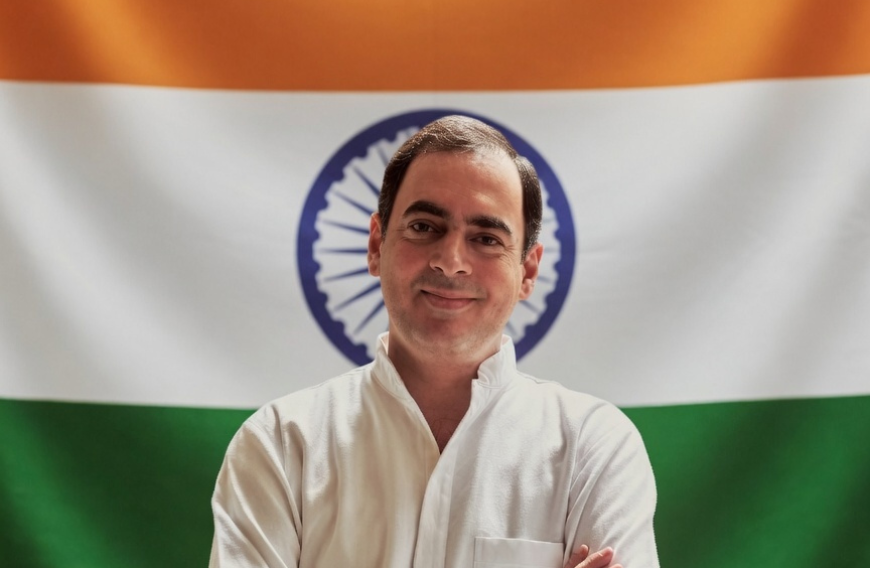
The passing of Rajiv Gandhi did not merely interrupt a political campaign; it fractured a specific sensibility in Indian public life.
To look back at his legacy decades after his departure—and more than forty years since he reluctantly stepped into the political arena—is to examine a transformative, deeply polarizing, yet fundamentally decent figure.
He remains one of the most elegant and complicated characters in the long democratic journey of modern India—a leader of unusual grace navigating a system seldom known for grace.
For those who encountered him before the office consumed him—back when he was a newly appointed General Secretary of the Congress party—the initial impression was often one of striking understatement. In the early 1980s, the Indian media landscape was less ubiquitous, less transactional. At a large reception at the Ashoka Hotel in Delhi, a waiter could look at the quiet man at the center of a swirling crowd and innocently ask a guest if that was Arun Shourie, the crusading editor of the day. It was a telling mistake of the era: it spoke to a time when journalism held a massive, defining space in the public imagination, and it captured the unpretentious, almost civilian simplicity that Rajiv Gandhi carried into a world of hardened political operatives.
To meet him in those years was to experience a rare form of political conduct. In an environment often defined by sycophancy or transactional grit, he possessed an innate politeness, a gentility, and an elegance of manner that stood entirely apart. Whether casually suggesting to an independent mind, in the presence of veterans like B.K. Nehru, that they ought to be nominated to the Rajya Sabha, or nudging technocratic minds to involve themselves in the nascent Ministry of Non-Conventional Energy Sources, he approached governance not as a dispenser of patronage, but as a recruiter of talent.
He sought out people who didn’t fit the traditional bureaucratic mold, frustrating those who spent their lives escaping the pull of state machinery, precisely because his invitation felt like a shared modernizing enterprise rather than a political trap. It is difficult to recall another Indian leader who carried authority so lightly, who appeared so instinctively uncomfortable with rancour, or who wore high office without allowing it to harden the human being beneath it.
READ: Satish Jha | The indispensable fragility: Pakistan and the unmaking of the old Middle East (May 15, 2026)
Rajiv Gandhi’s political personality was defined by a profound tension: he was an outsider trapped in the ultimate insider’s role. He did not climb the greasy pole of organizational politics; he was drafted into it by tragedy. This gave him a unique detachment. He brought the crisp, problem-solving mindset of a professional pilot to a culture accustomed to ideological posturing and feudal deference. His early speeches radiated a genuine impatience with the status quo. He viewed India through a lens of latent potential, believing that the country’s massive demographic scale could be converted into a productive, forward-looking human capital engine.
His political language was not rooted in the old vocabulary of socialist scarcity, but in the possibilities of abundance, technological leapfrogging, and efficiency. Yet, this civility and openness also masked a vulnerability. His political instincts were collaborative and trusting, traits that were both his greatest strength and his ultimate undoing in the bear-pit of Delhi politics. He sometimes believed civility could soften the harsher arithmetic of power, leaving him vulnerable to an environment that rarely reciprocated his restraint.
If Jawaharlal Nehru built India’s heavy industrial foundations and Indira Gandhi navigated its geopolitical and social fractures, Rajiv Gandhi sought to wire the nation for the future. Much of the India that emerged after him—the India of technological confidence and administrative modernization—still carries the imprint of instincts he introduced before their time. His contributions were systemic, aiming to introduce structural civility and institutional resilience to Indian governance.
Long before India was recognized as a global software powerhouse, Rajiv Gandhi, alongside Sam Pitroda, established the Center for Development of Telematics (C-DOT). By bypassing traditional bureaucratic inertia, they democratized communication, bringing the yellow Public Call Office (PCO) booths to rural corners and laying the digital infrastructure that underpins contemporary India. He recognized early on that computers were not job-displacers, as his critics claimed, but tools of mass empowerment.
Perhaps his most enduring institutional legacy was the conceptualization of the 64th and 65th Constitutional Amendment Bills. Though defeated in the Rajya Sabha during his tenure, these bills laid the exact blueprint for the 73rd and 74th Amendments passed under the Narasimha Rao government. By providing constitutional status to rural and urban local bodies, Rajiv Gandhi sought to bypass the middle-tier political brokers and transfer power directly to the people, fundamentally altering the architecture of Indian democracy.
In 1989, his government lowered the voting age from 21 to 18 through the 61st Amendment. It was a profound act of faith in the youth of India, structurally shifting the political equilibrium toward the aspirations of a younger generation and expanding the democratic franchise to millions who had previously been spectators.
Inheriting a nation fractured by internal insurgencies, his early governance was also marked by an extraordinary willingness to sacrifice short-term partisan interests for institutional peace. The Punjab Accord (1985), the Assam Accord (1985), and the Mizoram Accord (1986) saw the Congress party concede local political power to regional movements in exchange for national integration and the restoration of electoral civility.
READ: Satish Jha | The day after the ballot: India and the politics of deferred reality (May 13, 2026)
Beyond these wider frameworks, his prime ministership achieved moments of singular historical clarity. In his very first year, he pushed through the 52nd Constitutional Amendment—the Anti-Defection Law—to curb the rampant culture of political turncoats, attempting to bring structural integrity and ethical predictability to parliamentary politics. His 1986 National Policy on Education led to the creation of the Jawahar Navodaya Vidyalayas, residential schools designed to bring high-quality, free education to gifted rural children, democratizing access to excellence across economic divides.
On the world stage, his 1988 address to the United Nations General Assembly presented a concrete, phased Action Plan for systemic global disarmament, combining high idealism with structured diplomacy.
The tragedy of Rajiv Gandhi’s political journey lies in the steep learning curve he faced when his initial idealism collided with institutional inertia and entrenched interests.
His historic 415-seat mandate in 1984 provided unparalleled power, but it also insulated his inner circle from the ground realities of Indian society. He was not always right. He misjudged adversaries and underestimated the endurance of older political reflexes. The contradictions of his tenure were real: the promise of reform coexisted with political compromise; boldness with hesitation; modern instinct with inherited burdens.
His historic miscalculations were born out of an attempt to balance competing, irreconcilable pressures. In 1986, his government used its massive parliamentary majority to pass the Muslim Women (Protection of Rights on Divorce) Act, effectively overturning the Supreme Court’s progressive judgment in the Shah Bano case. Undertaken to appease orthodox religious leadership, the move triggered a severe backlash from liberal and secular quarters. In an apparent attempt to balance this concession, the locks on the Babri Masjid gates in Ayodhya were opened shortly thereafter. This dual capitulation to identity politics compromised the state’s stance on secular neutrality and unleashed ideological forces that would reshape the Indian political landscape for decades.
Simultaneously, the deployment of the Indian Peace Keeping Force (IPKF) to Sri Lanka in 1987 under the Indo-Sri Lanka Accord proved to be a severe foreign policy misjudgment. It dragged the Indian military into a bloody, asymmetric counter-insurgency conflict without a clear exit strategy, alienating both the Sinhala majority and the Tamil minority, and ultimately extracting the ultimate tragic price from Rajiv himself.
At home, the controversy surrounding the purchase of Howitzer guns from AB Bofors became the defining crisis of his career. While no personal financial corruption was ever legally proven against him, the perception of a cover-up dismantled his image as “Mr. Clean.” It revealed a deeper vulnerability: his reliance on an insular bureaucratic and personal cabal that failed to understand how deeply the optics of corruption would wound his political standing.
Under Rajiv Gandhi, the Congress party underwent a profound internal convulsion. His finest moment as party leader occurred at the Congress Centenary Session in Bombay in 1985, where he delivered a scathing, historic indictment of his own party, labeling them “brokers of power and influence who dispense patronage… and have turned a mass movement into a feudal oligarchy.” It was a brave, revolutionary speech. However, when the Bofors crisis struck, he found himself dependent on the very regional power brokers and party machinery he had denounced. The party’s internal democracy remained frozen, and the idealistic shift toward a technocratic, merit-based organization was stalled by the survival instincts of the old guard.
Concurrently, the political opposition found a unifying principle in anti-Rajivism. Led by his former Finance and Defence Minister, V.P. Singh, a disparate coalition ranging from the political Left to the Right coalesced around the singular issue of integrity in public life. The 1989 election demonstrated that while Rajiv remained the most popular individual leader in the country, the institutional alignment of the opposition could effectively check an absolute majoritarian mandate.
READ: Satish Jha | Priced Justice: Adani, Trump, Modi, and the conversion of American legal authority from a court into a marketplace (May 14, 2026)
His assassination at Sriperumbudur on May 21, 1991, remains one of the most sophisticated and chilling political conspiracies of the modern era. Orchestrated by the Liberation Tigers of Tamil Eelam (LTTE) under Prabhakaran, the plot utilized a human bomb—a tactic virtually unprecedented in world politics at the time—to eliminate a leader they feared would return to power and enforce the Indo-Sri Lanka Accord. Subsequent investigations, most notably by the Justice Verma Commission and the Justice Jain Commission, pointed to monumental security lapses. They explored the wider geopolitical landscape, looking at how regional intelligence failures, domestic political calculations that led to the withdrawal of his elite Special Protection Group (SPG) security cover by succeeding governments, and deep-seated extremist networks combined to leave him fatally exposed during an open election campaign.
In the decades since his passing, India has transformed radically, yet almost every contemporary macro-trend can trace its lineage back to the cracks and foundations laid during the Rajiv era. The 1991 economic reforms, executed by Narasimha Rao and Manmohan Singh, were politically accelerated by the acute crisis of that year, but the intellectual and technological scaffolding had been quietly erected in the mid-1980s. Rajiv’s push for modernization created the urban, aspirational middle class that today forms the backbone of India’s consumer economy.
History owes him honesty as much as affection, and his legacy lies not in a flawless record, nor in the innocence that admirers sometimes impose upon memory, but in the durability of the future he tried to imagine. Yet memory stubbornly resists reducing him to his errors; it returns instead to something rarer. To the extraordinary politeness. The gentleness of manner. The absence of bitterness. The quiet elegance that made even disagreement feel civil.
Decades after his passing, Rajiv Gandhi survives not merely as a former prime minister, but as the memory of an interrupted possibility—a different temperament in public life. A belief that modernity and civility could coexist; that technology could democratize opportunity; that politics, even when turbulent, need not become coarse.
Perhaps that is why his absence still feels strangely contemporary. India became faster, louder, more ambitious after Rajiv Gandhi. In many ways, it became the India he anticipated. Yet somewhere along the way, something quieter was lost—the conviction that power did not always need to shout to be heard, that courtesy was not weakness, and that gentleness, too, could leave a nation permanently changed.