



Editor’s note: This article is based on insights from a podcast series. The views expressed in the podcast reflect the speakers’ perspectives and do not necessarily represent those of this publication. Readers are encouraged to explore the full podcast for additional context.
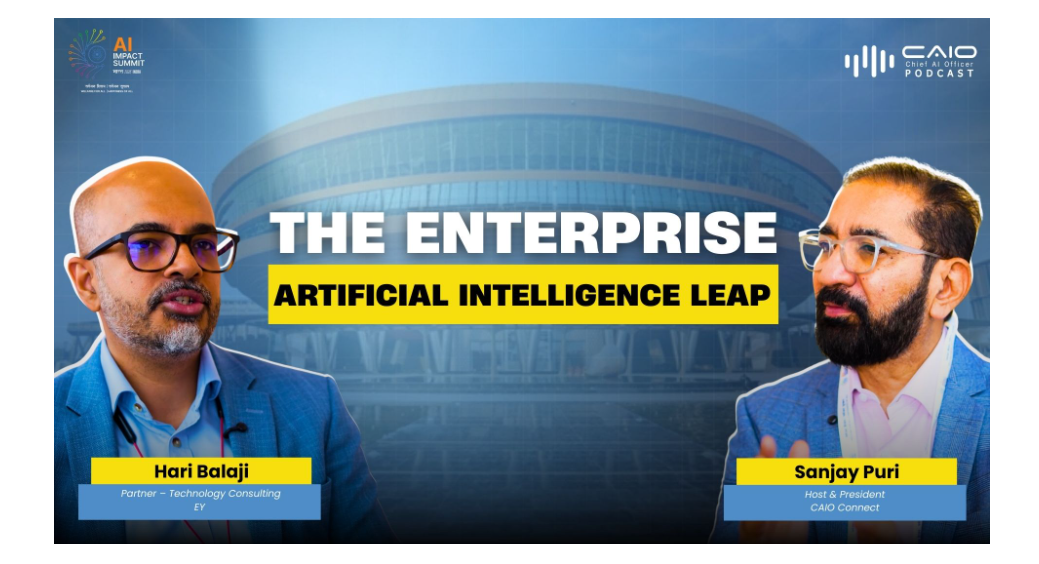
On the “CAIO Connect” podcast, host Sanjay Puri interviewed Hari Balaji, a partner at EY India and Leader of the Generative AI Center of Excellence, live from the AI Impact Summit. One thing that was clear from this podcast is that leadership in AI is no longer about models and infrastructure but about transformation, communication, and alignment.
As Balaji described on the podcast, the Chief AI Officer position has changed radically. In the first stage, the position was highly technical machine learning, data architecture, and experiments. They were building the AI infrastructure.
But now, the position is much more complicated. Companies are working 20 or more AI pilots at the same time. Some are successful. Some fail. Many are confused. The Chief AI Officer must now scale success, kill failure, deal with AI fatigue, and keep educating on new technologies such as agentic AI and new protocols that change the possibilities every month.
Balaji said, “I think that role has become very complex because it’s no longer about technology, it’s no longer about transformation, it’s a lot about communication, expectation management, getting the buy-in of various stakeholders and bringing the entire organization along with you when all of them have had different experiences with AI.”
The leadership of AI has moved from being highly technical to highly strategic.
READ: Google DeepMind’s Owen Larter discusses trust, access and governance in the AI era (May 20, 2026)
Balaji pointed out the widening gap. Employees are already using AI tools on their own. They are testing chatbots and productivity assistants. At the same time, C-suite teams are embarking on enterprise-wide AI transformation initiatives.
When these two trends don’t work together, adoption will fail.
Balaji stressed the need for internal communication. AI transformation cannot be communicated in technical speak. It has to answer the questions that employees are asking. What does this mean for me? What skills do I need? How will my job change?
Skilling has to be personalized. Communication has to be transparent. Adoption is as much human as it is tech.
The emergence of “shadow AI” the unauthorized use of AI in the enterprise is both a warning flag and an opportunity indicator.
As Balaji said, “I think it’s good to the extent that it shows and it demonstrates that you don’t really have to sell AI into your org. The benefit of what people can get out of adopting AI is so apparent to everyone because they’ve interacted with it in their personal lives and they’re really sort of, you know, thirsty for, you know, the ability to be able to use AI and to be able to bring that into their work life.”
However, left unchecked, it poses risks of data breaches, IP exposure, hallucination-driven outcomes, and regulatory non-compliance.
The solution is not a “no AI” hard line.
One of the most compelling parts of the discussion was related to leadership accountability. As Balaji said, the CEO needs to transform into the Chief AI Communicator. The vision cannot be delegated.
The Chief AI Officer, CIO, and Responsible AI leaders are the ones who execute, but the story of why AI is important and what the future holds for the company needs to be told by the leadership. AI strategy is as important as financial strategy.
READ: Prith Banerjee on making ‘physical AI’ real for global South (May 15, 2026)
Balaji’s transformation represents a larger shift. From being a systems technologist, he is now applying his skills as a transformation leader in AI.
He said that the conversation about AI has shifted to include business outcomes first. Technology is no longer at the forefront. Organizations are now transitioning from using AI as a “co-pilot” to improve workflows to completely revamping workflows around the capabilities of AI.
The key to success will be in the hands of those who are willing to rethink workflows from scratch.
At the AI Impact Summit, Balaji demonstrated the application of AI in areas beyond chatbots, such as edge computing and robotics, made possible by sophisticated hardware integration. Such applications as infrastructure scanning and public safety surveillance illustrate the practical potential of AI.
It’s a wake-up call: AI is more than conversational. It’s operational.
As Balaji so aptly summarized at the end of his appearance, the age of AI will be characterized by clarity of communication, risk awareness, and leadership.
The future is for those who can marry bottom-up curiosity with top-down vision to redesign, to empower, and to lead with confidence.
The leadership of AI today is not merely about developing models. It is about developing trust, alignment, and momentum.