



Editor’s note: This article is based on insights from a podcast series. The views expressed in the podcast reflect the speakers’ perspectives and do not necessarily represent those of this publication. Readers are encouraged to explore the full podcast for additional context.
What does it take to make AI real, not just powerful, but practical?
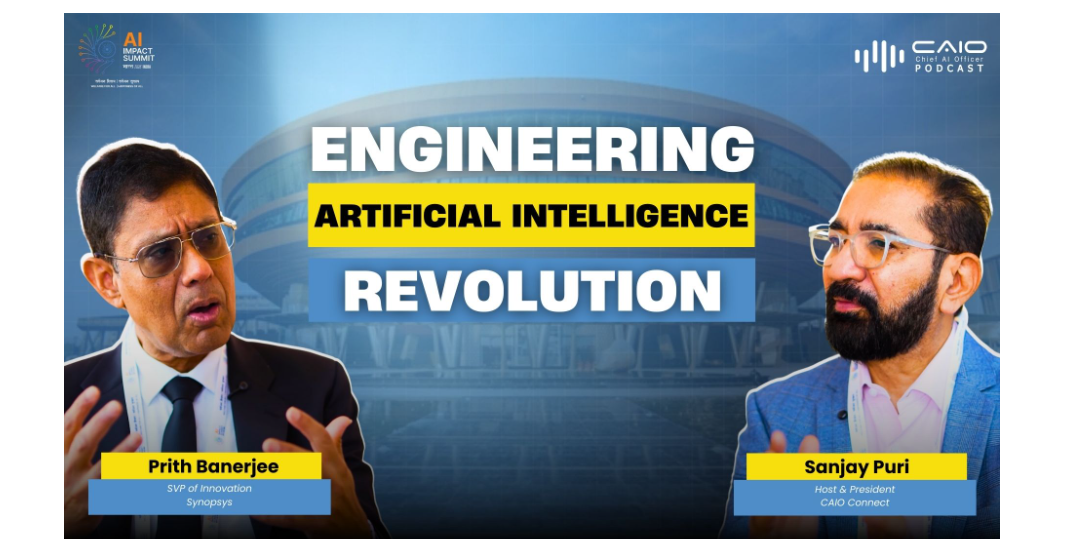
That question anchored a compelling live conversation between Prith Banerjee, Senior Vice President of Innovation at Synopsys, and host Sanjay Puri at the India Innovation Impact Summit.
Broadcasted on the “CAIO Connect” podcast, the discussion moved seamlessly from semiconductor design to farmers in rural India and made a powerful case for inclusive AI.
Banerjee’s thesis was simple but ambitious: India built digital public infrastructure like Aadhaar and UPI that transformed financial inclusion. Now it has the opportunity to build an AI layer on top of that foundation, one that serves 1.5 billion people.
A major part of the conversation focused on the strategic logic behind Synopsys’ acquisition of ANSYS. Historically, Synopsys powered the design of the world’s most advanced semiconductor chips. But today, chips don’t exist in isolation. They power complex, software-defined systems, autonomous vehicles, aircraft, robots, spacecraft.
ANSYS brought deep physical simulation capabilities. Together, the combined company can now model not just the chip, but the entire system: the software running on it, the physics surrounding it, and the real-world environment in which it operates.
READ: Anu Bradford on why India should build a hybrid AI governance model (May 11, 2026)
As Banerjee explained, the industry is moving from designing the “brain” of a machine to optimizing the entire organism. That means digital twins of semiconductor fabs, full mission simulations for spacecraft, and integrated modeling for software-defined vehicles.
One of the most fascinating parts of Banerjee’s appearance on “CAIO Connect” was his explanation of “physical AI.”
Traditional large language models use words as tokens. Image models use pixels. Video models use frames.
Physical AI goes further.
It uses real-world variables pressure, temperature, airflow, electromagnetic fields, 3D spatial dynamics as training inputs. These are often referred to as “world models.” Instead of just predicting text, physical AI learns how reality behaves.
Through high-fidelity simulation, companies like Synopsys can generate synthetic physics-based data to train robots, autonomous systems, and AI-driven machines without having to measure every physical variable in the real world.
This represents the next frontier of embodied intelligence.
READ: ‘Not a shiny new toy’: Thomas Davin on AI’s role in education and protecting childhood (May 8, 2026)
During the conversation with Banerjee outlined the AI ecosystem as a five-layer stack:
- Infrastructure (GPUs)
- Cloud platforms
- Foundation model builders
- Workflow and agentic AI
- Applications
His advice to entrepreneurs especially in India was clear: don’t compete at the infrastructure layer. Instead, build at the application layer, “you don’t have to work at the lowest level of the GPU level, or the cloud level, or the model level. Work at the application level. Make an impact (on) society. See if you can have an impact on the farmer, or to the patient, or to these children.”
Create AI solutions for farmers optimizing crop yields. Develop AI tutors for children in rural villages who cannot afford private coaching. Build AI diagnostic tools to assist doctors in underserved areas.
Each use case may be a million-dollar opportunity. But there are millions of such use cases. Multiply that out, and you begin to see a trillion-dollar opportunity sitting at the application layer.
Banerjee closed his argument with a policy message. AI, he said, is as transformative as electrification but like nuclear power, it must be governed responsibly.
Governments need frameworks to prevent misuse. At the same time, AI cannot become a tool accessible only to the elite.
Just as Aadhaar enabled financial participation at national scale, AI must be made universally available especially across the Global South.
In the end, as Banerjee emphasized, the real measure of AI’s success won’t be model size or valuation. It will be whether it makes a tangible difference on people.