



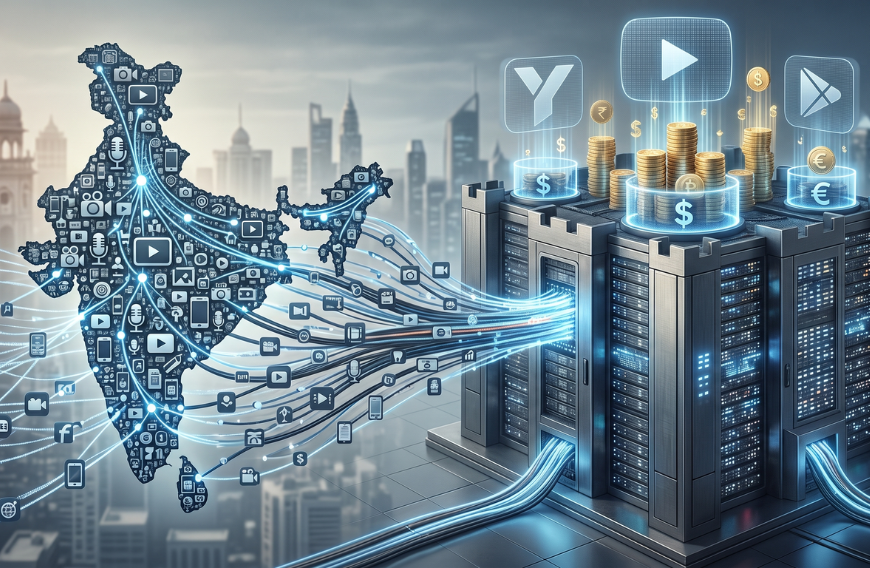
In 1600, the British East India Company arrived in India with ships, spices, and a trading license. It left 250 years later having extracted the equivalent of $45 trillion from the subcontinent — its resources, its labor, its markets, its sovereignty. The extraction was systematic, patient, and dressed in the language of civilization and progress.
In 2005, Google arrived in India with servers, algorithms, and a free platform. It is still here. It is not leaving.
And it is extracting.
Let us talk about numbers. Not the numbers YouTube publishes in its glossy impact reports — those are marketing documents, not balance sheets. The real numbers.
YouTube paid Indian creators ₹21,000 crore (about $2.4 billion) over three years — 2022, 2023, and 2024 combined. This is the number YouTube CEO Neal Mohan announced at the World Audio Visual and Entertainment Summit in Mumbai in 2025. The Indian media reported it as generosity. As investment. As YouTube’s commitment to India’s creator nation.
Nobody asked the obvious question.
If YouTube paid creators ₹21,000 crore (about $2.4 billion) — that is the 55% share creators receive under YouTube’s Partner Programme. Which means YouTube kept approximately ₹17,000 crore (about $2 billion) for itself from Indian content over those same three years. That money — every rupee of it — left India. It went to Google’s headquarters in Mountain View, California. It was reported in Alphabet’s quarterly earnings. It was taxed in America. It employed accountants in Dublin and lawyers in Singapore and lobbyists in Washington.
Read more Akhlaq Siddiqi’s column : Eid Mubarak, if they let you (May 28, 2026)
It did not stay in India.
India has 491 million YouTube users. The largest YouTube audience in the world. Indian creators produce content that generates billions of dollars in advertising revenue annually — from Indian advertisers, selling to Indian consumers, on Indian data networks, watched on phones assembled in Indian factories. And 45 cents of every rupee that advertising generates goes directly to an American corporation that pays Indian taxes reluctantly, employs Indian workers minimally, and answers to Indian regulators not at all.
This is not a partnership. This is a toll road. And India is paying the toll on its own creativity.
Now let us talk about what India built in response.
In June 2020, India banned TikTok. Around 150 million Indian users, overnight, looking for an alternative. It was the single greatest market opportunity in the history of Indian technology. A billion-dollar user base, suddenly available, hungry for a new platform, already habituated to short video content. A genuine chance to build something Indian — something that kept the advertising revenue in India, employed Indian engineers, paid Indian taxes, built Indian infrastructure.
Six years later, here is what India has.
Josh — 150 million monthly users. Dance videos, comedy reels, lip sync. No journalism. No long-form. No monetization transparency. Creators paid through coin systems and invitation-based brand deals.
Moj — 160 million monthly users. Essentially identical. Short videos in fifteen Indian languages. No YouTube equivalent for independent journalism or education.
Chingari — a blockchain-based platform that pays creators in cryptocurrency tokens. Genuinely innovative in theory. Marginal in practice.
That is it. That is India’s answer to YouTube after six years and a government that talks constantly about “Atmanirbhar Bharat” — self-reliant India.
India has no YouTube. Not one. No open, long-form video platform with transparent ad revenue sharing where an independent journalist can build a channel, grow an audience, and earn a sustainable income outside the control of a foreign corporation. The government banned TikTok and then watched as Instagram Reels and YouTube Shorts filled the vacuum — both American, both extracting, both answerable to Menlo Park and Mountain View, not to New Delhi.
The Modi government gave YouTube ₹850 crore to invest in Indian creators. Let that sink in. India — a country of 1.4 billion people with the world’s largest YouTube audience — used public money to subsidize an American corporation’s dominance of its own creative economy.
Atmanirbhar Bharat. Self-reliant India.
Now let us talk about the journalism question — because it sits at the heart of this story.
Is YouTube journalism in India real journalism or sophisticated self-employment?
Read more Akhlaq Siddiqi’s column : The truth does change with a headline, Byju (May 27, 2026)
The honest answer is — mostly self-employment. With exceptions so rare they prove the rule.
Ravish Kumar has 14.5 million subscribers. He is genuinely excellent — ground reporting, marginalised voices, long-form analysis that mainstream television abandoned years ago. He won the Ramon Magsaysay Award. He won the Peabody Award. He resigned from NDTV the day Adani took over rather than compromise his journalism. He is, in the fullest sense, a journalist.
But Ravish Kumar is one man. And even he faces the fundamental structural problem of YouTube journalism — the platform owns the relationship with the audience. YouTube’s algorithm decides who sees his videos. YouTube’s monetization policies decide what he can say. YouTube’s terms of service can demonetize his channel overnight. YouTube’s data — who his viewers are, what they watch, what they respond to — belongs to YouTube, not to him.
He built his audience on someone else’s land. And someone else’s land can be repossessed.
Beyond Ravish, the picture is less inspiring. The vast majority of Indian YouTube news channels are what the name suggests — channels. Content pipelines. Daily outrage machines that pick a political side, feed their audience confirmation of what it already believes, generate advertising revenue, and call it journalism.
Dhruv Rathee has 28 million subscribers. He is articulate, researched, and popular among the urban English-speaking liberal audience. He is also — and this must be said plainly — a content creator who has found his niche. His audience does not go to him for challenge. They go for confirmation. That is not journalism. That is a mirror with good production values.
The BJP has its own ecosystem of YouTube channels — equally large, equally engaged, equally profitable, equally not journalism.
Both sides are self-employed. Both sides are generating advertising revenue. Both sides are keeping their audiences angry and coming back. YouTube profits from all of it equally. The algorithm does not distinguish between Ravish Kumar investigating unemployment and a faceless channel spreading communal misinformation. It only asks — are people watching? Are they engaging? Are they staying on the platform?
The answer to all three is yes. So the algorithm promotes both equally.
And here is the deepest irony of all.
Yesterday’s column asked whether the Sarve bhavantu sukhinah civilization — May all beings be happy, may no one suffer — had been betrayed by Indian journalism’s thirty years of communal monetization.
YouTube was supposed to be the answer. The free press that corporate media had abandoned. The platform where Ravish Kumar could speak truth and fourteen million people could hear it.
But YouTube is also the platform where a hundred communal channels each have a million subscribers. Where misinformation travels faster than correction. Where the algorithm that promotes Ravish Kumar’s journalism also promotes the hate content that makes his journalism necessary.
YouTube gave India’s suppressed journalists a platform. It also gave India’s communal provocateurs a megaphone. It profited equally from both. It answers for neither.
The East India Company at least had to govern what it extracted. It built railways — bad railways, built for extraction not connection, but railways nonetheless. It maintained courts — partial courts, colonial courts, but courts with records and precedent.
YouTube governs nothing. It extracts everything. It is accountable to no Indian institution, no Indian court, no Indian regulatory body with real teeth. When the Ministry of Information and Broadcasting announced it would regulate social media creators — the announcement was greeted with alarm by independent journalists and cheers by the government’s supporters. Both were right to respond as they did. The regulation will target Ravish Kumar before it targets the communal channels. That is how Indian regulation works.
India’s creator economy is real. The numbers are real. ₹16,000 crore contributed to GDP. 930,000 jobs supported. Two million monetized creators. These are not small achievements. A young man from a village in Jharkhand making science videos in Hindi and earning enough to feed his family is a genuine story of digital empowerment. That matters.
But the architecture of that empowerment is owned by an American corporation. The revenue sharing is dictated by an American corporation. The algorithm that decides who succeeds is written by an American corporation. The data that tells advertisers which Indian consumers to target is harvested by an American corporation and sold back to Indian businesses at a profit.
Read more Akhlaq Siddiqi’s column : The Nerve and the Wound (May 31, 2026)
India’s creativity. America’s infrastructure. America’s rules. America’s revenue.
The ships have changed. The extraction has not.
India does not need to ban YouTube. Banning has never built anything. India needs to build its own YouTube — a long-form open platform with transparent revenue sharing, Indian data sovereignty, Indian regulatory oversight, and genuine competition for the 491 million users who currently have no Indian alternative.
It needs to stop giving ₹850 crore to YouTube and start giving it to the engineers who could build what YouTube is.
It needs to treat its creator economy the way it treats its space programme — as a matter of national strategic importance, worthy of sustained public investment, not as a market to be captured by whoever arrived first.
India sent a rocket to the moon. It cannot build a video platform.
That is not a technology problem.
It is a priority problem.
And until India’s leaders treat digital sovereignty with the same urgency they treat territorial sovereignty — until the day comes when an Indian creator can build an audience, earn a living, and speak freely on Indian infrastructure governed by Indian law — the new East India Company will keep collecting its 45%.
Quietly. Algorithmically. Profitably.
Without a single ship.