



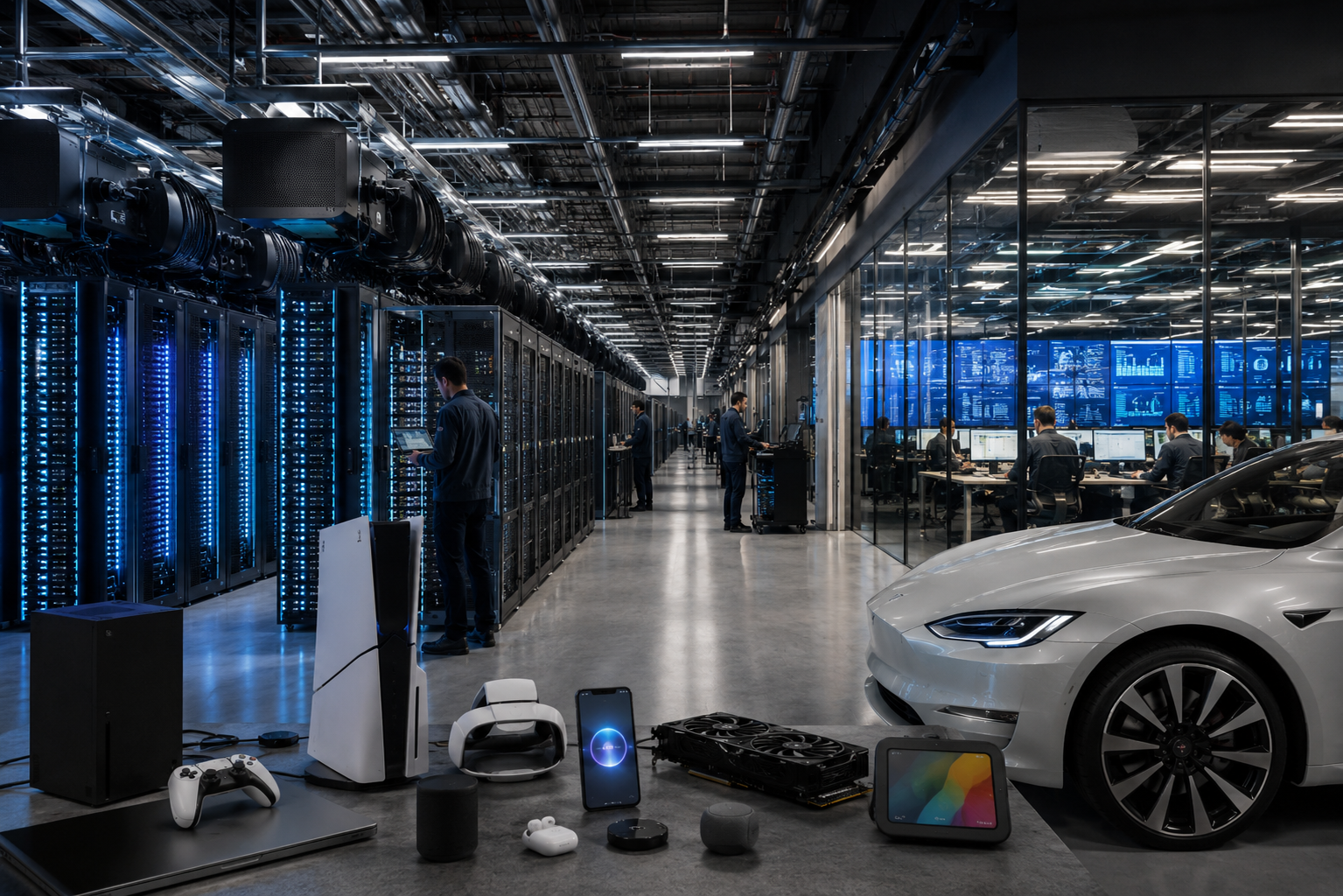
Big Tech’s multitrillion-dollar investment in artificial intelligence is no longer reshaping only the technology industry. It is increasingly influencing everyday consumer prices, from gaming consoles and smartphones to vehicles, home appliances and electricity bills, as demand for AI infrastructure strains global supply chains.
According to a new analysis by TechSpot, the combined market value of leading AI companies has climbed to roughly $8 trillion, fueled by aggressive investments from firms including Microsoft, Nvidia, Alphabet, Amazon and Meta. Those companies are spending hundreds of billions of dollars to build AI data centers, purchase advanced chips and secure enough electricity to power the next generation of artificial intelligence systems.
The scale of that expansion is beginning to affect industries far removed from AI. Modern AI data centers require massive quantities of graphics processors, high-bandwidth memory chips, cooling equipment, fiber-optic networking hardware and backup power systems. As technology companies compete for those resources, manufacturers are prioritizing higher-margin AI components over consumer electronics, tightening supplies for other industries.
READ: Ford rehires hundreds of employees as AI strategy backfires (June 29, 2026)
The impact is already being felt in the gaming industry. Manufacturers of video game consoles, including Sony, Microsoft and Nintendo, have faced rising component costs as memory chips become more expensive due to booming AI demand. Analysts have warned that console makers, which traditionally operate on thin hardware margins, may increasingly pass those higher costs on to consumers through price increases.
The pressure extends beyond gaming. Automakers are also competing for many of the same semiconductors used in AI servers, while smartphone makers, laptop manufacturers and television producers are confronting higher costs for advanced memory and processing components. As demand continues to outpace supply, manufacturers across multiple industries are being forced to absorb higher production expenses or raise retail prices.
Energy infrastructure has become another major constraint. Large AI data centers consume enormous amounts of electricity, prompting technology companies to invest heavily in new power generation, including natural gas, nuclear energy and renewable projects. The rapid expansion has intensified competition for electricity in some regions while increasing demand for skilled labor and construction materials needed to build data centers.
READ: China overtakes US with world’s fastest supercomputer not built for AI ( June 23, 2026)
Unlike previous technology cycles centered primarily on software, today’s AI race depends on physical infrastructure, including chips, transmission lines, cooling systems and power plants, which require substantial capital investment and long construction timelines.
Despite the mounting costs, the largest technology companies continue to accelerate spending, betting that artificial intelligence will generate long-term productivity gains and new revenue streams that justify the unprecedented investments. Analysts expect AI-related capital expenditures to remain elevated over the coming years as companies race to expand computing capacity and secure strategic advantages in the rapidly evolving market.