



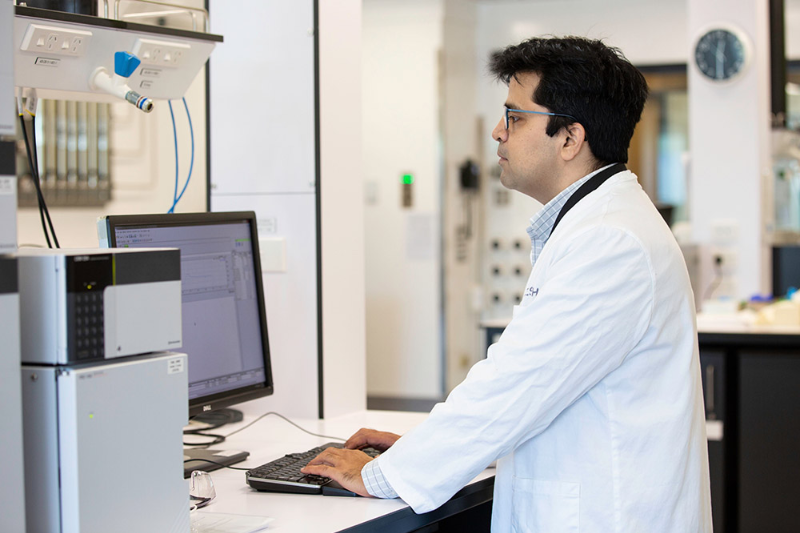
Lokesh Padhye, an Indian American professor at Stony Brook University is leading two of New York Sea Grant’s (NYSG) seven
research projects — that will directly address multiple high-priority community, economic and environmental objectives.
NYSG, a cooperative program of Cornell University and the State University of New York, has awarded $1.5 million to support the two-year projects representing a range of stakeholder-driven topics to benefit residents across a number of New York’s coastal geographies.
One of four Stony Brook research projects, each of which will receive $240,000 in funding, relates to ‘Transforming Invasive Bamboo into a Sustainable Solution for PFAS Remediation in Long Island’s Contaminated Groundwater,’ according to SBU News.
It’s led by Padhye, Associate Professor, Associate Director of Emerging Contaminants Research at the New York State Center for Clean Water Technology, and Christopher Gobler, Endowed Chair of Coastal Ecology and Conservation, Distinguished Professor, School of Marine and Atmospheric Sciences (SoMAS).
Read: Indian American researcher hunting for clean, affordable hydrogen energy
(July 9, 2026)
Contaminated groundwater on Long Island may be responsible for transporting per- and polyfluoroalkyl substances (PFAS) into coastal waters. PFAS — a family of contaminants that negatively impact all living organisms, including humans — can impair water quality in coastal areas, pose exposure risks and threaten aquatic ecosystems.
Since conventional treatment approaches are costly and operationally challenging for low-level PFAS contaminants, investigators propose using invasive bamboo to produce a sustainable biochar (a highly porous, charcoal-like substance) to remove PFAS from contaminated groundwater.
“We can transform an invasive plant that many homeowners and towns are struggling to manage into a tool for cleaning up ‘forever chemicals’ in groundwater,” said Padhye. “This is not just an academic exercise in creating a new material; it is a practical effort to protect Long Island’s drinking water and coastal ecosystems by leveraging resources already available in the region and providing a viable alternative or complement to conventional, but expensive treatment.”
If successful, Padhye says the approach that he, Gobler and the research team develop could be adapted for use in other regions and with other waste biomasses, helping communities turn local environmental problems into part of the solution.
The second project led by Padhye and Oliver Shipley, Assistant Professor, relates to ‘Tracking Forty Years of PFAS Prevalence in the Hudson River Estuary.’
Read: Indian American cancer researcher Manoj Mishra joins national immunology body (July 20, 2026)
The driver in the second PFAS study is that, as Shipley said, “PFAS exposure in humans has been of growing concern over the last decade, especially given that some compounds have been linked to chronic disease such as cancers.”
The investigators will analyze PFAS effects in the Hudson River Estuary (HRE) by analyzing protein extracted from striped bass scales collected over four decades through the Hudson River Biological Monitoring Program.
The intention is to use results to inform next steps for fisheries management, consumption advisors and stewardship of the HRE. Sampling of modern fishes will provide important insight into emerging PFAS that could be of human health concerns to seafood consumers.
Padhye’s research focuses on improving water quality in natural and built environments, with a strong emphasis on addressing water quality challenges of the 21st Century.
Padhye did his BE in Civil Engineering from University of Mumbai, SPCE, Mumbai, before earning his MS in Civil Engineering and PhD in Environmental Engineering from Georgia Institute of Technology, Atlanta.
He also worked as an Assistant Professor at Centre for Environmental Science & Engineering, Indian Institute of Technology Bombay and as an Associate Professor, Department of Civil and Environmental Engineering, The University of Auckland, for ten years before joining Stony Brook in 2024.