




By Vinson Xavier Palathingal
Every time students take to the streets over a decision made in New Delhi, I ask myself one simple question.
Has India become too big for so much decision making to remain concentrated in one city?
The recent unrest over NEET is only the latest reminder that India has become too large, too diverse, and too complex for excessive centralization. Different states have different educational systems, different economies, different demographics, and different priorities. Yet a single decision made in New Delhi can trigger protests across the entire country.
NEET may have triggered this discussion, but the real issue is much larger than one examination. It is about whether India’s constitutional balance between New Delhi and the states still serves the India of 2026.
When our Constitution came into effect in 1950, India had just emerged from Partition. Hundreds of princely states had to be integrated, national unity was fragile, and a strong central government was understandable, perhaps even necessary.
But India in 2026 is no longer India in 1950.
READ: Indian Overseas Congress USA holds NY Times Square rally in support of student protests in India (August 3, 2026)
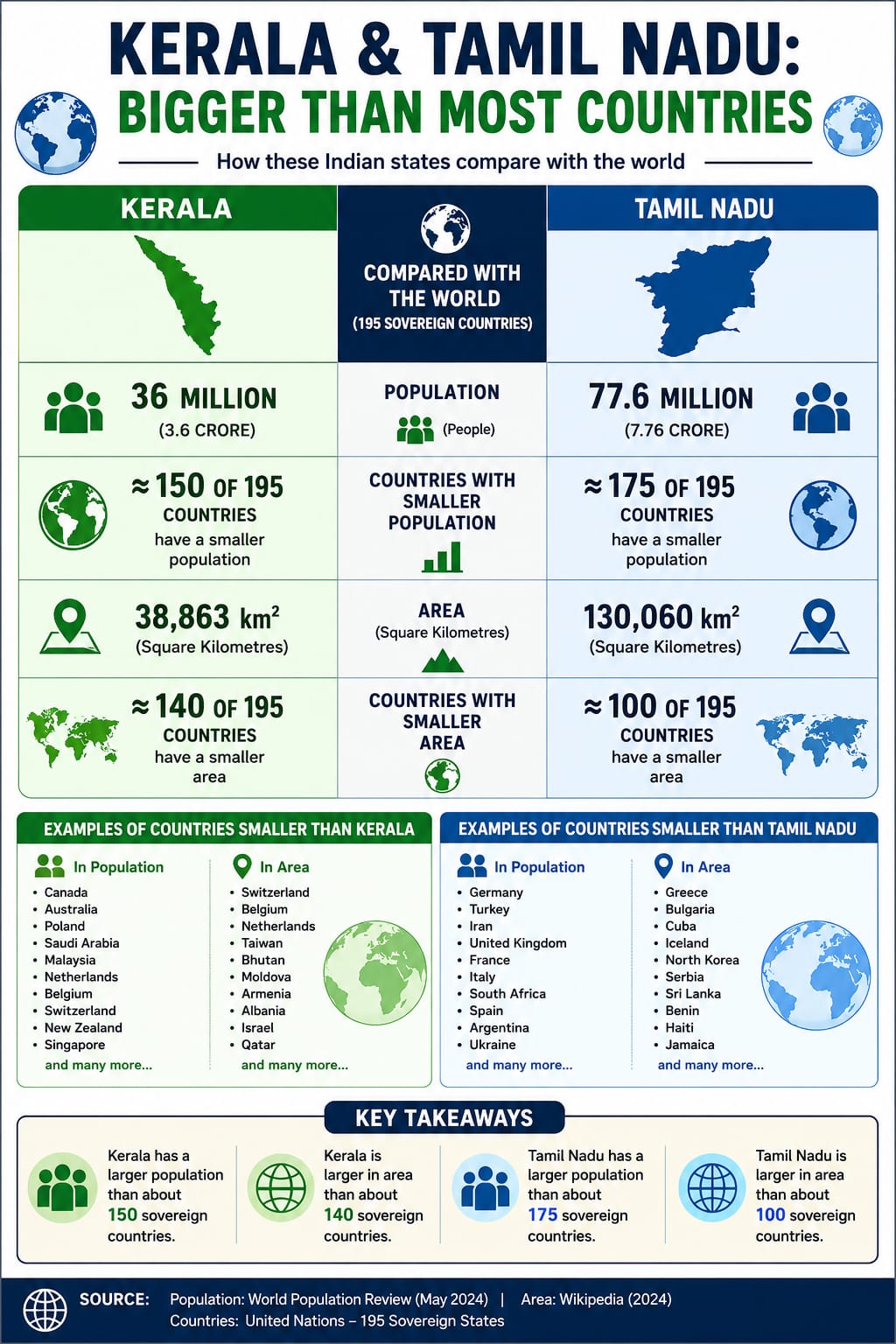
Today, India is the world’s fourth largest economy, a major technological power, and a far more confident democracy. Our states have evolved as well. Kerala, with nearly 36 million people, has a larger population than about 150 of the world’s 195 sovereign countries. Tamil Nadu, with nearly 78 million people, has a larger population than about 175 countries. If they were independent nations, both would rank among the larger countries in the world by population.
Yet these states enjoy far fewer constitutional powers than states in many mature federations.
Here is where India and the United States took two very different constitutional paths.
The American Constitution gives the federal government only those powers specifically delegated to it. The Tenth Amendment goes one step further by making it clear that powers not delegated to the federal government are reserved to the states or to the people.
India adopted the opposite philosophy.
 Article 246 and the Seventh Schedule divide legislative powers between the Union and the States.
But then comes Article 248.
This is where India fundamentally differs from the United States.
In America, if a power is not specifically delegated to Washington, it generally remains with the states. In India, residuary powers automatically belong to Parliament in New Delhi.
In other words, the constitutional presumption in India favors the Union. In the United States, the constitutional presumption favors the states.
The Constitution further strengthens Parliament through several other provisions. Article 249 allows Parliament to legislate on State List subjects when the Rajya Sabha declares it necessary in the national interest. Article 250 permits Parliament to do the same during a National Emergency.
Article 252 allows Parliament to legislate on State subjects at the request of two or more states.
Article 254 provides that where Union and State laws conflict on Concurrent List subjects, Union law generally prevails. Article 356 empowers the Union to impose President’s Rule when the constitutional machinery of a state has failed.
Taken together, these provisions reflect a constitutional design that gives the Union government considerably greater authority than is found in classical federations such as the United States.
The first objection to greater federalism is always the same.
“Won’t this weaken India?”
My answer is simple.
Look at the United States.
I have lived in America for more than three decades. Americans rarely worry that giving more constitutional authority to their states will weaken their country because history has shown exactly the opposite.
California is different from Texas. Florida is different from Massachusetts. Their education systems are different. Their criminal laws are different. Their tax policies are different. Their election laws are different. Their environmental regulations are different. Their business regulations are different.
Yet all remain proudly American.
READ: Abhijeet Dipke: The man behind India’s Cockroach Janta Party is a Boston University student (May 22, 2026)
America did not become the world’s strongest military power and largest economy despite its federal system.
It became stronger because its states were free to compete, experiment, innovate, succeed, and even fail. Good ideas spread across the country. Bad ideas usually remain confined to one state. Competition among states has produced innovation, prosperity, and accountability without threatening national unity.
That principle should sound familiar to every believer in free markets.
Competition produces better businesses than monopolies. Why should we assume that competition among states cannot also produce better public policy than concentrating every important decision in one capital?
If federalism did not weaken America, why should we automatically assume it would weaken India?
Let me be absolutely clear.
I am not arguing for a weaker Union.
National defense, foreign affairs, currency, immigration, interstate commerce, and national security must remain firmly with New Delhi. Those are unquestionably national responsibilities.
What I am suggesting is something very different.
I believe the time has come for India to begin a serious national debate on an Indian version of the Tenth Amendment. Not a copy of the American Constitution, but an Indian constitutional principle under which powers not expressly assigned to the Union would belong to the states unless there is a compelling national reason otherwise.
India’s Constitution has served our nation remarkably well. But no Constitution should discourage thoughtful debate about how best to govern a nation that has changed so dramatically over seventy five years.
India has changed.
READ: Boston University student and CJP founder Abhijeet Dipke heads to India to lead NEET protest (June 5, 2026)
Perhaps our constitutional understanding of federalism should evolve as well.
That would not divide India.
It would modernize India’s federal structure for the realities of the twenty first century.
So let me return to where this article began.
If Kerala, Tamil Nadu, Maharashtra, Karnataka, or any other state can elect its own government, manage its own universities, regulate its own professions, and govern populations larger than most countries in the world, why shouldn’t it have the constitutional authority to decide how students are selected for professional colleges within its own territory?
If your answer is still “No,” then perhaps the real question is this.
Do we trust the people of our states to govern themselves, or do we still believe New Delhi knows best?
I know where I stand.
Strong States. Strong Union. Stronger India.