



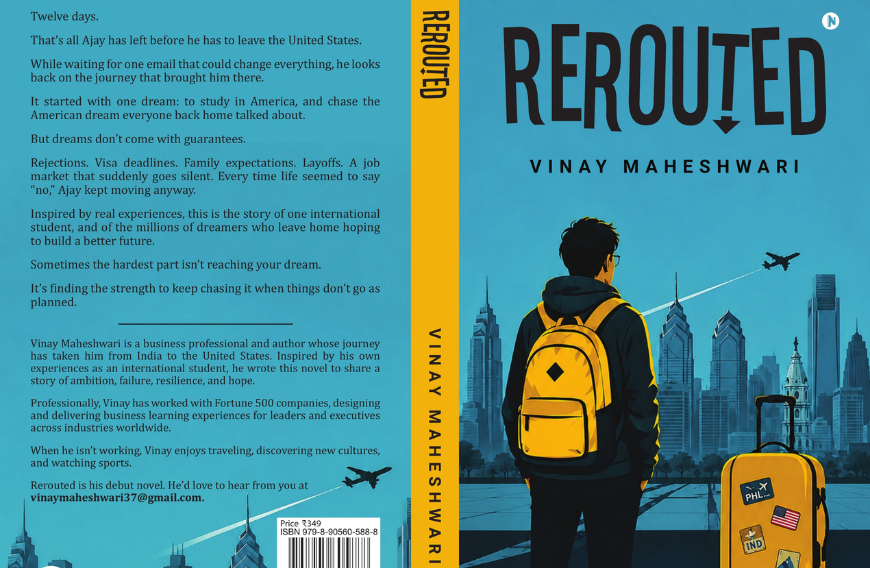
For years, the American Dream has been sold as a promise of opportunity, success and a better life. But for immigrants and international students building their lives in the U.S., that dream can change in a matter of minutes.
For Vinay Maheshwari, the author of the debut novel “Rerouted,” that change came through a 15-minute phone call.
After spending years studying and working in the U.S., Maheshwari was laid off, abruptly bringing an end to three years of work and leaving him to confront a reality familiar to many foreign workers on visas: the clock starts ticking almost immediately. He had designed and delivered business simulations for Fortune 500 clients.
“Three years of hard work, working there, working day and night, spending time and then just like in one phone call, everything was gone,” Maheshwari said in an exclusive interview with The American Bazaar.
The experience eventually became the foundation for “Rerouted,” a fictionalized story inspired by his years in the U.S., his experiences as a student and professional, and the struggles he witnessed among fellow immigrants and international students.
READ: In conversation with Nicole Kamaleson: Between identity, love, and life’s interruptions (August 9, 2026)
Maheshwari, who is from Indore and studied and worked in the Philadelphia region, said the idea was born from seeing how many people around him were facing similar challenges but rarely saw those experiences reflected in conversations about life in America.
While returning to India at the end of last year, he said he spent time reading stories on Reddit, Facebook and YouTube about people struggling to find jobs, taking contractual work and dealing with the uncertainty surrounding their immigration status.
“And then I realized that there’s just so many of us in the same boat and it’s something that hasn’t been talked about,” he said.

“Everyone talks about success, but let’s talk about something that hasn’t been talked about.”
That is the central idea behind “Rerouted.” Rather than focusing only on the success stories of Indians who move to the U.S., the book explores what happens when that carefully built life suddenly falls apart.
The protagonist’s journey is fictional, but much of the story draws from Maheshwari’s own experiences. He said the book incorporates elements from his life before moving to the U.S., his college years, corporate America, travel and the realities of living as an immigrant.
“A lot of things are related,” he said. “I have used sort of the real life experiences that I faced throughout my time before going to the U.S., staying in the U.S. and the college experiences, the work experiences, how corporate America is different, the travels and the fun things that happen around.”
But the story is ultimately fictionalized.
One of the most intense parts of the book deals with the period immediately following a layoff, when a foreign worker has to deal with the consequences of losing employment while also navigating immigration deadlines.
Maheshwari described the experience as one of the hardest parts of the immigrant journey.
“You’re working, and within minutes everything logs you out. Teams, email, files. It all just disappears,” he said. “And then you have a big, big timeline lying on your head.”
The protagonist begins reaching out to lawyers, contacting professional networks, updating resumes and searching for another employer. But the biggest obstacle remains the same: sponsorship.
“Interviews are coming in. But the biggest thing is sponsorship, sponsorship, sponsorship,” Maheshwari said, describing the repeated response from potential employers: “Sorry, we can’t hire because of this visa.”
The book explores not only the professional uncertainty but also the financial and emotional pressure that follows. Rent, electricity bills, food, subscriptions and other expenses continue even when the paycheck disappears.
READ: Isheeta Ganguly reimagines Tagore’s heroines in new graphic novel ‘Three Women’ (June 6, 2026)
That pressure is reflected in another striking contrast in the novel. The protagonist moves from staying in luxury hotels for work to cleaning floors and beds at a hostel in Asheville, North Carolina, simply to reduce his expenses while trying to figure out what comes next.
“It’s a big contrast as compared to staying in a very, very fancy hotel,” Maheshwari said.
The shift is intended to show how quickly circumstances can change for someone who appears successful from the outside.
For Maheshwari, that is also where the title “Rerouted” takes on its deeper meaning.
He recalled first hearing the word during a flight from his hometown to Delhi when severe turbulence forced the aircraft to change course.
“At that time, I didn’t really understand what does it mean? Like, so we are going back, what’s happening?” he said.
He later came to see the word differently.
“Rerouted is sort of meaning that you’re going back where you came, it’s not a failure, but it’s actually a journey,” he said.
That idea became central to the book and to his own experience of returning to India.
After years of living independently in the U.S., returning home allowed him to reconnect with his family and participate in events and functions he had missed while abroad. At the same time, he said, being back has also made him aware of the things he misses about life in the U.S.
“I’m glad to be back home,” he said.
Maheshwari said the book was something he had thought about writing even before moving to America, but the layoff became the moment that finally pushed him to do it.
“The nail in the coffin moment was this layoff when that happened,” he said.
His experiences over roughly eight years in the U.S., including traveling to different locations, meeting people from different backgrounds and seeing how corporate America operates, eventually gave him the material for the story.
He said he did not initially know how the story would end, but eventually realized that “Rerouted” was the right description for what had happened.
Despite the challenges explored in the book, Maheshwari does not see the U.S. as a place Indian students should avoid.
READ: JLF Los Angeles examines the New World Order (August 13, 2026)
He still considers it “an amazing place” to study, travel, live and build experiences, while acknowledging that the current environment is difficult.
“There are always so many opportunities,” he said. “If you work hard, if you work hard and if you keep grinding, good opportunities will follow your pace.”
His advice to students considering the U.S. is to look beyond simply getting admitted to an American university. The choice of course, major, university and city can all have an impact on their experience, particularly for those hoping to find employment or eventually settle in the country.
“It’s a great place to go if you plan up correctly,” he said.
“Rerouted” has released in India through Notion Press this week and will be available through platforms including Amazon and Flipkart. The U.S. release is expected a week later, with the book planned for Amazon.com, other online platforms and libraries.
For Maheshwari, however, the book is about more than one layoff or one immigrant’s return home. It is an attempt to document the uncertainty that exists behind the success stories and to remind readers that changing direction does not necessarily mean that the journey has failed.