



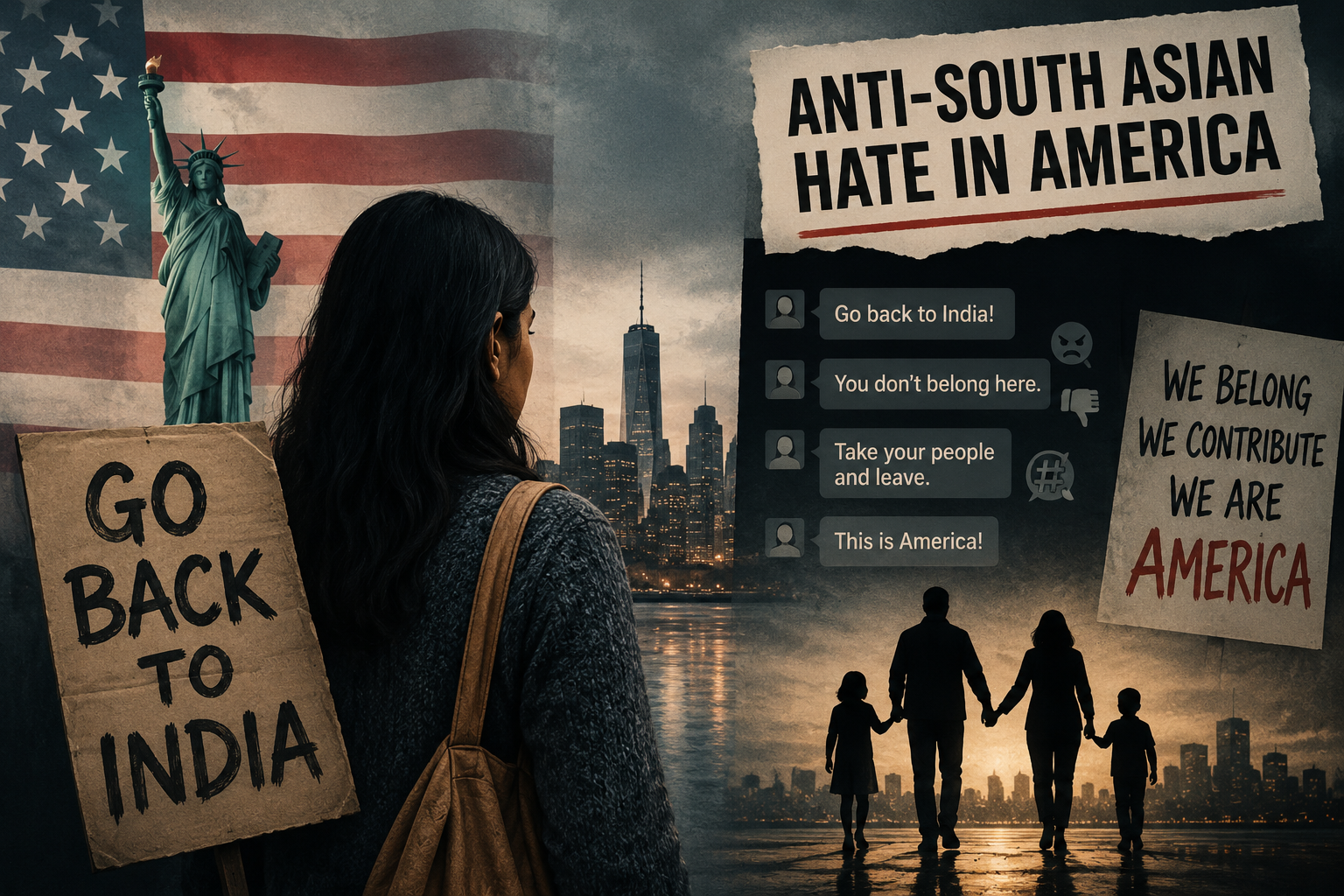
Sarika Kapoor, a longtime resident of Irving, Texas, was recently shopping with her two children, ages 5 and 7, at a local Target when an ordinary family outing took an unsettling turn.
“They were just being kids on summer break, talking and strolling through the aisles as I shopped,” Kapoor recalled. “I noticed a white man, maybe in his 50s or 60s, stop for a few seconds. He stared at me, smiled an uncomfortable smile and muttered, ‘So noisy, like India in here.’”
At first, Kapoor said, she did not fully register what he had said. “But when I saw my kids still talking and laughing, I figured it was a warped racist comment. I did not see that guy again, and honestly, I finished my shopping and decided to return home sooner to avoid any drama while I was with my kids.”
The encounter left Kapoor disturbed.
“It’s my neighborhood, and I visit this place at least once a week,” she said. “To think that someone can just casually make a passive-aggressive remark and go about his day while I am left scared makes me feel vulnerable in a country I now consider home.”
READ: ‘Pajeet’, a racist slur against Indians, is spreading across the internet (November 16, 2025)
Kapoor’s experience is far from isolated. Across the United States, immigrants and communities of color say they are increasingly encountering hostility, harassment and discrimination, reflecting a broader rise in anti-immigrant sentiment.
As political rhetoric targeting immigrants has intensified in recent years, many immigrants and people of color say they are witnessing its ripple effects in their daily lives. From hostile comments in grocery stores to acts of discrimination and harassment, incidents reported across the country suggest that divisive political messaging is increasingly translating into real-world hostility, testing America’s multicultural identity.
A new report titled published on Sept. 3, 2026, by Stop AAPI Hate, an advocacy organization that tracks and combats discrimination against Asian Americans and Pacific Islanders, lends statistical weight to those experiences, documenting widespread discrimination and insecurity among South Asian Americans.
The findings of the report, titled “The State of Anti-South Asian Hate,” are striking. Between January 2023 and December 2025, the use of anti-South Asian slurs online rose 109%, according to the report. It also found that 55% of South Asian adults said they or another Asian American or Pacific Islander in their community had been affected by changing immigration policies or anti-immigrant sentiment.
READ: 300 million views of hate: How 2025 became a minefield for Indian Americans (March 12, 2026)
In what can be termed as a newer phenomenon according to pop sociologists, it may also be one of the first times that an educated, professionally successful and financially upwardly community has become the target of both overt and subtle forms of racism. Many are reporting racism arising not just at working-class neighborhoods but also in some of the nation’s most economically thriving communities and business centers.
A multiethnic Indian woman in California shared her experience on condition of anonymity that the fitness studio staff, in her local gym refused to allow her to sign up for a class. She said, “(He) told me my kind aren’t valued there, started to ignore my questions … said I couldn’t afford classes and then called me currymuncher, darkie, half-breed. As I left, the employee gestured the middle finger towards me, and I heard her remark how Indians are smelly, poor, and subhuman.”
The report also found that South Asians were the targets of a disproportionate share of online threats against Asian communities. Between August 2024 and December 2025, 71% of all anti-Asian threats of violence tracked in online spaces associated with targeted violence were directed at South Asians, making them the most frequently threatened Asian regional group, according to the report.
Several South Asians interviewed by The American Bazaar in Texas, New York and Chicago said they believe the political climate surrounding immigration during President Donald Trump’s second term has contributed to increased hostility toward their communities, both online and in everyday life.
In June 2026, a video showing a man tearing an Indian flag outside Frisco City Hall as people nearby shouted anti-India slogans went viral.
Late last year, far ight group Take Action Texas showed up outside the Karya Sidhi Hanuman Temple in Frisco, Texas, where masked men held up placards flashing messages like, “Don’t ‘India’ my Texas,” and “Reject foreign demons; Jesus Christ is God.”
The report also found a sharp increase in immigration enforcement involving nationals of South Asian countries. Among Asian regional groups, South Asians accounted for the highest number of ICE arrests, detentions and deportations during Trump’s second administration. Compared with the previous administration, deportations involving South Asian nationals were approximately 14 times higher, according to the report.
Venkata Vasamsetty, a Green Card holder and randmother who has lived in the country for nearly three decades, was arrested and detained by US Immigration and Customs Enforcement (ICE). An immigration judge later ruled in Vasamsetty’s favour, finding that DHS had failed to meet the legal burden required to establish that she had abandoned her permanent residency.
The uncertainty has also prompted some Indian professionals to reconsider whether to remain in the United States. Mahesh Shetty, an H-1B worker in Seattle, told The American Bazaar that after losing his job at a global conglomerate, he and his wife decided to return to India rather than remain in the United States while he searched for another job and navigated his visa options.
He shared, “the toll was too much to take. Every day in the past one year, we either heard a lay-off story or an online trolling incident involving Indians on H-1B. Also, even though we work and pay our taxes, the U.S. immigration system provides us with no stability.”
The report also spotlights how the work-visa community has been targeted despite their contributions to the American economy. It states, “A dominant theme in online posts was the xenophobic narrative of an Indian “invasion” or “great replacement,” in which Indian people are portrayed as taking jobs away from white people.6 Debates over H-1B visas have fueled substantial increases in anti-South Asian slurs.
An Indian woman from Texas revealed how she faced hatred at her workplace. She said, “A customer came in asking for help with something. Me and my coworker were calmly explaining what the process is going to be … He starts yelling profanities — ‘tramp,’ ‘troll,’ ‘Indian sl-t’ — and proceeds to say, ‘I am glad Trump is deporting you b-tches.”
For many in a community that has spent decades building businesses, careers, families and lives in America, the concern is no longer simply about being told to “go back.” It is about wondering whether the country they came to call home still sees them as belonging here.