



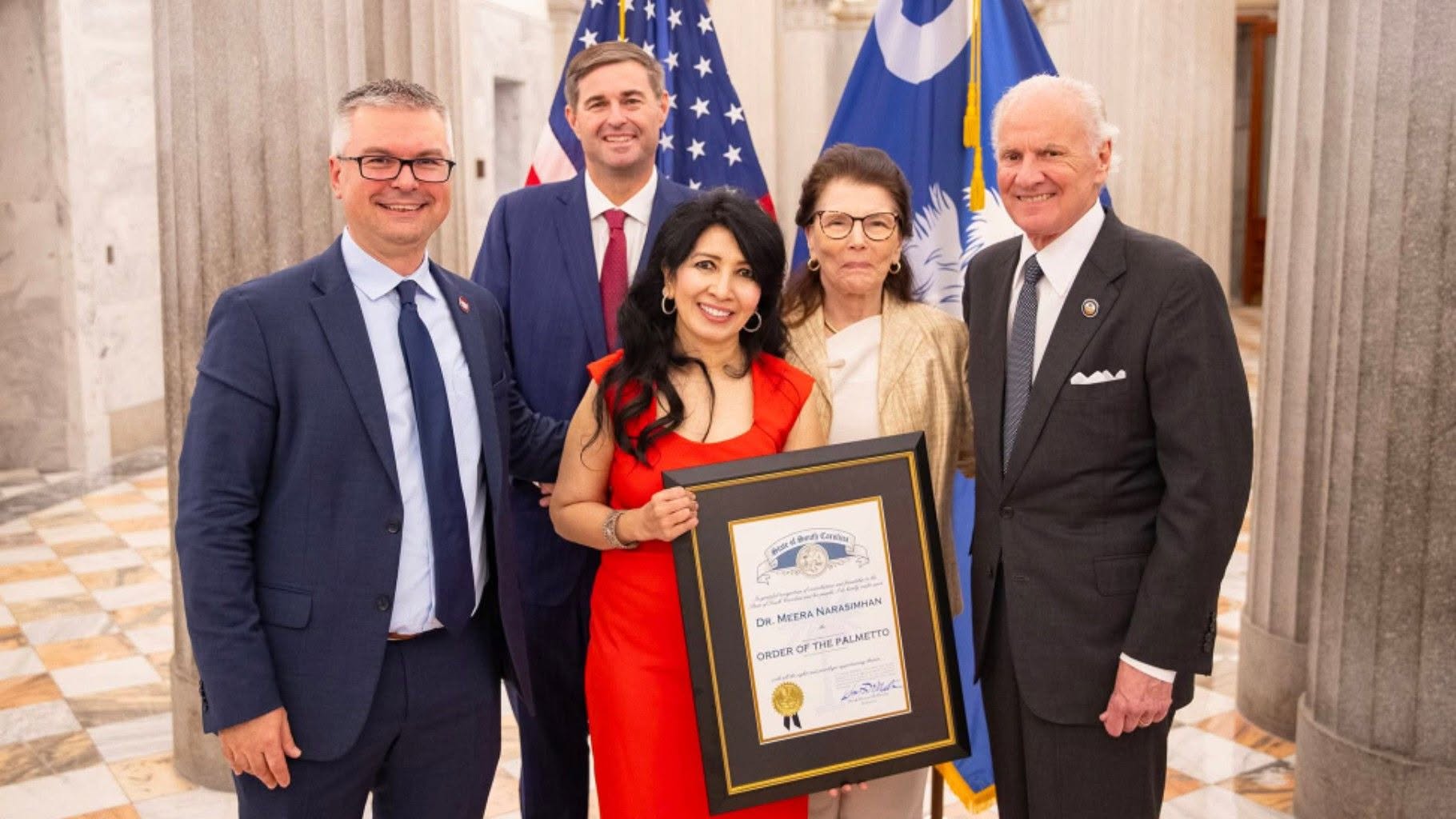
Indian American psychiatrist and academic leader Dr. Meera Narasimhan, whose pioneering work in telepsychiatry has helped bring mental health services to rural and underserved communities across South Carolina, has been awarded the Order of the Palmetto, the state’s highest civilian honor.
Governor Henry McMaster presented the award to Narasimhan at the State House, recognizing nearly three decades of work to transform the delivery of psychiatric and behavioral health services.
“Dr. Meera Narasimhan has helped change the course of mental health care in South Carolina,” McMaster said. “For more than 25 years, she has brought new ideas, built programs, and brought people together to expand access to care across our state.”
One of the most personal moments of the ceremony came as Narasimhan, joined by her parents, reflected on the values that had shaped her life.
READ: Shikhar Mehrotra wins Medical University of South Carolina’s Impact award (December 26, 2025)
Her parents, she said, “instilled in us that while you make a living by what you earn, you make a life by what you give.”
The words carried particular resonance as Narasimhan accepted the state’s highest civilian honor for a body of work dedicated to improving the lives of others.
For Narasimhan, who studied medicine at Gandhi Medical College in Bhopal before completing her psychiatry residency and a neuroscience fellowship at Yale University, the award marks another milestone in a professional journey spanning medicine, research, technology and public policy.
She is professor and chair of the Department of Neuropsychiatry and Behavioral Sciences at the University of South Carolina’s Floyd School of Medicine and serves as senior medical director for Behavioral Health at Prisma Health Midlands.
At the center of Narasimhan’s efforts has been a persistent challenge: how to bring specialized psychiatric services to patients who may live hours away from a psychiatrist.
Long before telehealth became commonplace during the COVID-19 pandemic, Narasimhan was helping establish telepsychiatry, bringing together health systems, universities, policymakers and community organizations to reach underserved populations.
South Carolina House Speaker Murrell Smith, speaking at the State House ceremony, recalled meeting Narasimhan at a time when telehealth was still viewed with considerable skepticism.
Narasimhan was already receiving national recognition for her expertise in telepsychiatry, Smith said, and her advocacy helped persuade him that the technology offered a practical way to reach rural communities.
“That right there convinced me that telehealth was a possibility in this state,” Smith said, describing Narasimhan as one of South Carolina’s pioneers in the field.
Her efforts eventually extended into ICARE – Integrated Care to Improve Access in Rural Counties to Eliminate Health Disparities – a University of South Carolina initiative using telehealth to address health disparities in rural communities.
Beginning in 2015, Narasimhan spearheaded efforts to integrate telemental health into rural primary care through ICARE. The initiative helped lay the foundation for the university’s Center for Rural and Primary Healthcare, expanding an approach that connects patients in remote areas with medical expertise through technology.
Beyond clinical care, Narasimhan has worked at the intersection of research and health policy. She has received funding from the National Institutes of Health (NIH) and other federal, foundation and industry sources for clinical, translational and technology-driven initiatives.
She has served on the South Carolina Telehealth Alliance, the Palmetto Care Connection board and the American Psychiatric Association’s Telehealth Steering Committee, and has been involved in statewide suicide-prevention initiatives.
The Order of the Palmetto follows decades of honors from medical, academic and community organizations.
Narasimhan has been recognized by numerous organizations, among them the American Psychiatric Association, National Alliance on Mental Illness, Mental Health America, American Foundation for Suicide Prevention, American Association of Physicians of Indian Origin (AAPI), and Indo-American Psychiatric Association.
Programs she championed have received the American Psychiatric Association’s Psychiatric Services Achievement Award and recognition through Harvard Kennedy School’s Ash Center Bright Ideas program.
In 2014, Narasimhan received the Hind Rattan, or ‘Jewel of India,’ an Indian diaspora honor recognizing outstanding global contributions. That year, the National Alliance on Mental Illness also named her among its Exemplary Psychiatrist Award recipients.
In 2024, the University of South Carolina School of Medicine presented Narasimhan with its Career Achievement Award, recognizing her contributions to clinical care, research, education and health policy.
For Narasimhan, however, the Order of the Palmetto is as much a reflection of collective effort as individual achievement.
“I’m deeply honored to receive the Order of the Palmetto,” she said. “This recognition reflects decades of advocacy on behalf of individuals and families seeking access to compassionate, high-quality mental health care.”
She credited colleagues, community partners and policymakers who have shared that commitment and made clear that she views the award not as a culmination, but as encouragement to continue the mission.
“Our work is far from complete,” Narasimhan said, pledging to continue advocating for greater access to care, health equity and innovative solutions to improve mental health and well-being.
And while she described the Order of the Palmetto as a momentous milestone and recognition of her life’s work, Narasimhan returned to a measure of accomplishment that echoed the values she had spoken of earlier in the ceremony.
“What is truly meaningful to me is the legacy we create and the lives we touch,” she said.