



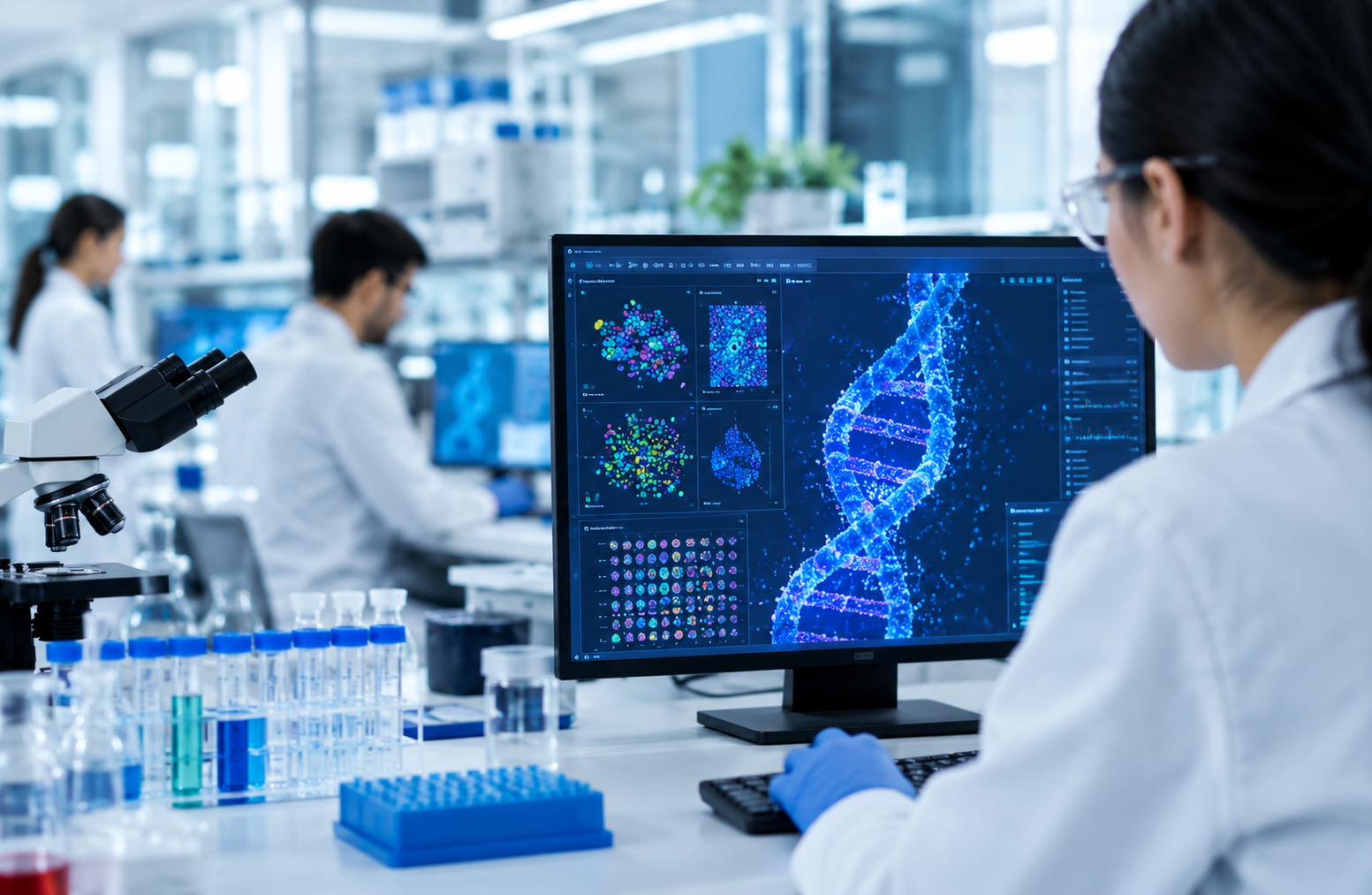
The U.S. government, Google and Meta Platforms are joining forces with Biohub, the nonprofit founded by Mark Zuckerberg and Dr. Priscilla Chan, in a $1.8 billion initiative to develop large-scale biological datasets for artificial intelligence models, Reuters reported on Oct. 7.
The initiative, known as the Virtual Biology Initiative, aims to generate data that can help AI systems predict how cells and biological systems respond to diseases, environmental conditions and potential treatments. The broader goal is to accelerate biomedical research and drug development by allowing scientists to conduct more experiments digitally.
READ: Zuckerberg-Chan to pledge $3 billion to cure all diseases (September 22, 2016)
The funding includes $300 million from Meta, Google DeepMind and Isomorphic Labs. The U.S. Department of Energy is committing more than $500 million over five years. The National Institutes of Health is coordinating federal participation and contributing datasets, repositories, and other scientific resources backed by more than $500 million in previous federal investment. Biohub had earlier committed $500 million to the effort.
The project is centered on creating what Biohub describes as a “virtual cell,” a predictive model capable of simulating biological processes and helping researchers understand how cells react under different circumstances.
Biohub said the initiative will use technologies including spatial transcriptomics and environmental response screening to generate large volumes of biological data. The resulting datasets are intended to become an open resource for researchers, although investors will receive an initial period of exclusive access to some data.
Alex Rives, Biohub’s head of science, said an accurate predictive model of biology could significantly accelerate scientific discovery by enabling researchers to conduct experiments digitally. Biohub expects to release its first major dataset within a year and aims to have functional predictive models within five years, according to Reuters. The initiative comes as technology companies and governments increasingly turn to AI for applications in drug discovery, disease research and clinical development. Other AI companies, including OpenAI and Anthropic, are also pursuing biological and pharmaceutical applications of AI.
The Biohub effort represents a significant expansion of Zuckerberg and Chan’s focus on biomedical science. Biohub was established in 2016 and has increasingly centered its work on using AI and large biological datasets to understand disease and develop new treatment approaches.
READ: Google unveils Gemini 4 Argon with coding and security capabilities (October 1, 2026)
The partnership also reflects a broader shift toward using AI to simulate biological processes rather than relying exclusively on physical laboratory experiments. AI companies are already developing tools that simulate potential drug responses and clinical trial outcomes, although human trials remain necessary to establish safety and effectiveness.
For the U.S. government, the project also places federal scientific infrastructure behind the development of AI-ready biological data. NIH said its Bio Genesis Mission will bring together existing biomedical datasets, national data infrastructure and research programs to support predictive models of human biology.
The initiative could eventually give researchers a way to test biological hypotheses at a scale that would be difficult, expensive or time-consuming to achieve through conventional experiments alone. Its success, however, will depend on the quality and breadth of the biological data used to train the models and on how accurately AI systems can reproduce complex human biology.
Biohub and its partners are seeking to compress decades of biological research into a much shorter period, with the ultimate objective of improving scientists’ ability to understand disease and identify potential treatments.