



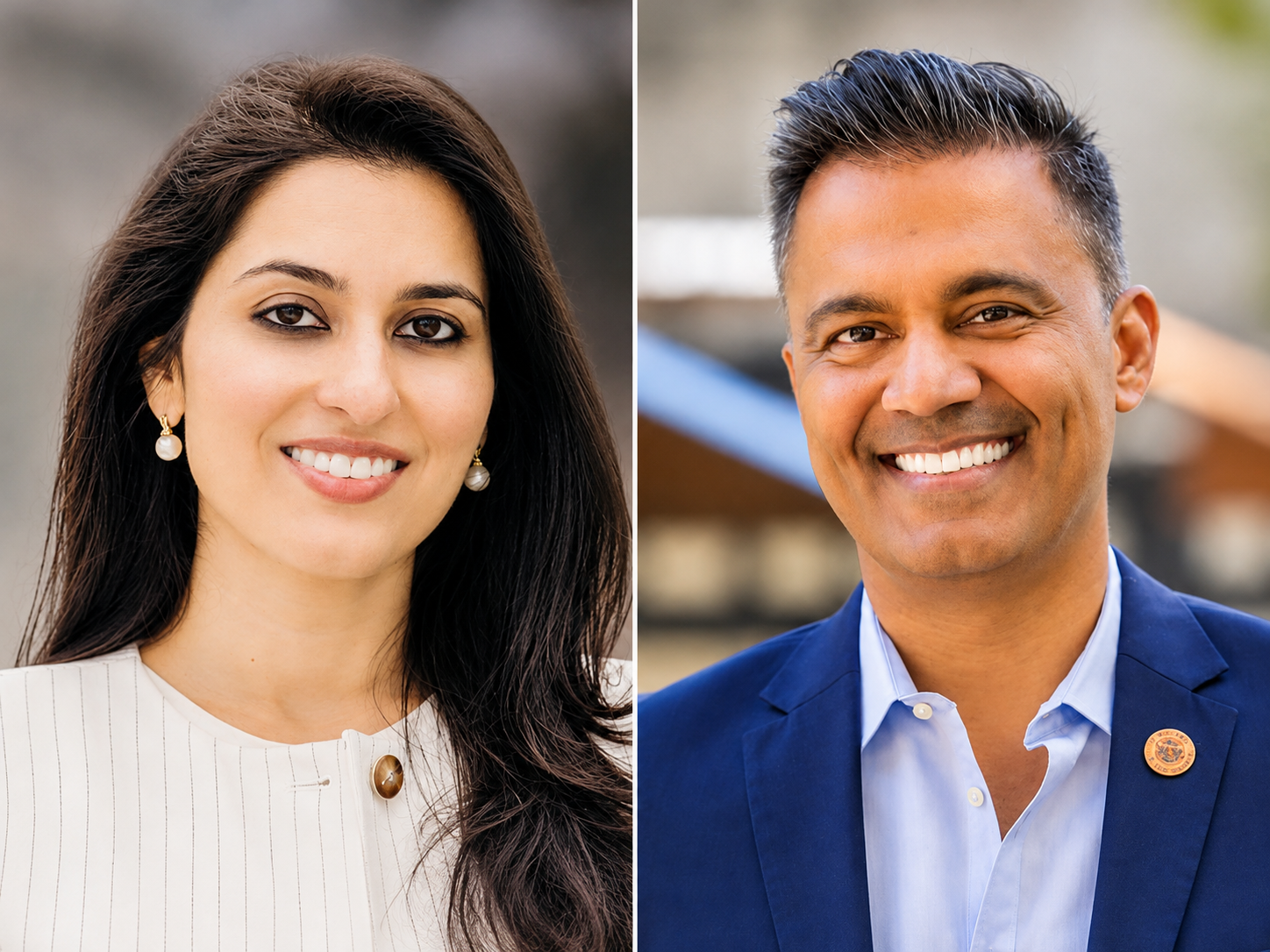
The victories of the two Indian American Democrats mark the Jain community’s first representation in Congress, drawing praise from community leaders who see a new era of political participation and public service.
Jain Americans have welcomed the election of Pia Dandiya of Florida and Dr. Amish Shah of Arizona to the U.S. House of Representatives, celebrating what community leaders describe as a historic breakthrough for one of America’s smallest religious communities.
The victories in the November 3 midterm elections have generated particular excitement among Jain Americans, who see them as an opportunity to strengthen their community’s voice in national politics and encourage younger generations to pursue public service.
Dandiya, a former educator and technology executive, defeated Republican Casey Askar in Florida’s newly redrawn 22nd Congressional District. Shah, an emergency physician and former state legislator, won Arizona’s 1st Congressional District, defeating Republican Jay Feely.
Both Democrats won competitive contests, demonstrating their ability to attract support from voters across diverse communities.
READ: Jain Indian American Amish Shah wins Arizona house race, makes Congressional history (November 5, 2026)
Their election also means that Indian American representation in the House will remain at six members when the new Congress convenes in January 2027.
Four incumbent Indian American Democrats, Ami Bera and Ro Khanna of California, Pramila Jayapal of Washington and Suhas Subramanyam of Virginia, won reelection.
Two outgoing members will not return. Raja Krishnamoorthi of Illinois lost his Democratic primary for the U.S. Senate, while Shri Thanedar of Michigan was defeated in his congressional primary.
The victories of Dandiya and Shah will offset those departures, maintaining the six-member Indian American delegation, informally known as the Samosa Caucus.
For Jain Americans, the significance of the election extends beyond the number of seats in Congress.
Jainism is one of the world’s oldest living religious traditions, originating in India and emphasizing nonviolence, compassion, self-discipline and respect for different perspectives.
Although Jain Americans have established successful careers in medicine, technology, business, education and other professions, the community has historically had limited representation in electoral politics.
Young Jains of America estimates the Jain population in the United States at approximately 150,000, making it a small minority within the country’s broader Indian American population.
Dr. Jasvant N. Modi, a Los Angeles-area physician, entrepreneur and philanthropist who has supported Jain educational and charitable initiatives in several countries, described the election results as a major development.
“These victories carry special significance for the Jain American community,” he told the American Bazaar. “This will inspire younger generations to pursue public service, become more civically engaged and participate across party lines. It also shows that a community’s influence need not be determined by its size, but by its values, commitment to service and willingness to help shape society.”
Modi pointed out that Jain values, including ahimsa (nonviolence), anekantavada (respect for multiple perspectives) and aparigraha (non-possessiveness), have much to contribute to American public life.
“While Jain Americans have achieved considerable success in business, medicine, education and philanthropy, political participation has remained limited,” he said.
Modi’s remarks reflect a broader sentiment among Jain Americans that political representation should become an increasingly important part of the community’s engagement with American society.
For decades, Jain immigrants and their descendants have established temples, community centers and educational organizations while contributing to hospitals, universities and charitable institutions.
Community leaders believe the next generation can build on those achievements by becoming more involved in government, public policy and electoral politics.
Two different paths to Congress
Dandiya and Shah bring distinct professional backgrounds to Washington.
Born and raised in Palm Beach County, Florida, to immigrant parents from India, Dandiya comes from a Digambar Jain family with roots in Jaipur, Rajasthan. Her father, Dr. Rohit Dandiya, is a physician based in Jupiter, Florida, while her paternal grandfather, Dr. P.C. Dandiya, is a retired professor at Sawai Man Singh (SMS) Medical College in Jaipur, where he continues to live.
Dandiya began her career in education. She worked as a teacher, became a high school principal and later served as a White House Fellow at the U.S. Department of Education.
She subsequently joined Apple, working on initiatives involving education, healthcare and government services.
Her campaign emphasized affordability, education, healthcare, Social Security and improving opportunities for working families.
READ: Indian American Democrat Pia Dandiya wins Florida House seat (November 3, 2026)
Shah, who was born in Chicago to Indian immigrant parents, worked as an emergency physician before entering politics.
He previously served in the Arizona House of Representatives, where healthcare and public policy were among his principal areas of interest.
Shah has publicly discussed his family’s Jain and Hindu heritage and the influence of Jain teachings on his personal outlook.
The two candidates’ victories are notable because neither relied exclusively on Indian American voters. Both built broader coalitions in competitive congressional districts.
Sulekh C. Jain, PhD, a longtime Jain community leader based in Las Vegas, Nevada, saw the importance of interdependence and collective well-being in the election victories of Dandiya and Shah.
“We are not separate beings sharing the same world; we are interconnected lives, inseparable in our existence and interdependent in our survival. To live in harmony and help others live is to celebrate this profound truth.”
The election has also resonated with younger Jain Americans who are increasingly becoming involved in political organizing.
Ankith Desai, a graduate student at Georgetown University’s McCourt School of Public Policy, is a co-chair of JAAP PAC, a Jain political affairs group that helped support both Dandiya and Shah.
Describing the election results as an unprecedented moment for the community, Desai said they had become a source of encouragement for young Jain Americans interested in public policy and political leadership.
“Jains make up such a small community in U.S. and worldwide, however, these two victories chart historic entrance of our mighty community in the halls of power and our community’s representation where decisions are made,” he said.
“At a time when we saw record violence and injustice in the US and overseas, under this government, electing not just one, but two Jains for the first time gives us hope and resolve that our values of compassion, diversity, and justice will be central to decisions that are made. Representation matters, and electing the first two Jains to Congress is just the beginning.”
The victories also come at a time of growing concern about hostility toward Indian Americans, including attacks on immigrants, professionals and religious traditions.
For members of smaller communities, representation in government can provide greater visibility and opportunities to participate in decisions affecting their lives.
Jain organizations have traditionally focused on religious education, philanthropy, cultural preservation and community service. Political participation is emerging as an additional area of interest.
The election of Dandiya and Shah, community leaders say, will encourage greater involvement at the local and state levels, including school boards, city councils, state legislatures and public commissions.