



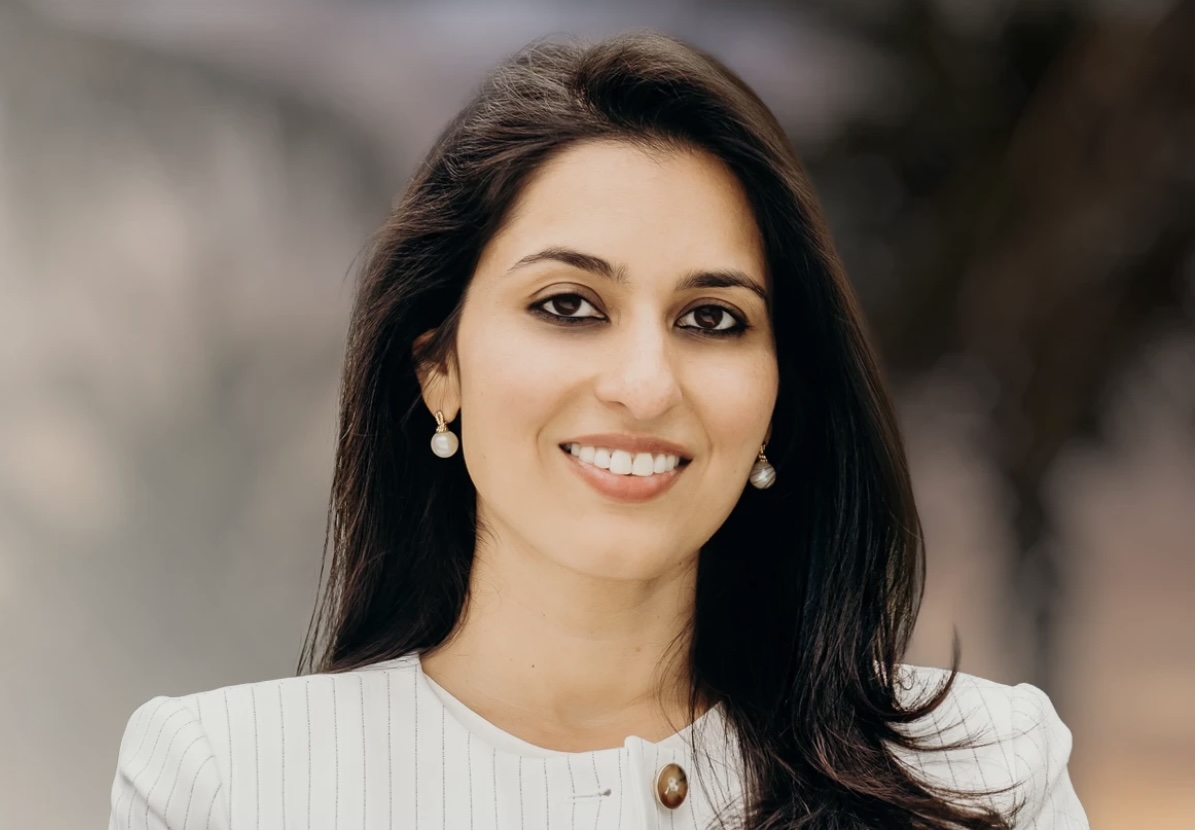
Indian American Democrat Pia Dandiya has won Florida’s newly redrawn 22nd Congressional District, defeating Republican businessman Casey Askar.
CBS News and NBC News projected Dandiya’s victory Tuesday evening in one of Florida’s most closely watched congressional contests. The result is particularly significant because the open district was redrawn earlier this year by Florida’s Republican-controlled legislature as part of an effort to create more favorable electoral conditions for the GOP.
Dandiya, a 36-year-old former teacher and high school principal, prevailed in a district that President Donald Trump carried by approximately 10 percentage points in 2024.
The victory makes her the first Indian American elected to the U.S. House of Representatives from Florida and the 10th Indian American elected to Congress in the nation’s history.
It also guarantees that the next Congress will have at least one newly elected Indian American representative, even as the community faces a potential reduction in its current six-member House delegation.
Pia Dandiya shifts Congressional run from Florida to 22nd District (May 25, 2026)
Four incumbent Indian American Democrats — Ami Bera and Ro Khanna of California, Pramila Jayapal of Washington, and Suhas Subramanyam of Virginia — are seeking reelection. All four entered Election Day in races where they were expected to retain their seats. If they prevail, Dandiya’s victory would bring Indian American representation in the House to at least five members.
Two other Indian American lawmakers will not return to the House. Raja Krishnamoorthi of Illinois lost his Democratic primary for the U.S. Senate, while Shri Thanedar of Michigan was defeated in his congressional primary.
In Arizona’s 1st Congressional District, Indian American Democrat Amish Shah is locked in a closely contested race.
Dandiya’s victory is especially notable because of the political circumstances surrounding the race.
She originally entered the 2026 election cycle challenging Republican Congressman Brian Mast in Florida’s 21st District.
However, the Republican-dominated Florida legislature redrew the state’s congressional boundaries earlier this year, prompting her to shift her campaign to the newly configured 22nd District.
The resulting open seat stretched across parts of Palm Beach, Broward, Hendry and Collier counties, encompassing communities with different economic and political characteristics.
The nonpartisan Cook Political Report initially rated the district as leaning Republican before shifting the contest into its competitive toss-up category.
Dandiya faced Askar, a businessman and Marine Corps veteran who campaigned on conservative economic policies, immigration enforcement and support for Trump’s agenda.
Her campaign, by contrast, focused on affordability, healthcare, Social Security, education and government accountability.
Born and raised in Palm Beach County to immigrant parents from India, Dandiya built much of her professional career in education before entering electoral politics.
After graduating from Harvard University with a degree in government, she taught in underserved schools through Teach For America and earned a master’s degree in education from Boston University.
She later became a founding mathematics teacher at a Brooklyn charter school before establishing Democracy Prep Endurance High School in Harlem in 2014.
According to her campaign, during her tenure as principal, all of the school’s more than 300 students received college admission offers, despite most coming from economically disadvantaged families.
Dandiya subsequently served as a White House Fellow at the U.S. Department of Education before joining Apple, where she worked on initiatives involving education, healthcare and public services.
Dandiya’s campaign attracted support from Indian American political organizations, including Indian American Impact and the AAPI Victory Fund, as well as prominent Democratic leaders.
Dandiya’s election represents another milestone for a community that has gradually expanded its presence in American politics, from the historic election of Dalip Singh Saund in 1956 to the growing number of Indian Americans serving in Congress and state legislatures.
For Dandiya, whose career has spanned education, government and technology, the victory marks the beginning of a new chapter in public service.
It also demonstrates that Indian American candidates can compete beyond established Democratic strongholds, even in districts drawn to favor Republicans.