



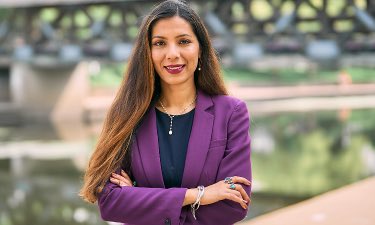
Indian American Democrat Saba Haider has won election to the Illinois House of Representatives, securing 71.2 percent of the vote in the Nov. 3 midterm elections. She becomes the first South Asian woman elected to the Illinois General Assembly, according to published election results.
Haider defeated Republican candidate Brian Scopa in the race for Illinois’ 84th House District, receiving 21,995 votes against Scopa’s 8,902, according to Ballotpedia’s reported results. Scopa received 28.8 percent of the vote, compared with Saba Haider’s 71.2 percent, giving her a margin of 13,093 votes.
The constituency includes parts of Will, DuPage, Kane and Kendall counties, covering communities such as Aurora, Naperville, Oswego, Montgomery and Boulder Hill. Her election takes her from county-level government to the Illinois state legislature, where she will represent residents of the 84th District.
READ: Indian American Priya Sundareshan makes history as Arizona Senate president-elect (November 7, 2026)
Haider’s victory also marks a milestone in South Asian American political representation in Illinois. She is reported to be the first South Asian woman elected to the state’s General Assembly. The Illinois General Assembly comprises the state House of Representatives and the state Senate, and is responsible for passing state laws and approving the state budget.
From Uttar Pradesh to American politics
Haider’s family traces its roots to Aurangabad in Uttar Pradesh’s Bulandshahr district. She grew up in Ghaziabad, where her father, Syed Ali Haider, worked as an engineer before retiring. Her mother, Chandni, has recalled that Haider participated in school debates and public-speaking competitions from an early age.
She attended Holy Child School in Ghaziabad before earning a Bachelor of Science degree from Ram Chameli Chadha Vishvas Girls’ College, where she reportedly topped her class. She subsequently pursued a Master of Science in Wildlife Sciences at Aligarh Muslim University (AMU), earning a gold medal.
During her time at AMU, Haider also participated in wildlife census work, developing an academic background in environmental and wildlife studies before moving into community engagement and public service.
In 2006, she married Ali Kazmi, a computer science engineer whose family is from Bulandshahr. The couple moved to the United States in 2007 and settled in the Naperville area of Illinois. They have two children. After moving to the US, Haider became a certified yoga instructor, teaching students and professionals from different backgrounds. Her involvement in community activities, parent-teacher initiatives, interfaith engagement and local Democratic Party outreach gradually brought her into American public life.
Political journey: From an electoral setback to the state legislature
Saba Haider’s entry into electoral politics was not immediately successful. She first contested a DuPage County Board seat in 2022 but lost. She continued her involvement in local affairs and returned to the electoral contest in 2024. In November 2024, she defeated Republican incumbent Patricia “Patty” Gustin to win a seat on the DuPage County Board’s District 5. The official county canvass recorded 40,330 votes for Haider against 31,395 for Gustin, giving Haider 56.23 percent of the vote against Gustin’s 43.77 percent.
Her election to the county board made her the first Indian-origin woman elected to that local governing body, according to Clarion India. She subsequently chaired the board’s Strategic Planning and Environmental committees and served on the DuPage County Health Department’s Public Health Board.
READ: Meet the Sikh Americans who won in the 2026 US midterm elections (November 6, 2026)
In 2026, Haider took her political career to the state level. She won the Democratic primary for the 84th House District on Mar. 17, defeating Jared Ploger with 63.5 percent of the vote. She then defeated Scopa in the November general election.
Her campaign focused on affordable healthcare, education, economic growth, environmental sustainability and issues affecting working families and immigrant communities. Her transition from community-based work and county government to the Illinois legislature represents nearly two decades of life and public engagement in the United States.
What her victory means
Saba Haider’s election adds another Indian American name to the growing list of South Asian-origin politicians holding elected office in the United States. Her political career has developed through local community involvement, county governance and now state-level representation.
Her background in wildlife sciences, experience in local government and family connections to Uttar Pradesh have also drawn attention in India, particularly in Ghaziabad, Aligarh and Bulandshahr, where her family has roots. Her election is significant not only for her family and the Indian American community but also for South Asian representation in Illinois state politics.