



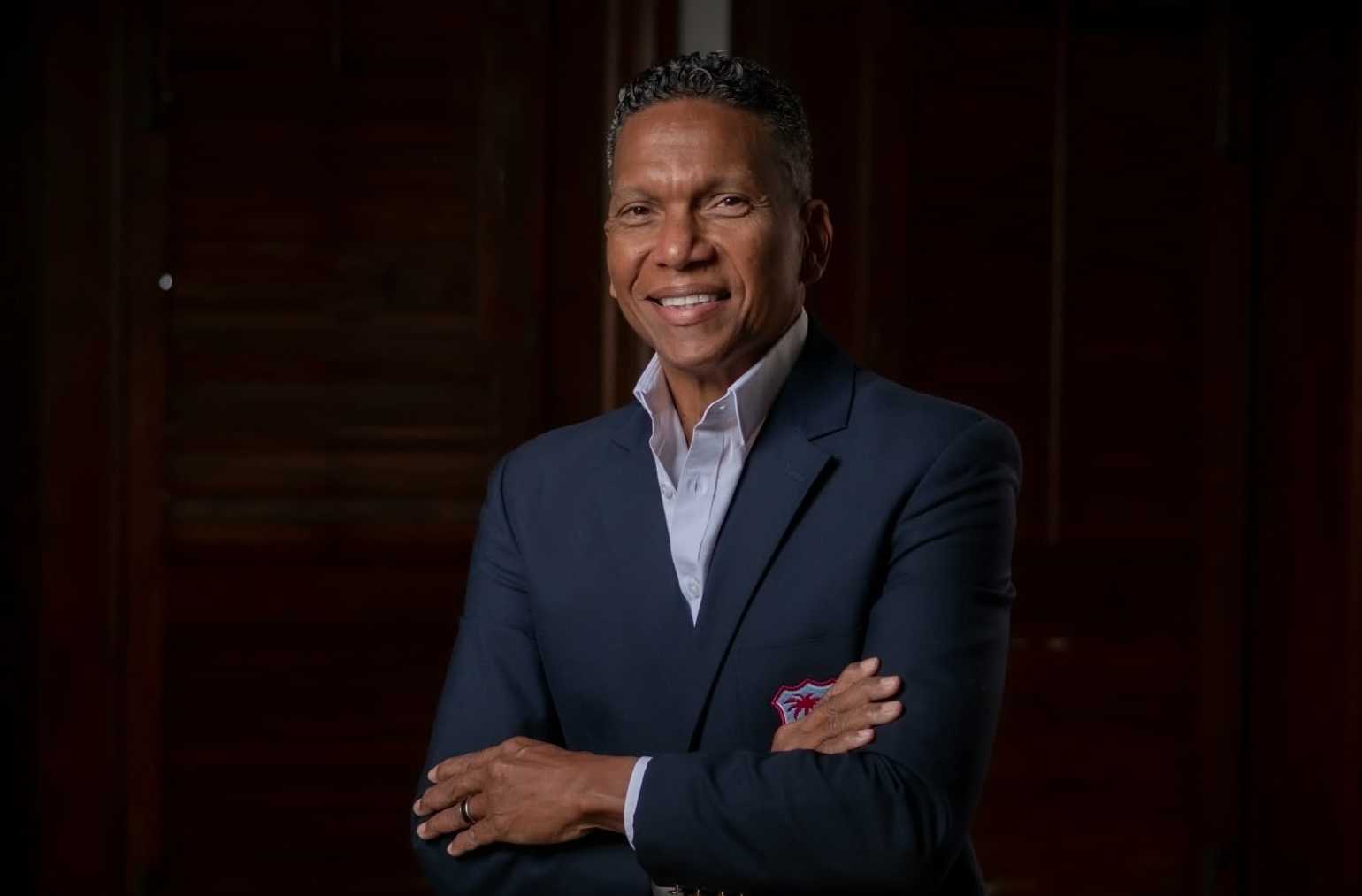
In an interview with The American Bazaar, Dehring discusses how the booming U.S. cricket market could help revitalize West Indies cricket, the opportunity presented by the 2028 Olympics and his vision for a pan-American cricket league.
Few know the evolution of cricket in the United States as well as Chris Dehring. The Jamaican was in the country when cricket barely registered on the American sporting landscape.
Dehring, who attended West Virginia Wesleyan College on a soccer scholarship from 1981 to 1984 and helped the team win an NAIA national championship, has watched cricket gradually take root in the world’s largest economy, even as its following has remained largely concentrated among immigrants from South Asia, the Caribbean, the British Isles, Australia and New Zealand.
The landmark 2024 ICC Men’s T20 World Cup, co-hosted by the West Indies and the United States, reinforced his conviction that cricket has a future in America. Since taking over as CEO of Cricket West Indies (CWI) in February 2025, Dehring has been determined to make the United States an integral part of his strategy for growing West Indies cricket.
Last month, he was in the Washington, DC, area to attend the groundbreaking ceremony for a cricket stadium in Frederick, Maryland, that will serve as the home of Washington Freedom, at the invitation of his friend and the team’s owner, Indian American tech entrepreneur Sanjay Govil.
For Dehring, the October 16 event was also something of a homecoming — and a striking reminder of how far the game has come in the United States.
“I have to tell you, I went to school five and a half hours from here in West Virginia, and DC was my playground,” Dehring said at the groundbreaking event. “We would drive five and a half hours on Friday to have a wonderful time in [DC]. I could never have imagined that I would be standing here in Frederick, Maryland, so many years later at a groundbreaking ceremony for the glorious [stadium].”
A few days after the groundbreaking, Dehring spoke to The American Bazaar in a wide-ranging interview about the prospects of cricket in North America and what the sport’s growth in the region could mean for West Indies cricket and the global game. He is particularly bullish about the nascent Major League Cricket (MLC), which has already attracted some of the world’s finest cricketers, including Australian stars Pat Cummins, Steve Smith and Glenn Maxwell, as well as several West Indian greats.
Dehring also reflected on his early years as a cricketer in Jamaica, his experiences studying and playing soccer in West Virginia, and the Caribbean’s longstanding ties with cricketing communities across the United States. He explored the commercial opportunities emerging from the sport’s expansion in America and how West Indies cricket could benefit from that growth.

A strategic opportunity for West Indies
For Dehring, the emergence of the United States as a cricketing market represents an opportunity to address one of the biggest challenges facing West Indies cricket: the limited economic resources available in the Caribbean to develop and sustain the sport at the highest level.
A flourishing cricket ecosystem in North America, he believes, could provide new professional opportunities for Caribbean cricketers, attract investment and generate resources for the development of the game back home.
“The United States, Canada have much larger economies than in the Caribbean,” Dehring said. “And therefore, any type of mutually beneficial relationship we’re going to explore.”
Although Cricket West Indies does not have a formal partnership with Major League Cricket, the organization has cultivated relationships with several of the league’s owners and has held discussions with MLC about potential cooperation.
Some of those relationships date back to the early years of the Indian Premier League (IPL), when West Indian stars such as Chris Gayle, Dwayne Bravo, Kieron Pollard and Sunil Narine were among the competition’s biggest attractions.
READ: Why Major League Cricket matters beyond the pitch (June 18, 2026)
“Anything that is developing cricket in the Americas, Cricket West Indies wants to be a part of because we see it as a mutually beneficial relationship,” he said.
Among the American franchise owners with whom Dehring sees opportunities for collaboration is Govil.
“We have a very good relationship with Sanjay Govil, for instance, who owns the Washington Freedom,” he said. “And we’re in discussions with him about how we can get more involved with what he’s doing, and how he can benefit from that association with Cricket West Indies.”
Dehring’s engagement with Govil, who also co-owns Welsh Fire in The Hundred, extends beyond the United States. He arranged a meeting between the Indian American entrepreneur and Jamaican Prime Minister Andrew Holness, which, he said, led to fruitful discussions about hosting international cricket and attracting investment to the island nation.
“Now is the time to be looking seriously at cricket as an investment vehicle,” he said. He pointed to the involvement of business leaders such as Govil, Microsoft CEO Satya Nadella and Indian billionaire Mukesh Ambani, whose family owns the Mumbai Indians, as evidence of the growing commercial appeal of cricket.
When entrepreneurs and investors of that caliber are committing resources to the sport, Dehring suggested, Caribbean governments would be well advised to take notice, he said.
Lessons from the 2024 World Cup
Dehring offered a candid assessment of the 2024 ICC Men’s T20 World Cup, describing its results as mixed, despite what he characterized as a strong financial performance.
One of the tournament’s biggest achievements, he said, was exposing mainstream America to the extraordinary commercial phenomenon that is Indian cricket, particularly through the much-anticipated India-Pakistan encounter in New York.
“Most Americans had no clue what was going on until these thousands of South Asians just descended on New York City,” he said. “I think it was a huge eye-opener.”
The spectacle reminded Dehring of the 2003 Cricket World Cup final in Johannesburg, when chartered jumbo jets carrying Indian cricket fans descended on South Africa after India reached the final. Thousands of supporters congregated outside the Wanderers Stadium, hoping to secure tickets.
It was one of his earliest encounters with the spending power and extraordinary mobility of Indian cricket fans. He had also witnessed the intensity of the India-Pakistan rivalry at the 1999 World Cup in Manchester.
“It’s one of the great phenomena of world sport,” he said of the rivalry.
The 2024 tournament offered Dehring a more personal glimpse into the commercial appeal of the fixture. Having secured admission for himself, he attempted to purchase a hospitality ticket for his wife for the India-Pakistan match in New York. He was offered one at what he was told was half price: $22,000.
“So I told her to watch it on television,” he recalled with amusement.
While Dehring was pleased with the reception the tournament received in Dallas, he lamented the rain that disrupted matches in South Florida. He was particularly critical of the decision to spend substantial sums on a temporary stadium in New York without leaving behind permanent cricket infrastructure.
“Having spent so much money to build a temporary stadium, I thought was a bit of a mistake,” he said.
Nevertheless, he believes the World Cup created a valuable platform on which American cricket can build. The development of permanent facilities, such as the one being planned by Washington Freedom in Maryland, represents another important step in that direction.
Taking cricket to mainstream America
The Caribbean’s relationship with American cricket long predates the current wave of investment and the establishment of Major League Cricket.
Dehring recalled how West Indies cricket was among the pioneers in bringing live cricket broadcasts to American audiences, including international matches and domestic competitions.
Cricket administrators in the Caribbean have long had their eyes on the North American market, drawing on the popularity of legendary players such as Brian Lara and the global appeal of the West Indies cricket brand.
READ: If inaugural season is an indication, Major League Cricket is here to stay (July 31, 2023)
Geography and immigration have helped sustain those ties. South Florida and the northeastern United States are home to sizeable Caribbean communities, including current and former cricketers. Many West Indians hold dual citizenship or have residency arrangements that allow them to move between the Caribbean and the United States.
Dehring, who himself maintains a base in South Florida, cited former West Indies batting great Shivnarine Chanderpaul, who has coached American women’s cricket teams, as an example of the Caribbean’s contribution to the development of the sport in the United States.
The West Indies’ decades of experience in international cricket, its global reputation and its geographical proximity, Dehring believes, make it a natural partner for American cricket.
But perhaps the most compelling argument he makes for greater Caribbean involvement in American cricket has little to do with what happens on the field.
Dehring believes the West Indies possesses something that could prove invaluable to American cricket administrators seeking to take the game beyond its traditional immigrant constituencies: a cultural brand that already enjoys considerable appeal among mainstream Americans.
“You don’t need the West Indies and the West Indies brand to reach the South Asian community. Cricket does that, the sport itself does it,” he said.
The challenge, he argues, is creating a crossover product that attracts Americans who have had little or no exposure to cricket.
For decades, the Caribbean has occupied a special place in the American imagination, with its beaches, music and laid-back lifestyle attracting generations of American vacationers.
Dehring pointed to the success of American singer-songwriter Jimmy Buffett, who built an entertainment empire around a lifestyle associated with the Caribbean, as an illustration of the region’s crossover appeal.
“Cricket in the Caribbean encapsulates all of that,” he said.
It is precisely that fusion of sport, music, entertainment and culture, Dehring believes, that could help cricket find a wider audience in the United States.
The biggest party in sport
Dehring argues that the West Indies helped lay the foundations for the entertainment-oriented spectacle that modern franchise cricket has become.
Long before music, dancing and elaborate spectator entertainment became staples of Twenty20 competitions around the world, Caribbean cricket grounds had transformed international matches into celebrations of the region’s culture.
Ironically, Dehring was initially skeptical when the idea of Twenty20 cricket was proposed at the International Cricket Council.
“I was one of those skeptics that said, ‘Wow, that sounds like a gimmick,’” he recalled.
Having grown up with Test cricket and the carnival-like atmosphere that accompanied matches in the Caribbean, even the one-day format seemed too short for him.
“I couldn’t imagine partying only for three hours,” he said.
At one of the party stands in Jamaica, festivities during a Test match would begin at six in the morning and continue until midnight, only to resume six hours later.
“It was a virtual carnival,” he recalled.
The creation of party stands was not merely a spontaneous expression of Caribbean culture. It was also a deliberate commercial strategy designed to attract new audiences.
Dehring recalled how surveys of young people in the Caribbean revealed that one of the biggest reasons they stayed away from Test matches was boredom. Another, which ranked almost as highly, was the absence of girls at cricket grounds.
The response was to make cricket more appealing to younger audiences and women. At Jamaica’s Sabina Park, for instance, an event called Mount Mania transformed a day at the cricket into an all-day entertainment experience.
Dehring recalled a Canadian woman who attended her first cricket match simply because she had purchased tickets for the party. By the end of the day, she was discussing team selection and debating whether Brian Lara should be dropped. Before coming to the stadium, she had not even heard of him.
For Dehring, the experience demonstrated that entertainment could bring people to a cricket ground and cricket itself could turn them into fans.
“You have to find ways to pull audiences to your sport that is not necessarily your sport,” he said of the challenge facing American cricket.
Dehring pointed to the Caribbean Premier League (CPL) as evidence of the commercial potential of the region’s distinctive approach.
He described the CPL as the world’s second-most-watched cricket league, behindf the IPL, and said one of the features that distinguishes the competition is the composition of its audiences, with women accounting for more than half of spectators at matches.
“It’s the biggest party in sport,” he said.
The combination of high-quality cricket, entertainment and the natural beauty of the Caribbean, Dehring believes, makes the CPL a unique product for international broadcasters and audiences — and offers lessons for Major League Cricket as it seeks to broaden its appeal.
Winning over a new generation
Equally important, Dehring said, is introducing American children to cricket at an early age.
He recalled an encounter at a cricket camp in Broward County, Florida, where a boy of about 10 or 11, accustomed to baseball, was introduced to cricket.
After striking the ball and scoring a few runs, the boy began walking off the field, assuming his turn at bat was over. He was surprised when the organizers told him he could continue batting.
“More? I can bat more?” the delighted youngster asked, Dehring recalled.
When told that he could continue batting as long as he was not dismissed, the boy was thrilled. He continued returning to the camp, even after his parents stopped paying for his attendance.
For Dehring, the episode illustrated how some of the fundamental differences between cricket and baseball could work in cricket’s favor when attracting American children.
“In cricket, you’re involved every delivery,” he said. “That’s the beauty about the sport.”
One of the biggest opportunities to introduce cricket to a new generation of Americans will come in 2028, when the sport returns to the Olympic program at the Los Angeles Games.
Drawing on the Caribbean’s remarkable success in track and field, Dehring spoke about the power of the Olympic dream in inspiring young athletes.
One reason track and field enjoys such popularity in the Caribbean, he said, is that it offers children something to aspire to from a very early age.
“Kids, when they’re six, seven, eight years old, they’re not dreaming of making money, they’re dreaming of the gold medal at the Olympics,” he said.
Cricket, he believes, could offer American children a similar aspiration. The Los Angeles Olympics, where cricket returns after 128 years, should be the starting point for a sustained effort to develop cricket across the Americas rather than the culmination of one.
Growing up with the giants of West Indies cricket
Dehring’s enthusiasm for the game is rooted in a childhood spent witnessing some of the greatest moments in West Indies cricket.
His father regularly took him to the iconic Kingston Cricket Club, where his initial attraction to the game was less about cricket itself than the enjoyment of spending a day at the ground.
One of his earliest memories of international cricket is particularly vivid.
He was playing with toy soldiers beside the gate at Kingston Cricket Club when he heard an extraordinary roar from the crowd. Looking up, he saw a tall, elegant man, his collar turned up, walking through the gate beside him and onto the field at Sabina Park.
The man, he later realized, was Sir Garfield Sobers.
“I just never forget this incredible roar of the crowd,” he recalled.
Dehring was also at Sabina Park when Jamaican batting prodigy Lawrence Rowe scored a double century and a century on his Test debut against New Zealand.
Like countless Caribbean youngsters growing up during that golden era of West Indies cricket, Dehring dreamed of eventually wearing the famous maroon cap.
A promising young cricketer, he played for Kingston Cricket Club and represented Jamaica at the under-19 level. Among his teammates were Courtney Walsh and Patrick Patterson, both of whom would go on to become formidable West Indies fast bowlers.
Jamaica had won the regional under-19 championship, and Dehring was the team’s best batsman, occupying the No. 3 position.
“Like every youngster in the Caribbean, I was absolutely sure I was gonna play for the West Indies,” he recalled.
But competing against some of the finest young cricketers of his generation gave him a sobering appreciation of the extraordinary depth of cricketing talent in the Caribbean at the time.
Among the players he played against were future West Indies internationals Richie Richardson, Gus Logie, Phil Simmons and Roger Harper.
He vividly remembers watching Richardson, a former West Indian captain, handle the pace of Walsh and Patterson as though they were bowling spin.
An accomplished fielder, Dehring nevertheless managed to outshine some of those future West Indies stars in one department, winning the best fielder award at the regional under-19 tournament.
Eventually, however, he recognized that his prospects of making the West Indies team were slim.
Another sport opened a different door for the young Jamaican.
He received soccer scholarship offers from several American institutions, including Duke, North Carolina State, Northern Kentucky University and Clemson. He opted for West Virginia Wesleyan College, a smaller institution, partly because several friends from his neighborhood in Jamaica were already studying there.
At West Virginia Wesleyan, Dehring found himself playing alongside teammates from Jamaica, Nigeria, Trinidad and Tobago, England and elsewhere.
He fondly recalled the camaraderie of college soccer and the competitiveness of a team that, he said, regularly ranked among the top five in the country, regardless of division.
The team won the NAIA Division II national championship in 1984.
Although his sporting career had taken him away from cricket, his association with the game would eventually resume in a very different capacity.
From investment banking to the Cricket World Cup
Dehring brings to his current role a combination of entrepreneurial experience, commercial acumen and an intimate understanding of West Indies cricket.
His entry into cricket administration came not through the conventional route of a former player or sports official, but through investment banking.
Having established what he described as Jamaica’s first investment bank, Dehring was approached by the then-president of the West Indies Cricket Board to establish the organization’s commercial operations.
“Back then, West Indies cricket was a very small operation,” he recalled. “They didn’t even have a computer.”
Television was beginning to transform the economics of international cricket, and the board had yet to develop a commercial arm capable of capitalizing on those opportunities.
Initially seconded from his bank for three years, Dehring negotiated television rights agreements and helped build the board’s commercial infrastructure.
It was, in many respects, an extension of what he was already doing as an investment banker: negotiating contracts, structuring deals and identifying commercial opportunities.
A considerably more ambitious assignment followed. At the request of the cricket board and Caribbean political leaders, Dehring put together the region’s bid to host the 2007 ICC Cricket World Cup.
At the time, it seemed an almost impossible undertaking. The Caribbean lacked much of the stadium infrastructure required to host an event of that magnitude. The ICC itself was a much smaller organization, leaving considerable responsibility for commercial negotiations and tournament delivery with the host.
Having secured enough votes to win the bid, Dehring intended to return to his investment banking business. Caribbean political leaders and cricket administrators, however, had other ideas.
They wanted him to deliver the tournament he had brought to the region.
With the encouragement of his business partners, Dehring spent the next decade working on the World Cup project, overseeing preparations that included stadium construction, coordinating government agencies and helping draft legislation to be enacted across multiple Caribbean nations.
The undertaking required regular meetings with nine prime ministers, as well as ministers of finance and tourism, police chiefs and other officials across the region.
“There had never been a pan-Caribbean event of this stature,” he said.
Following the 2007 World Cup, Dehring returned to the private sector.
Among his entrepreneurial ventures was SportsMax, the Caribbean’s first sports television channel, which he subsequently sold to telecommunications giant Digicel. He also ventured into satellite internet distribution and held leadership positions in the telecommunications industry.
After selling his last business in Jamaica, Dehring found himself contemplating his next chapter when the opportunity to return to West Indies cricket arose.
He was no longer particularly interested in embarking on another entrepreneurial venture. Instead, he wanted to devote his energies to something that was personally meaningful.
The opportunity to lead Cricket West Indies allowed him to combine his decades of commercial experience with a lifelong passion.
More than a game
For Dehring, however, West Indies cricket has always represented something far greater than a sporting or commercial enterprise.
Growing up in Jamaica, he heard his father speak incessantly about Sir Frank Worrell and listened to his mother sing calypsos celebrating Sonny Ramadhin.
Though he belonged to a generation that had not watched those cricketers play in their prime, he understood what their achievements meant to his parents.
The West Indies’ historic victory over England in 1950 carried a significance that transcended the boundaries of a cricket field.
Dehring recalled what Ramadhin’s achievements meant to his mother, who, as a young Black girl growing up in British colonial Jamaica, could not enter a hotel in Kingston through its front doors.
It was through his parents that Dehring came to appreciate the historical, emotional and social significance of West Indies cricket to generations of Caribbean people.
“West Indies cricket meant so much to me growing up,” he said.
Returning to cricket administration after decades in the corporate world, therefore, was not simply another career move. It was an opportunity to contribute to an institution that had helped shape the identity and aspirations of his parents’ generation and his own.
It was, as he put it, an opportunity “to be part of something bigger than yourself.”
Rebuilding West Indies cricket
Even as Dehring looks to North America for new avenues of growth, he acknowledges that West Indies cricket faces considerable challenges at home.
He challenged the conventional wisdom that the decline of West Indies cricket can largely be attributed to the growing popularity of basketball and other American sports among Caribbean youngsters.
While acknowledging that there was some truth to the argument, he said its significance had been exaggerated.
The more fundamental problem was the inability of relatively small Caribbean economies to match the resources that other cricket-playing nations were investing in player development.
Dehring described the extraordinary era of West Indies dominance as something of an “accident of history,” given the concentration of exceptional athletic talent within one or two generations despite the region’s limited resources.
The Caribbean, he said, still has no shortage of athletic talent. What it lacks is the modern infrastructure, coaching, equipment and development pathways needed to turn promising young athletes into world-class professional cricketers.
During a visit to his former high school in Jamaica, which had won the national cricket championship, Dehring was struck by how little the facilities had changed since his own school days some five decades earlier.
The students were practicing in a single net, using a handful of old cricket balls, on a practice pitch they probably had to roll themselves.
“There’s no professional athlete that is developed the same way as 50 years ago,” he said.
The limited number of competitive matches available to Caribbean cricketers also means that many take considerably longer to mature as international players, Dehring said.
While players elsewhere may have accumulated the experience necessary to succeed at the highest level by the age of 23 or 24, their Caribbean counterparts may not reach a comparable stage until they are 28 or 29.
Dehring nevertheless remains optimistic about the talent emerging in the region, pointing to recent performances by West Indies captain Shai Hope and others, as well as the emergence of promising young fast bowlers.
The challenge of developing talent is particularly acute in women’s cricket. Despite the Caribbean’s rich sporting heritage, Dehring pointed out that the region lacks school cricket tournaments for girls at the primary and secondary levels.
Yet the West Indies has managed to produce internationally competitive women’s cricket teams, including one that won the Women’s T20 World Cup in 2016.
The Olympic triumphs of athletes such as Saint Lucia’s Julien Alfred and Dominica’s Thea LaFond, he said, demonstrate the extraordinary athletic talent that exists even in the Caribbean’s smallest island nations.
Dehring went so far as to suggest that, had Alfred, the Olympic 100-meter champion, been developed as a fast bowler, she might have become the first woman to breach the 140-kilometers-per-hour bowling barrier.
His larger point was that thousands of talented Caribbean youngsters never get the opportunity to explore their potential as cricketers.
“We have this raw athletic ability,” he said. “How do we give these youngsters the opportunity to play cricket?”
A bigger vision for cricket across the Americas
Dehring’s ambitions for cricket in the Western Hemisphere extend well beyond the Caribbean Premier League and Major League Cricket.
He envisages a greater role for American cricketers in the CPL as the sport gains popularity in the United States and Canada.
Although franchise teams have limited slots for overseas players, he expects more American cricketers to find opportunities in the Caribbean as the quality and depth of cricketing talent in North America improve.
Looking further ahead, Dehring sees the potential for a much larger competition encompassing the Americas, drawing on the economic resources of the United States and Canada, the cricketing traditions of the Caribbean and emerging markets such as Brazil.
For him, the challenge is to think beyond the immediate opportunities presented by the expansion of Major League Cricket and the return of cricket to the Olympics.
“We need to kind of project where this thing could be in 20, 30 years, not just in the next five or six years,” he said.
His vision is of a continent-spanning cricket league with the scale, resources and ambition to make cricket one of the biggest sporting attractions in the Western Hemisphere.
Such a competition could open new markets for investors and broadcasters, create professional opportunities for cricketers across the Americas and generate much-needed resources for the development of the sport in the Caribbean.
The integration of West Indies cricket into the emerging American cricket ecosystem could also extend to infrastructure, with venues such as Washington Freedom’s stadium in Maryland potentially serving as American homes for Caribbean cricket.
At the groundbreaking ceremony in Frederick, Dehring jokingly suggested that Govil had more than one reason for inviting him to the event.
“I know there’s an ulterior motive for inviting me here to be a partner,” he said. “He, I’m sure, sees this beautiful venue not just as a home of Washington Freedom, but a home of West Indies cricket as well.”
Then, almost thinking aloud, Dehring offered a glimpse of what that partnership might one day look like.
“I can well imagine West Indies playing India here one day. Can you imagine? My God.”
For the Jamaican who once spent his college weekends in the nation’s capital, the prospect of watching West Indies take on India just outside Washington would have been unthinkable four decades ago.
Today, it is a possibility he is eager to explore.