



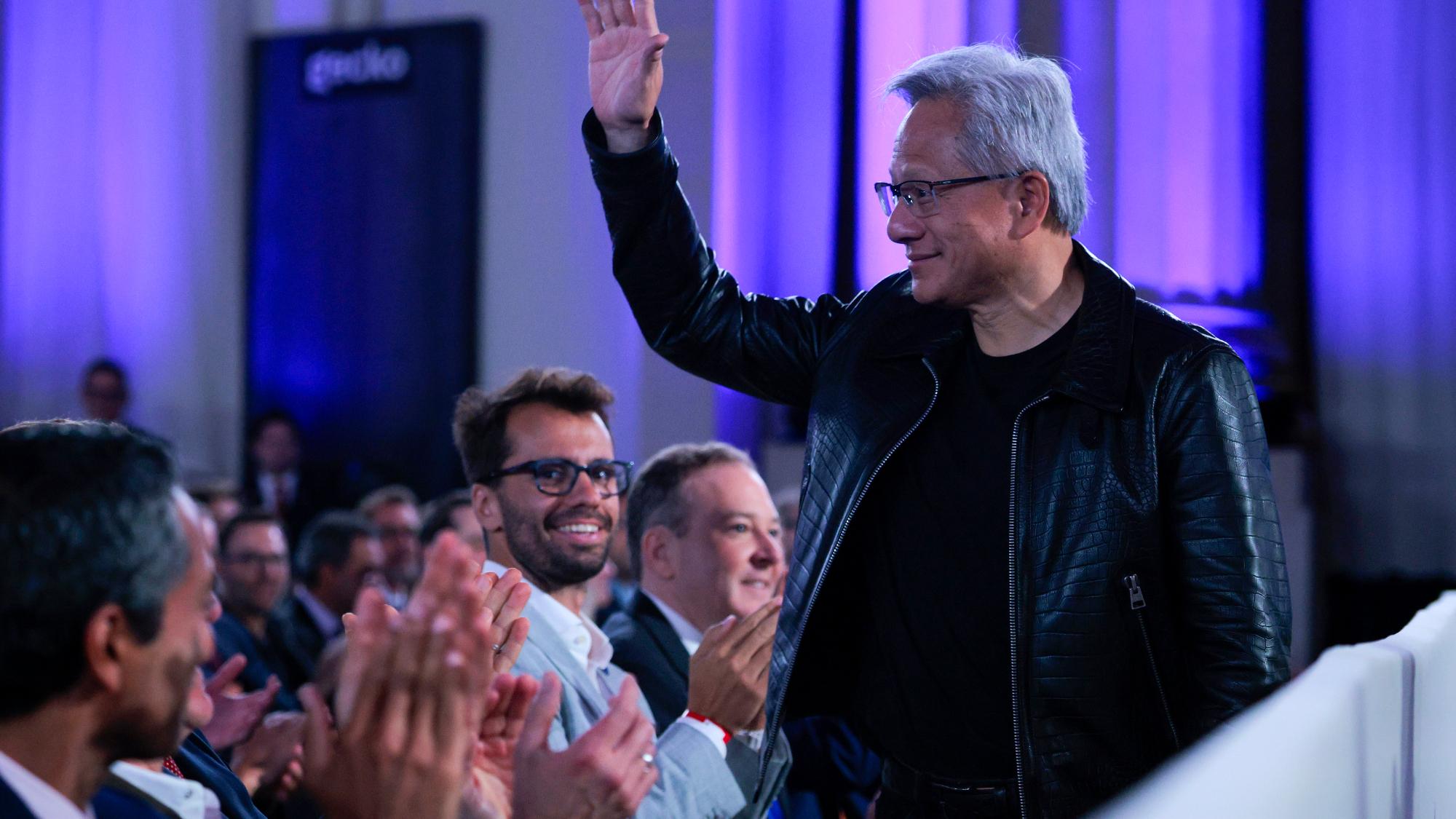
Eleven days without Jensen
On Nov. 12, Jensen Huang, who had led Nvidia since he co-founded it at a Denny’s booth in 1993, resigned after reports of extramarital relationships, including one with Alice Huang, a former chief executive of the Nvidia customer Megaspeed, whom U.S. intelligence reportedly suspects of ties to China’s security services. Beijing denies it, and nothing has been proven. Nvidia’s shares plunged as much as 14% at the open that morning, and by the end of the week the company had shed more than a trillion dollars in market value. Five days later, on the same day Nvidia reported a record quarter under interim CEO Colette Kress, the new board chair, Harvey Jones, said the board did not intend to bring him back.

Then employees, investors, a director warning of “irreplaceable talent,” Elon Musk and the President of the United States all pushed the other way. More than 200,000 people, including some 10,000 current Nvidia employees, signed an open letter for his return, and Musk put it in the only language everyone understands: letting Huang go, he said at the DealBook Summit, was like kicking Michael Jordan off your team in the middle of a winning streak. Sam Altman, who once spent five days in the same exile, told the same summit that it was hard to imagine the AI industry without Jensen. On Monday morning, Nov. 23, the board voted unanimously to reinstate him, saying it was satisfied with his candor, had received input from senior levels of the U.S. government, and was confident his return posed no national-security risk; an independent committee’s investigation will continue. By the closing bell, Nvidia’s stock was up 31.5%, to $165.05, its best day in more than two decades. “The mistake has been corrected,” Musk posted. When Huang walked back into headquarters, three floors of employees chanted his name. “Thank you all for the second chances,” he told them. “I’m going to be a better CEO the second time around.”
The next morning, the tone changed. At an hour-long all-hands meeting on Tuesday, Huang apologized. He told employees he had made terrible mistakes, that he had been unfaithful to his wife and had hurt his children and his colleagues, and that he was in therapy every day. He acknowledged he had broken a code of conduct he had helped write, and insisted he had not been brought back because he was a tech bro who stood above the law. He took no questions. Nvidia’s stock gave back about 6%. The franchise player was back on the court, but the crowd had not finished deciding whether to cheer.
Much of the commentary treated all of this as scandalous in a second sense: how can a trillion-dollar company, and a superpower’s technology strategy, hinge on one man? But any sports fan already knows the answer. A general manager who lost the best player in the world over a personal scandal, and could get him back, would not deliberate for long. Fans understand, instinctively and without resentment, that an iconic player can transform a team, a league, a city and an entire industry.
We accept that logic on the hardwood. We resist it in the boardroom.
The Jordan Logic
No one needs a lecture on power laws to understand Michael Jordan.
READ: The Review by Ajay Raju | Thirty-two seagulls fighting over a French Fry: An open letter to Philadelphia (November 20, 2026)
The team. When Jordan arrived in 1984, the Chicago Bulls were a losing franchise playing to empty seats. The following year Jerry Reinsdorf’s group bought control of the team for roughly $16 million. Jordan delivered six championships in eight seasons. Today Forbes values the Bulls at around $6 billion, and the franchise still trades on the banners he hung four decades ago.
The league. In the early 1980s, NBA Finals games were still shown on late-night tape delay. Jordan, alongside Magic and Bird, turned the league into prime-time and then global entertainment, exported to Beijing, Belgrade and Madrid. The descendants of that audience are why the NBA could sign media deals worth roughly $76 billion over eleven years in 2024, and why the Lakers sold at a $10 billion valuation in 2025.
The city. Chicago’s West Side got the United Center, opened in 1994 and nicknamed the House That Jordan Built, and with it decades of development that its owners are still extending today. Around the world, “Chicago” came to mean a red jersey with the number 23 as much as it meant Al Capone or the Sears Tower.
The industry. In 1984 Nike was a running-shoe company losing basketball to Converse. It paid a rookie not a flat fee but a royalty on every shoe. Forty years later, Jordan Brand is a business of about $7.3 billion a year, roughly 14% of Nike, and Jordan himself earned an estimated $300 million in a single year, mostly from royalties, more than two decades after his last game. He invented the athlete as brand, and every signature shoe and athlete-owned media company since walks in his footprints.
A great player wins games. A once-in-a-generation player changes the economics of the game itself. That is the Jordan logic, and almost everyone who has ever sat in a gym accepts it.
Selective Anger
Here is the curious thing. The same fan who cheers a $300 million maximum contract for a franchise player, who would trade three starters and four draft picks for one superstar, who believes in his bones that one person can lift a city, often bristles when that logic is applied to a founder or a chief executive. Nobody calls LeBron James an oligarch. Nobody demands that the Bulls give Jordan’s minutes to the twelfth man in the name of fairness.
In a Pew survey this summer, 52% of Americans said AI made them more concerned than excited. Elon Musk drew the highest unfavorable rating, 61%, of the fourteen figures in Gallup’s July 2025 survey. And within hours of Monday’s reinstatement, the outrage arrived from both parties. Senator Ruben Gallego called for an investigation of stock trades ahead of the announcement and declared the White House the most corrupt in history; Senator Chris Van Hollen called it what a rigged system looks like, pointing to Nvidia’s $25 million gift to the President’s ballroom; Republican Representative Don Bacon called Huang “compromised and exploited.”
Pennsylvania’s own governor, Josh Shapiro, widely seen as a 2028 presidential aspirant, released a statement calling the reinstatement another example of “a rigged system that protects those at the very top no matter what” and of “a corrupt White House that cannot be trusted,” and concluding that “the sheer corruption and weakness of Donald Trump” is putting America’s economy and national security at risk.
I read the statement twice and noticed what is missing. There is not a word about chips, about CUDA, about Huawei, about what Nvidia means to the American economy, or about what the country would lose if its most important technology company were run by committee during the most consequential technology race of the century. Huang appears only as the occasion; the target is the President. This looks like selective anger to me: the indispensable individual reduced to a prop in someone else’s campaign.
The selectivity is sharper because of the speaker. In June 2025, the same governor stood in Berwick to announce Amazon’s plan to invest at least $20 billion in Pennsylvania data centers, the largest private-sector investment in the Commonwealth’s history, and said Pennsylvania would lead in the U.S.-China AI battle. The few were partners when their capital was arriving in Pennsylvania. They are symbols of a rigged system when their story is useful against an opponent. To be fair to the governor, he has since said he heard constituents’ concerns and wants guardrails so developers do not run roughshod over communities, and that is a legitimate evolution. But it is hard to court the AI build-out in one season and denounce its central figure in the next without the anger looking more tactical than principled.
Nor is selectivity one party’s vice. A President who rose by denouncing elites now calls Huang a “Great Patriot and National Treasure”; some who cheered Musk’s billions when he wielded them for their side discovered a passion for curbing billionaires when he did not. Sports fans will recognize the pattern. When a rival’s superstar is reinstated after a scandal, the league is rigged; when it is our own, he deserves a second chance. The anger follows the jersey, not the principle.
And then there is Donald Trump, who has a way of becoming the story inside every story. He told CNBC that he “convinced” the board, speaking to it “directly and indirectly,” and his communications director said the President was “totally involved.” On Tuesday, Huang told his own employees that the board had decided on its own. Then, to celebrate, the President posted an AI-altered version of the photograph taken moments after the assassination attempt at his July 2024 rally in Butler, Pennsylvania, with a bloodied Huang in his place, raising a red bra instead of a fist, an Nvidia flag flying where the American flag had been. Explaining why the Nvidia story caught fire, he told CNBC, “Sex sells, fellas.”
This deserves a plain rebuke. Butler is not a meme. Corey Comperatore, a former volunteer fire chief, died there shielding his wife and daughters from the gunfire, and two other men were gravely wounded. The Secret Service agents in that photograph put their bodies between a bullet and a President. To turn that moment into a punchline about a married man’s affairs is an insult to a grieving family in western Pennsylvania, to the agents who did their duty, and to the women who would rather not see infidelity waved like a trophy. It is an insult, too, to every employee who has ever sat through harassment training, signed a code of conduct and taken it seriously, because the most powerful man in the country just told them those rules are a joke for the winners. The irony deepened a day later, when Huang himself stood before his employees and called his breach of that very code “not acceptable.” Even some of the President’s own supporters objected; one, a self-described conservative woman, called the post gross, and others threatened to stop following him. The President’s style thrills a base and guarantees that every story, even one about chips and China, becomes a story about him. But the presidency is the most important office on earth, and it has a dignity that does not belong to any one occupant. The man who holds it should not need to be reminded of that.
READ: The Review by Ajay Raju | Fifty-six trips around the sun: Part 5 of a 7-Essay collection (November 16, 2026)
The deeper cost of the spectacle is that it buries the questions that actually matter. Scroll through social media this week and you would think the President was the whole story. The market answered different questions in a single session. By Monday’s close, Huang’s return had added roughly $950 billion to Nvidia’s value, the largest one-day gain for any company in history and more than double the previous record of about $450 billion set by Microsoft in July. The Nasdaq 100 added about $2.7 trillion by midday and the S&P 500 climbed out of correction, in Wall Street’s best session since April 2025. The tremor crossed the Pacific overnight: on Tuesday, Taiwan’s Taiex posted the largest single-day point gain in its history. Most of that was Huang; markets were rebounding from the Nasdaq’s worst week since 2020 after his resignation.
Then, on Tuesday, Nvidia gave back about 6%, as investors turned from the scoreboard to the hearing calendar.
The order of magnitude is stunning, but here’s the question: is Jensen worth a trillion dollars to Nvidia, and trillions more to the retirement accounts of ordinary Americans? That is the Jordan question.
None of this means the questions are frivolous. They are serious. The New York Times reported that the woman at the center of the scandal kept in contact with China’s top spy agency through the fall of 2026, and the Director of National Intelligence says the investigation of her and of Megaspeed is ongoing. On December 1, Huang sits for a closed-door, transcribed interview before the House Intelligence, Foreign Affairs and China select committees, whose chairs said the board’s brief internal review does not erase the national-security questions; Nvidia’s general counsel, Tim Teter, follows on December 2. Senate Minority Leader Chuck Schumer has promised that Democrats will use their full power to investigate. Senator Elizabeth Warren wants to know what “input” the administration gave the board, and from whom. California’s attorney general says his office will keep probing whether Nvidia misled investors. Treasury Secretary Scott Bessent has publicly faulted the Commerce Department for moving too slowly on Megaspeed, and on Monday, the same day Huang returned, Commerce finally added Megaspeed, its affiliates and Alibaba’s Singapore subsidiary to the U.S. Entity List. Bacon wants to know who approved high-end chip sales to China. Those are the right questions, and they belong in hearing rooms, with evidence, under oath.
The principled critic asks what happened with the chips and with China. The opportunist asks only how the scandal can wound the other party. Only one of them is protecting America’s position in the race that matters.
Every Revolution Has Its Jordan
Every great economic revolution had only a few memorable faces. Steam had James Watt and Matthew Boulton, who began selling Watt’s improved engine in 1776, the same year a room full of lawyers in Philadelphia rewrote the rules of power. Oil and steel had John D. Rockefeller and Andrew Carnegie, an immigrant bobbin boy from Dunfermline. Electricity had Thomas Edison and the Serbian immigrant Nikola Tesla. Mass production had Henry Ford and his moving assembly line of 1913. The personal computer had Bill Gates and Steve Jobs.
READ: The Review by Ajay Raju | Fifty-six trips around the sun: Part 3 of a 7-Essay collection (November 2, 2026)
Most of these founders were unpopular with the larger public in their lifetimes. But history has a way of overruling the crowd’s verdict. Rockefeller was the most hated man in America; his name now rests on a university and the institute where much of modern biology was born. Carnegie broke the Homestead strike; his libraries taught generations of immigrant children to read. Jobs was, by many accounts, a tyrant in the office. We remember the iPhone. Even the Jordan logic has always carried a hard edge. Jordan was famously merciless with teammates, and in a 1995 practice he punched Steve Kerr; Kerr later said the fight earned Jordan’s respect, and the Bulls went on to win three more titles. Huang, too, has his critics: The New York Times, drawing on court documents and interviews with current and former employees, reported that he used humiliation as a tool and at times belittled staff. We forgive ruthlessness in both arenas for the same reason, because it wins. Whether we should is a fair question, and the honest answer is that the few have rarely been gentle. The many judge the few by their character. History judges them by their consequence. Few are only the faces of revolutions; the rarest actually shape the industries those revolutions create.
Too Big to Replace: Nvidia
Jensen is one of history’s rarest. Apply the Jordan logic to him and the four circles reappear, only larger.
The team. Huang has run Nvidia for all of its thirty-three years. Under him, a graphics-card company for gamers bet, nearly two decades ago, on CUDA, the software that let scientists use its chips for general computing, when few outside Santa Clara understood why. That bet is the franchise. In the quarter ended October 25, reported on November 17 while Huang was away from the building, Nvidia posted $115.8 billion in revenue, up 103% in a year, with $107.6 billion from data centers, and guided to about $130 billion for the current quarter.
The league. Every frontier lab, every hyperscaler and every sovereign AI program builds on his chips. The largest technology companies are on track to spend roughly $800 billion on capital expenditures this year, much of it, in effect, a purchase order with Nvidia’s name on it.
The city. Silicon Valley’s gravity, its venture capital, its talent and its billionaire count, now orbits AI, and AI orbits compute. So, increasingly, does Taipei, whose stock market had its biggest day ever on the news that one man was going back to work in Santa Clara.
The industry. Huang did not merely ride the AI revolution; he built its picks and shovels and set its tempo, from Blackwell to the Vera Rubin platform now shipping, with Vera Rubin Ultra due next year and Feynman in 2028.
That is why the eleven days mattered. A board, a workforce, the markets and the White House reached the same conclusion a coach reaches about a franchise player: there is no one on the bench who does what he does. Nvidia has a capable finance chief in Colette Kress, who steadied the company as interim CEO and delivered a record quarter in the middle of the storm, and a deep bench of engineers. But capability is not the same as vision. The fundamentals did not change in those eleven days; only the name on the door did. The market voted on the difference twice: down on the day he left, up 31.5% on the day he returned.
The Second Time Around
We have seen this film before, and it is worth remembering how it ended.
In 1985, Apple’s board sided with a professional manager and pushed out its thirty-year-old co-founder, Steve Jobs. Over the next twelve years, Apple drifted toward irrelevance; by the time it bought Jobs’s company NeXT and brought him back in 1997, it was, by his own later account, within months of running out of cash. The second Jobs gave the world the iMac, the iPod, the iPhone and, for a time, the most valuable company on earth. He was, by every account, a better CEO the second time around. Huang’s words to his cheering employees on Monday echo that history almost exactly.
Then there is the more recent rerun. Three years ago this very month, in November 2023, OpenAI’s board fired Sam Altman. More than 700 of its roughly 770 employees signed a letter threatening to quit, Microsoft offered to hire them all, and within five days Altman was back and most of the board was gone. Jobs needed twelve years; Altman, five days; Huang, eleven. Two Novembers, two boards, the same lesson: in the age of the indispensable founder, a board can fire the franchise player, but it may not be able to make the firing stick.
That raises the obvious governance question: who holds the indispensable accountable? At Nvidia, nearly half the board has served since the 1990s, and Bloomberg reported that the about-face was made without consulting the company’s leadership team. Even an analyst who upgraded the stock on Monday called the board’s on-again, off-again handling “frankly, clown-like.” Huang runs a famously flat company, with dozens of direct reports and no clearly defined successor; two of his children and his son-in-law are executives there. To its credit, the company has begun to write a rulebook. Nvidia is searching for its first Chief Compliance Officer, who will report to the board’s governance committee rather than to the CEO, and Huang told employees on Tuesday that his direct reports will now send the board reviews of his conduct. The Jordan logic tells us why the board brought him back. It does not tell us who will say no to him the next time. In sports, the answer is a commissioner, a salary cap and a rulebook that binds even the greatest player. Corporate America has not yet built its equivalent for the few it cannot live without. Nvidia’s new rules are a start; whether they bind is the test.
Too Big to Replace: America
If Huang mattered only to Nvidia’s shareholders, his eleven days would be a business story. They were a national-security story because the contest between the United States and China for technological supremacy over the next century runs, in no small measure, through his company.
Consider the scoreboard. Huang has argued for years that U.S. export controls forced an American company to cede China’s AI-chip market; he told the Associated Press that Nvidia once held about 95% of it. By the first half of 2026, IDC data showed Nvidia’s share of China’s data-center AI chips down to 34%, with Huawei at 28% and climbing, and nine of eleven Chinese chipmakers growing. Analysts still say China’s most advanced models lean on Nvidia silicon. Beijing’s strategy is plain: build the alternative, make Nvidia unnecessary, and wait.
The scandal has now rearranged that board. In the past two weeks, the administration moved to curtail China’s remote access to American AI chips, Nvidia stopped shipping its H200 chips to China despite prior approvals, and the company’s guidance for this quarter assumes no data-center compute revenue from China at all. Treasury Secretary Bessent says the proper restrictions are now in place. One Baird analyst called the combination, a Nvidia that has stepped back from China while keeping the man who built it, the worst-case scenario for Beijing. The franchise player is back, but he will play this season without his biggest away market.
READ: The Review by Ajay Raju | Fifty-six trips around the sun — Part 4 of a 7-Essay collection (November 9, 2026)
In that race, the American advantage is not a single chip but a cadence: a new architecture roughly every year, a software moat built over two decades, and a founder who knows every customer, every supplier in Taiwan and every engineer who matters. That cadence is the closest thing the United States has to a Jordan in the fourth quarter. A century-long rivalry will be decided less by any one product than by whether America keeps producing, and keeping, people who can set that tempo.
By the way, there is a hard truth inside this compliment. A superpower whose technological edge depends on one man’s continued presence, and on his private conduct, has a single point of failure. The scandal that nearly ended Huang’s tenure involved precisely the kind of foreign-intelligence exposure that should unsettle any strategist, and the investigations, by the board, by Congress and by the government, are not finished. Here lies the sharpest irony of the whole affair: America’s greatest asset in its race with China became exposed through a relationship with someone U.S. officials suspect of ties to Chinese intelligence. Beijing does not need to out-engineer Nvidia if it can reach Jensen. The franchise player is also the softest target on the court. Nvidia has now created a national security and export control committee and is hiring its first chief compliance officer. Great teams honor their franchise player and still build a bench. The wise course is not to pretend Jensen is replaceable, but to make sure that, one day, he is.
The Banner and the Bench
Let’s return, for a moment, to the arena. Above the court hang the banners: retired numbers, championship years, a few names stitched in gold. Below them sit the thousands who set the screens, took the charges and guarded the stars in practice. Without the bench, there are no banners. But without the one player whose name ends up on the banner, the bench rarely gets a ring.
On Monday, the bench chanted his name. On Tuesday, he stood before them and apologized. Both scenes belong to the same story, because the franchise player owes the team his talent and his conduct alike.
Here’s the lesson of rarity: the few who lead the many almost never arrive with credentials. They arrive as strangers, carrying a stubborn idea and the grit of people with nothing to fall back on. Every era is remembered by those handful of rare names. This one, for better and for worse, will be remembered by Jensen Huang and Elon Musk, however loudly the crowd boos.