



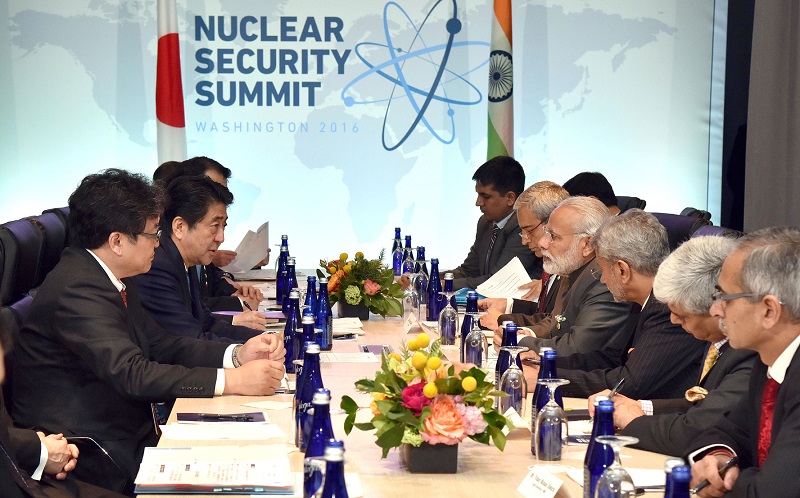
Attends dinner hosted by Obama, meets New Zealand, Canadian and British leaders.
By Surekha Vijh
WASHINGTON, DC: Indian Prime Minister Narendra Modi’s second trip to Washington, DC, was as hectic as his first one in September 2014. But it was a much more low-key affair than the last visit, which happened after his historic Madison Square Garden address.
Modi arrived in the US capital in the early hours on March 31. The mission of the trip was to participate in the fourth Nuclear Security Summit, hosted by the US President Barack Obama, which was attended by 52 nations and four international organizations.
The prime minister received a very warm welcome from members of the local Indian American community, who queued up early in the morning to greet him outside at the Willard Hotel.
He started his diplomatic engagement with some other heads of states and dined with the President Obama at the White House in the evening.
One of his first meetings was with his New Zealand counterpart John Key. The two discussed bilateral co-operation in trade, technology and tourism.
The World T-20 cricket tournament, which concluded in India on Sunday, reportedly figured in the talks of the leaders of the two cricket-crazy nations. The Indian team was batting against the West Indies in the semi-finals in Mumbai, when Key met Modi at Willard. New Zealand had handed India a shocking defeat at the start of the tournament.
During his stay in Washington, Modi also met Canadian Prime Minister Justin Trudeau, Japanese Prime Minister Shinzo Abe, British Prime Minister David Cameron and Kazakhstan President Nursultan Nazarbayev for bilateral talks.
On Thursday, Modi also met with scientists from Laser Interferometer Gravitational-wave Observatory (LIGO). He urged Indian scientists who are part of the LIGO project to interact with Indian students and visit Indian universities as much as possible.
India and the United States signed a memorandum of understanding for setting up a new LIGO in India that will play a significant role in carrying forward frontline research on various aspects of gravitational wave astronomy.
Nancy Aggarwal, a PhD student at the Massachusetts Institute of Technology in Boston, one of the two Indian students involved with the project who met Modi here, said the the prime minister was very curious to hear about the project and explore how it can be further helpful in boosting science and science education in the country.
Aggarwal, during the interaction, said it would be great for India and the US to work together, which would help create a brand new breed of Indian technicians. The prospect of LIGO India has opened up new prospects of opportunities in India, she added.
Another Indian PhD student from the Georgia Institute of Technology Karan P. Jani impressed the prime minister during their interaction. Modi asked him why Albert Einstein was so confident about his discovery when there was no such modern scientific tools and equipment available. Jani answered that this was because Einstein was curious, self-confident and had a base in mathematics.
The two-day nuclear summit was to deliberate on the crucial issue of reducing the security threat caused by nuclear terrorism. World leaders discussed ways and measures through which to strengthen the global nuclear security architecture, especially to ensure that non-state actors do not get access to nuclear material.
The participants included Algeria, Argentina, Australia, Brazil, Canada, China, France, Germany, Japan, New Zealand, Nigeria, Saudi Arabia, Spain, Turkey, the United Kingdom, the United States and Vietnam, in addition to the International Criminal Police Organization (INTERPOL), United Nations (UN), International Atomic Energy Agency (IAEA) and the European Union (EU).
As a member of all of the previously mentioned organizations, Spain assumes with special responsibility this joint work of the international community to strengthen security in light of the terrorist threat in the nuclear space.
Washington was the second leg of a three-nation trip by Modi, which started in Belgium. He left Washington on the evening of April 1 for a two-day visit to Saudi Arabia.