



Editor’s note: This article is based on insights from a podcast series. The views expressed in the podcast reflect the speakers’ perspectives and do not necessarily represent those of this publication. Readers are encouraged to explore the full podcast for additional context.
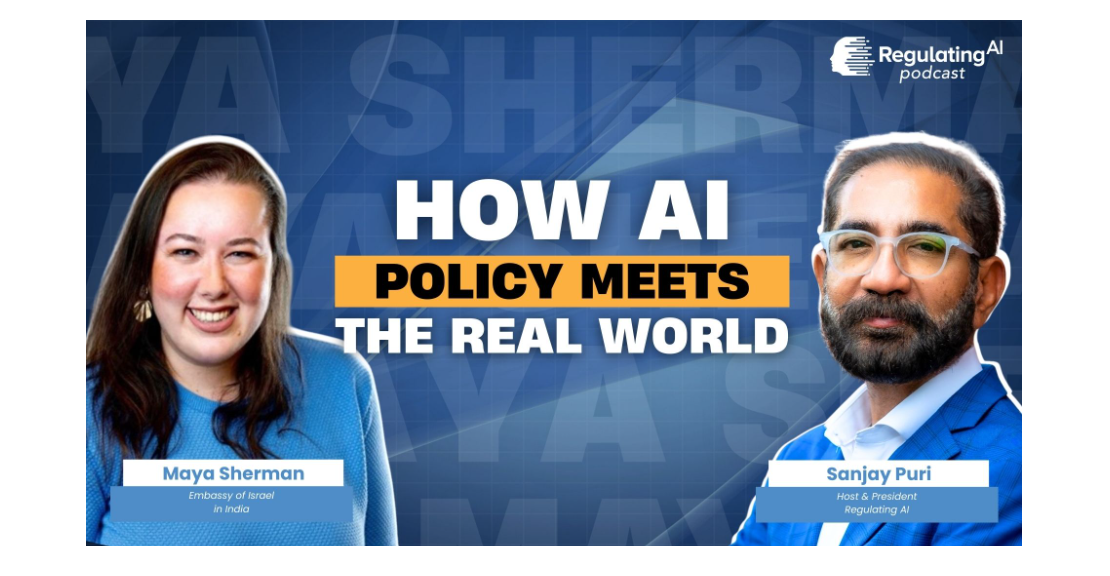
As highlighted in the latest conversation on the “Regulating AI” podcast, host Sanjay Puri sat down with AI policy researcher and technology diplomat Maya Sherman to unpack some of the most pressing questions shaping the future of artificial intelligence.
Sherman, currently serving as an Innovation Attaché at the Israeli Embassy in India and associated with the Oxford Internet Institute, works at the intersection of AI governance, digital ethics, and international policy. In her discussion, she offered a rare blend of policy insight, philosophical reflection, and practical examples from farmers in rural India to global AI diplomacy.
In the conversation, Sherman reflected on her unconventional career journey. She began by monitoring darknet spaces, tracking cybercrime, extremism, and hate speech before transitioning into AI governance research.
That experience, she explained, “For me, I felt it’s more a causational relation in the sense that I’ve learned and saw the perhaps darker side of technologies, of what happens when you have malign institutes and actors trying to harm the fact that data is accessible and users are not fully aware of what can happen.”
Her background ultimately shaped her belief that cybersecurity and AI ethics must go hand in hand in modern governance frameworks.
One of the more surprising insights was her intellectual connection between surrealist art and AI ethics.
READ: From Delhi to digital planet: Tufts University’s Bhaskar Chakravorti on technology reshaping economies (July 20, 2026)
Drawing inspiration from surrealist artists like Salvador Dalí, Sherman described, “there are different ways to explain surrealism, but for me, it’s the art of the impossible and the exception. Responsible AI, for me, is a paradox.”
Artificial intelligence was originally designed to increase efficiency and productivity, yet it now raises complex ethical questions about fairness, bias, and social impact. “… in many ways, AI accelerates (the) digital divide. It’s actually causing a lot of harm to the global south, but still, we’re using it so substantially,” she said.
For Sherman, the challenge of AI governance lies in navigating these contradictions and embracing the “gray areas” where technology intersects with society.
During the conversation, Sherman highlighted how AI can unintentionally deepen inequalities in emerging economies.
She pointed to several risks, including job displacement in informal sectors, “it doesn’t necessarily mean that (the) younger generation will find a job. It doesn’t mean that they really have the right skills to be able to think critically of situations. A lot of the skills that we used to develop in the offline world are taken.”
The spread of deepfakes, and widening digital divides for communities without access to digital tools. In countries where large portions of the population operate outside formal economic systems, these shifts can be particularly disruptive.
Sherman emphasized that governance discussions must therefore include voices from the Global South.
Another key topic explored was India’s evolving approach to AI regulation.
Rather than rushing into strict legislation like the EU AI Act, India has adopted a more flexible model, combining advisory frameworks with policies such as the Digital Personal Data Protection Act.
READ: Data, not just AI models, will shape India’s AI future, says EY partner Alexy Thomas (July 7, 2026)
Sherman described this approach as smart experimentation, “India’s approach is smart because in many ways, I feel that the country is trying a lot of different governance mechanisms based on what others are doing… We are seeing different regulations, advisories are coming all the time. But I think the beauty about what India is doing is, first of all, the attention to the industry. ”
Sherman also shared examples of AI literacy initiatives targeting farmers and informal workers in India. Through programs linked with the Global Partnership on AI, farmers were introduced to practical AI applications such as crop monitoring, weather prediction, and multilingual chatbot support.
In a country with extraordinary linguistic diversity, AI-powered translation tools could become a powerful enabler of digital inclusion.
Toward the end of the episode Sherman offered one major recommendation for global AI leaders: prioritize linguistic diversity.
Most AI systems today are optimized for English and a handful of major languages. Sherman argued that countries should invest in sovereign AI models capable of supporting local languages and cultural contexts.
As the discussion concludes, Sherman makes it clear that the future of AI governance will not be shaped by technology alone but by diplomacy, inclusion, and the ability to balance innovation with responsibility.