



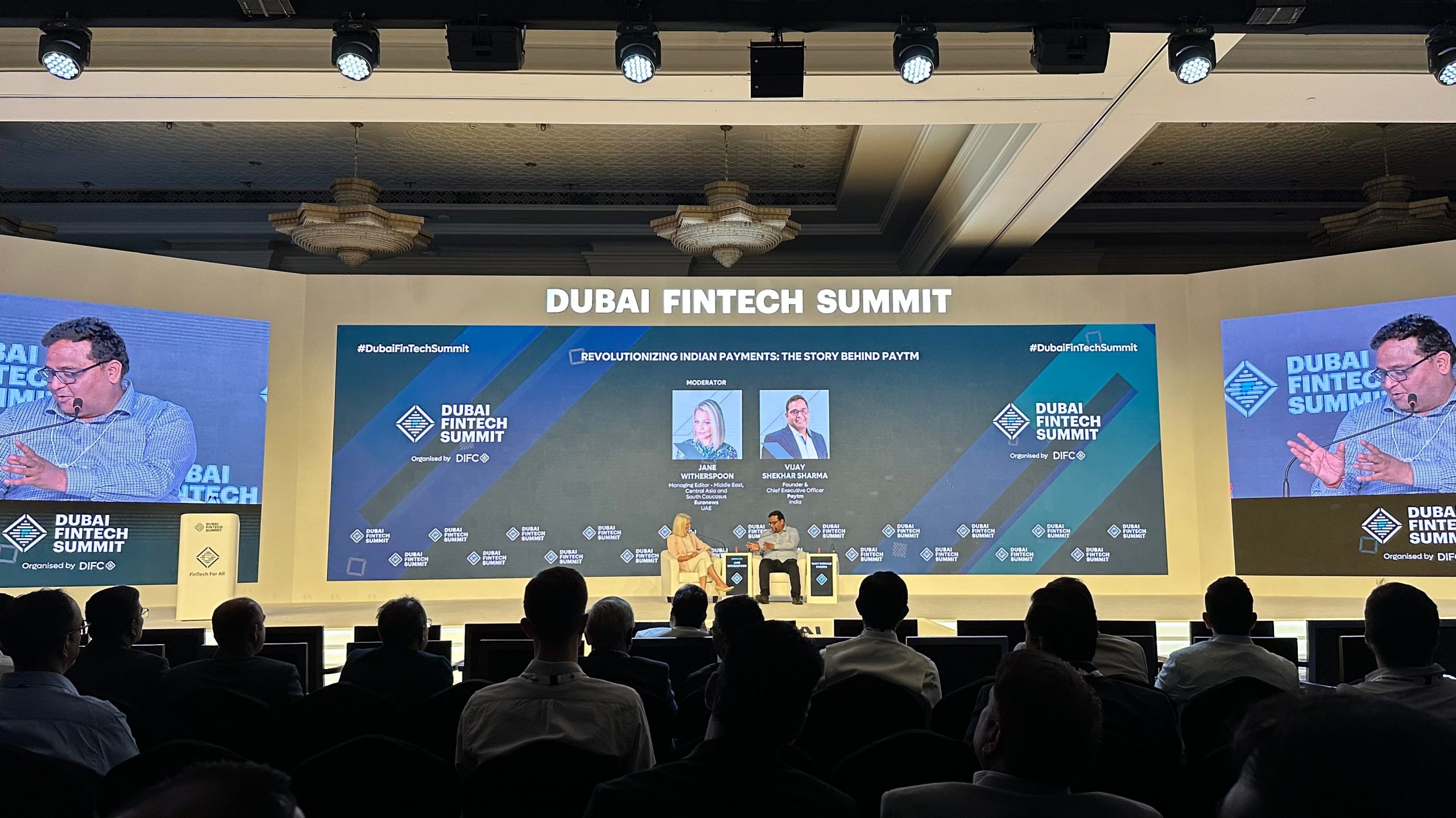
Dubai, UAE – At the Dubai FinTech Summit 2025 held in May, a fireside chat with Vijay Shekhar Sharma, the founder and CEO of PayTM, took a deep dive into his entrepreneurial journey, the founding of PayTM, and the revolutionary impact of QR code payments in India.
With over 20 years of experience in fintech, Sharma’s insights offered a rare look into the rise of one of India’s most iconic fintech companies and its vision for the future of digital finance.
PayTM, founded in 2010, emerged at a time when mobile payments were still in their infancy, particularly in India. During the chat, Sharma spoke candidly about the inspiration behind PayTM’s creation, which came from his own personal experiences. He recalled a time when he found himself stranded without cash or cards during a trip abroad. “The real reason [for founding PayTM] came when I left my wallet in Delhi Airport Lounge and landed in LA, I didn’t have cash or cards. The only way I could survive was that my friend gave me a credit card, which I could use to pay for Uber,” he said.
READ: Dubai FinTech Summit 2025 set to shape the future of finance (May 10, 2025)
This experience led Sharma to recognize a global shift toward mobile phone usage and the growing potential of mobile payments. “The world has mobile phones in their pockets, and the world has these cards. Why are they not smashing together?” he stated. This moment was the seed for PayTM’s mission to solve payment challenges for the masses, particularly in small shops and markets.
Early challenges and the rise of QR code payments
Sharma’s journey wasn’t without its challenges. At a time when mobile payments were not widely adopted in India, he faced resistance from both his board members and his team. “My board members were very much against it, and fellow teammates were also not sure whether it would work out or not, considering our country uses cash to a level that when a person is getting married, in India, you wear the garland of currency notes,” he said. This resistance stemmed from India’s deep-rooted cash culture where “cash is king,” as Sharma noted.
However, despite these initial setbacks, Sharma remained steadfast in his belief that the future of payments lay in mobile technology. He recalled his confidence in the smartphone economy and mobile applications, which led him to convince investors that PayTM could tap into a growing market for mobile-based payment solutions. “If you believe the smartphone economy is going to be successful, then you are saying that it will be successful,” Sharma explained. “I joined their philosophy that they believe in smartphones, and I was riding on that belief.”
One of the key milestones in PayTM’s journey was the introduction of QR code payments, a game-changing solution that made mobile payments accessible to small merchants across India. “PayTM was a journey of issues that I faced, and then I thought, okay, we have to solve for payments using mobile,” Sharma shared. “The real breakthrough came when we realized that we needed to solve it for the mass, small shops over the big customers first, and that’s how the QR code for payment came about.”
In India, where large transaction fees and infrastructure costs often deterred small merchants from adopting digital payment solutions, the QR code was a low-cost and efficient way to enable payments. Sharma proudly stated, “India gave the QR code system, which became the standard for all Asian players. It was a low-cost payment acquisition that revolutionized the market.”
Government support and financial inclusion
PayTM’s success was not only driven by its innovation but also by supportive initiatives from the Indian government. Sharma acknowledged the critical role played by the government in facilitating digital payments and financial inclusion. “I’m privileged to have our honorable Prime Minister, who became prime minister in 2014, and during that time, our government launched the Digital India mission, where the new, challenging companies were given an opportunity,” he said.
Sharma emphasized that this government initiative provided the incentive for startups like PayTM to break through the traditional financial system. “The government’s digitalization initiatives and services like PayTM were crucial in driving financial inclusion across India, especially in rural areas.”
READ: Dubai FinTech Summit 2025 kicks off with record attendance (May 12, 2025)
One of the standout stories of PayTM’s impact was its role in bringing small businesses and micro-merchants into the formal financial system. Sharma elaborated, “Economies that are serious about inclusive growth will be serious about inclusive technology and inclusive finance. By serving the small and micro-businesses, we bring them to the formal financial system. When a small merchant receives payments using PayTM, that merchant has a heartbeat on the formal financial system.”
The company’s unique approach of providing digital payments to street vendors, small shopkeepers, and rural businesses was transformative for the financial landscape in India. Sharma added, “The humble QR code that we gave them, along with special hardware, brought these businesses into the formal system. Once they joined, the ecosystem could reach out to them, and that’s our commitment to the economy.”
AI and small business transformation
As the conversation moved towards the integration of AI into PayTM’s offerings, Sharma expressed his excitement about the future of technology in fintech. PayTM’s collaboration with Perplexity AI to integrate AI-powered search and user experience features into its platform has enhanced the way users interact with the app. “AI is grossly underestimated by most of us,” Sharma said. “The use cases of AI are phenomenally different at a scale that people are not experiencing.”
He highlighted how AI could empower small businesses in India, a key segment for PayTM. “For example, if you were a roadside shop, you might not know who your loyal customers are, or when your sales fluctuate. AI allows these small businesses to access insights that were once only available to large enterprises,” he said.
Sharma explained how small businesses could now predict cash flow, access credit, and even get insurance, all with the help of AI. “Imagine if you could talk to a PayTM box, we call it a sound box, and ask, ‘What do you think will be my sales this month? Am I performing better than last month?’ With AI, these types of conversations are now possible,” he said, stressing the potential of AI to bring sophisticated financial services to the masses.
The road ahead for PayTM
Looking ahead, Sharma shared his vision for the future of PayTM and fintech in India. “Our commitment is clear: we want to bring small businesses and consumers the advantages of the mainstream economy. We aim to create a universal, accessible financial system where everyone, regardless of their background, has access to credit, insurance, and other financial services,” he stated.
READ: Global crypto leaders to converge in Dubai for the 30th edition of HODL Summit (May 9, 2025)
PayTM’s strategy focuses on innovation across technology, hardware, software, and services. “We are a full-stack company,” Sharma emphasized. “We are not just a payment platform; we’re building a complete ecosystem that includes hardware, software, and service solutions to meet the needs of our customers.”
In closing, Sharma reflected on his entrepreneurial journey and shared some advice. “The ultimate power of the universe in your life is something you have to believe in,” he said. “A company is worth the company it keeps, not just the business it runs.”