



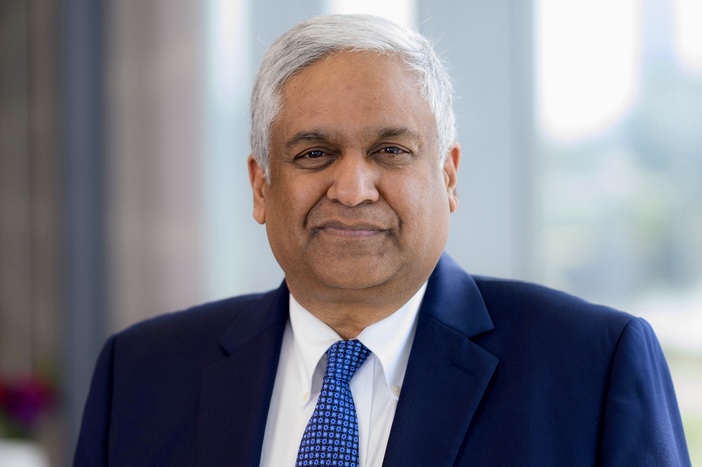
Anantha Chandrakasan, an Indian American professor of electrical engineering and computer science who has held multiple leadership roles at the Massachusetts Institute of Technology (MIT), has been named its new provost, effective July 1.
Chandrakasan has served as the dean of the School of Engineering since 2017 and as MIT’s inaugural chief innovation and strategy officer since 2024. Prior to becoming dean, he headed the Department of Electrical Engineering and Computer Science (EECS), MIT’s largest academic department, for six years.
“Anantha brings to this post an exceptional record of shaping and leading important innovations for the Institute,” wrote MIT President Sally Kornbluth, in an email to the MIT community. “I am particularly grateful that we will be able to draw on Anantha’s depth and breadth of experience; his nimbleness, entrepreneurial spirit and boundless energy; his remarkable record in raising funds from outside sources for important ideas; and his profound commitment to MIT’s mission.”
The provost is MIT’s senior academic and budget officer, with overall responsibility for the Institute’s educational programs, as well as for the recruitment, promotion, and tenuring of faculty.
With the president and other members of the Institute’s senior leadership team, the provost establishes academic priorities, manages financial planning and research support, and oversees MIT’s international engagements.
READ: Former SpaceX engineer’s startup AndrenaM raises $10 million in just over a day (June 17, 2025)
“I feel deeply honored to take on the role of provost,” says Chandrakasan, who is also the Vannevar Bush Professor of Electrical Engineering and Computer Science. “Looking ahead, I see myself as a key facilitator, enabling faculty, students, postdocs, and staff to continue making extraordinary contributions to the nation and the world.”
As MIT’s chief academic officer, Chandrakasan will focus on three overarching priorities: understanding institutional needs and strategic financial planning, attracting and retaining top talent, and supporting cross-cutting research, education, and entrepreneurship programming. On all of these fronts, he plans to seek frequent input from across the Institute, according to an MIT news release.
“Recognizing that each school and other academic units operate within a unique context, I plan to engage deeply with their leaders to understand their challenges and aspirations. This will help me refine and set the priorities for the Office of the Provost,” Chandrakasan says.
He also plans to establish a provost faculty advisory group to hear on an ongoing basis from faculty across the five schools and the college, as well as student/postdoc advisory groups and an external provost advisory council.
“My goal is to continue to facilitate excellence at MIT at all levels,” Chandrakasan says. “There is a tremendous opportunity for MIT to be at the center of the innovations in areas where the United States wants to lead. It’s about AI. It’s about semiconductors. It’s about quantum, the biosecurity and biomanufacturing space — but not only that.
“We need students who can do more than just code or design or build. We really need students who understand the human perspective and human insights. This is why collaborations between STEM fields and the humanities, arts and social sciences, such as through the new MIT Human Insights Collaborative, are so important.”
In February 2024, Chandrakasan was appointed at MIT’s first chief innovation and strategy officer, to help develop and implement plans to advance research, education, and innovation in areas that President Kornbluth identified as her top priorities.
Chandrakasan earned his BS, MS, and PhD in electrical engineering and computer sciences from the University of California at Berkeley. After joining the MIT faculty, he was the director of the Microsystems Technology Laboratories from 2006 until 2011, when he became the EECS department head.
READ: The angel investor who built a gaming unicorn says the AI hype will make many people lose money (June 17, 2025)
An active researcher throughout his time at MIT, Chandrakasan has led the MIT Energy-Efficient Circuits and Systems Group even while taking on new administrative roles. The group works on the design and implementation of integrated systems, from ultra-low-power wireless sensors and multimedia devices to biomedical systems.
Chandrakasan has more than 120,000 citations and has advised or co-advised and graduated 78 PhD students. He says this experience will help him succeed as provost. “To understand the pain points of our researcher scholars, you have to be in the trenches,” he says.
As higher education faces new challenges, Chandrakasan says he is looking forward to helping MIT position itself for the future. “I’m not afraid to try bold things,” he says.