



By Soumoshree Mukherjee
Editor’s note: This article is based on insights from a podcast series. The views expressed in the podcast reflect the speakers’ perspectives and do not necessarily represent those of this publication. Readers are encouraged to explore the full podcast for additional context.
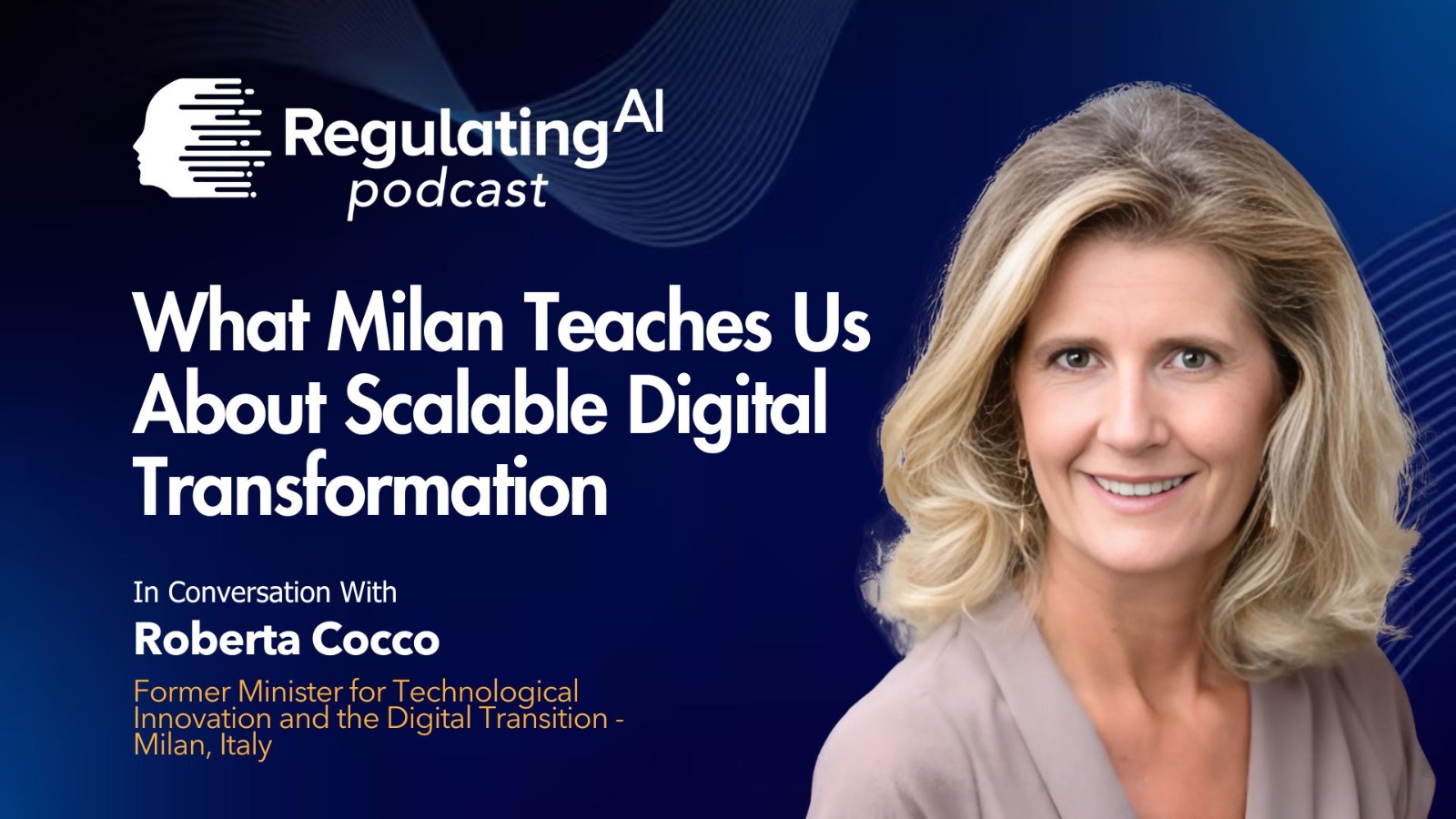
In the heart of Milan, a quiet revolution is underway, one where data, governance, and digital inclusion converge to reshape public life. As cities across the globe wrestle with the promises and perils of artificial intelligence, Milan stands as a blueprint for how local governments can lead responsibly in the AI age. At the forefront of this transformation is Roberta Cocco, former city councillor for Digital Transformation and Services to Citizens in Milan, whose insights illuminate a path that balances innovation with accountability.
“Artificial intelligence has the potential to both strengthen and challenge democratic institutions,” Cocco said in a recent podcast episode of “Regulating AI.” During her tenure, Milan harnessed data and AI to make public services more accessible, from streamlined municipal processes to digital platforms that empower citizens.
READ: Regulating AI: Sanjay Puri on policy, challenges, and ethical innovation (November 1, 2024)
Artificial intelligence, Cocco argues, is not merely a tool; it is a public responsibility. She noted that AI can enhance government responsiveness and inclusivity but it also demands a robust framework of accountability and transparency. Yet, she cautioned, “systems that automate decision-making can also obscure accountability and reduce transparency, if not managed in the proper way.”
Cocco’s solution? A robust governance framework prioritizing transparency and human oversight. “Transparency in artificial intelligence framework is not an option, it is fundamental because it gives us the assurance that the development will be always made by human touch,” she said. This human-centric ethos underpins Milan’s success, ensuring AI serves people, not just systems.
In Milan, data-driven governance has streamlined public services and made them more accessible. But this shift is far more than technological; it is deeply human. Ensuring human oversight in AI systems is crucial for upholding democratic values and public trust.
The European AI Act, a pioneering policy, plays a pivotal role. Cocco praised its risk-based approach, which provides legal clarity while fostering innovation. However, she noted, “enforcement structures remain fragmented,” calling for stronger interdisciplinary oversight that respects local cultural needs. Milan’s implementation of the Act demonstrates this balance, embedding Italy’s constitutional principles into a unified framework.
Milan’s strategy is notably holistic. Through initiatives like the “Repubblica Digitale Fund” and “Milano Digital Week,” the city promotes digital literacy, particularly among marginalized communities. These efforts are not just about access, but about agency empowering citizens to participate fully in a digital society. The digital divide, especially in terms of gender, remains a pressing concern, “I could testify that women are still a very small percentage of tech population.” Cocco firms that a fair AI system cannot be developed if women and underrepresented groups are excluded from the table.
READ: Harnessing AI for healthcare, agriculture, and disaster relief: Dr. Bilel Jamoussi unpacks ‘AI for Good’ (June 13, 2025)
Public-private partnerships are central to Milan’s success. By merging governmental oversight with the agility of the private sector and academic insight, the city has fostered a collaborative ecosystem for AI. This model also holds global relevance. Milan’s digital bridges to cities in the Global South reflect a growing recognition that digital transformation must be equitable and shared. From connecting over 280 institutional databases to addressing digital skills gaps in public service, Milan’s transformation is both granular and ambitious.
Cocco believes AI governance should emphasize protection before innovation. Transparency must be mandatory, not optional. Her vision is distinct: AI must serve the people, not the other way around.
As the world watches Milan, it becomes evident that the city is not just adapting to the digital era—it is shaping it. In Milan’s transformation, we find a powerful reminder: the future of AI isn’t just in algorithms. It lies in the values we encode into them and the people we empower along the way.