



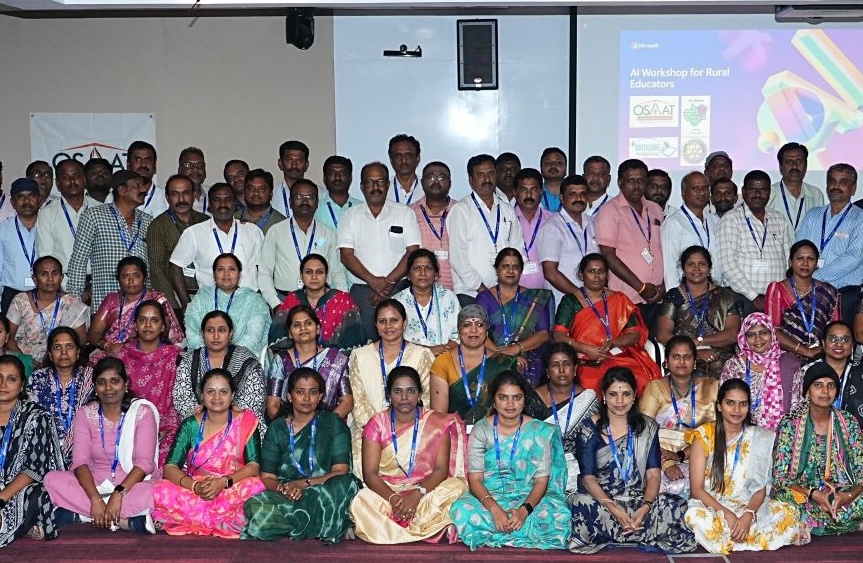
In mid-June, Srini Ambati, a Boston-based changemaker and senior leader at Microsoft, took a significant step to bridge the AI adoption gap among rural educators in the southern Indian state of Karnataka. At the Microsoft Research Centre in Bangalore, over 130 teachers from more than 100 government-run schools across Kolar and Chikkaballapur districts gathered for the groundbreaking one-day workshop, “AI for Rural Educators.”
The event was more than a training session; it provided a blueprint demonstrating how private companies, NGOs, and government bodies can collaboratively ensure inclusive participation in India’s AI revolution.
Microsoft joined hands with local government bodies and NGOs including OSAAT (One School At A Time), New England Kannada Koota (NEKK), Seva Mandaara USA, and Empower Atlanta. The primary goal was to empower teachers with practical, AI-powered tools to enhance classroom engagement and address educational challenges.
READ: How Jagadish Nadig and Wastelink are turning food waste into opportunity (December 2, 2024)
Ambati, one of the core organizers, hosted the event, coordinating grassroots partners, government stakeholders, and technology providers. For him, rural educators play a crucial role in shaping future generations.
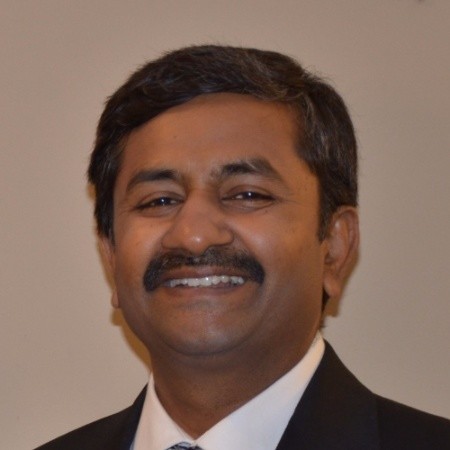
“This workshop goes beyond simply teaching AI to educators. It’s about equipping them with the confidence and practical tools needed to inspire their students,” Ambati explained. “My vision is for rural schools to actively participate in the digital revolution, not merely observe it from the sidelines.”
To ensure inclusivity, all sessions were conducted in both English and Kannada. For most teachers, this workshop was their first direct interaction with AI technology. Participants learned to leverage platforms for creating lesson plans, supporting multilingual education, and fostering engaging classroom environments. A highlight was Sanjay Jani, Director of Microsoft Garage, demonstrating Copilot in Kannada, which received enthusiastic responses.
Throughout the workshop, Ambati introduced various accessible and practical AI tools such as ChatGPT, Microsoft Copilot, Canva AI, Perplexity, Otter.ai, Gamma.app, and Bing Image Generator. The workshop’s objective was not to promote particular products but to familiarize teachers with user-friendly, relevant, and free-to-use AI tools. The interactive sessions included quizzes, demonstrations, and hands-on activities.
Anticipating post-workshop queries, the organizers established WhatsApp groups that continue to foster active engagement. Teachers have since enthusiastically shared AI-generated lesson plans and problem-solving prompts. Additionally, Nagendra Mishr created a multilingual AI-driven tool to answer ongoing teacher queries.
Ambati emphasized the broader implications, stating, “Every child deserves access to quality education, regardless of where they live. Empowering rural educators with practical AI skills bridges the digital divide and sparks curiosity, innovation, and transformative change in Karnataka’s classrooms.”
READ: Artists and global changemakers join hands to raise autism awareness (March 27, 2021)
The support extended beyond AI training. Seva Mandaara donated 15 projectors to schools lacking modern teaching technology, significantly enhancing classroom capabilities. Teacher feedback clearly illustrated the workshop’s profound impact. Manjunatha, one of the participating teachers, remarked, “For many of us teaching in resource-limited rural schools, this workshop was transformative, igniting curiosity and renewing our passion for technology integration.”
Since AI tools like ChatGPT emerged, global conversations around digital divides have intensified. In India, a similar gap persists between urban and rural areas, with government-led AI initiatives typically concentrated in metro cities like Bangalore, Delhi, and Mumbai. Ambati’s initiative demonstrates a tangible solution, proving that with vision, collaboration, and targeted action, the rural-urban AI divide can be effectively addressed, ensuring that rural India fully participates in this new technological era.
(Raghav Puri is pursuing a Master’s in International Relations and Area Studies, specializing in African Studies, at Delhi University.)