



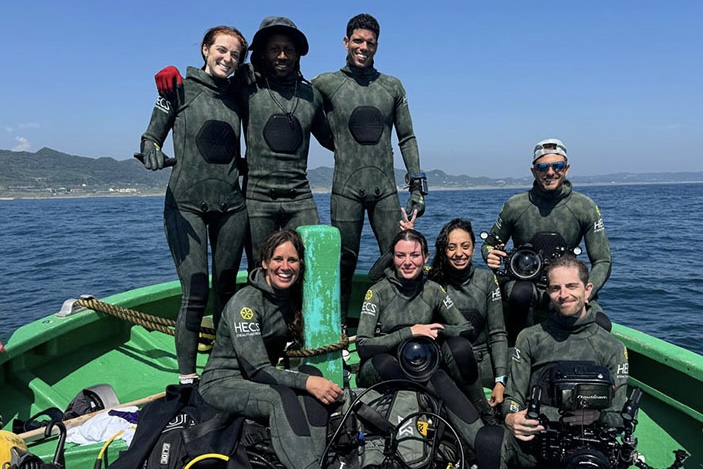
Brendan Talwar, a postdoctoral scholar at Scripps Institution of Oceanography at UC San Diego and marine biologist, Chris Malinowski from the Ocean First Institute, have won Netflix’s “All the Sharks,” a global underwater competition focused on photographing sharks in their natural habitats.
The team of Talwar and Malinowski, better known as “Shark Docs” was crowned kings of the sea and received the ultimate prize: $50,000 for their chosen nonprofit organizations, Reef Environmental Education Foundation and Ocean First Institute. (They also got a cool shark-shaped trophy.)
The six-episode competition series premiered on Netflix on July 4, 2025. It challenged four teams of ocean enthusiasts to compete in real-time marine fieldwork over two months —collecting photos of sharks in their natural habitats in exotic locations including the Maldives, the Galápagos Islands, The Bahamas, South Africa, Japan, and Australia’s Great Barrier Reef. The rarer the shark, the more points awarded.
In an exclusive interview with UC San Diego Today, Brendan Talwar discusses the experience’s impact on science, storytelling, and the power of sharks to connect us to the ocean.
When they received an email about a global series featuring the most biodiverse shark exploration ever, Talwar says they questioned its impact on their careers and the time they could spend publishing papers.
As his Scripps advisor, Brice Semmens, explained, the worst case was that they wouldn’t like the show but could still dive in pristine marine ecosystems. The best case was that it inspired the next generation of marine biologists, showcased shark and ray diversity, and excited a global audience about these animals and their habitats, many of which are under threat.
So, they decided the show’s goal was worth the risk, with every encounter with a shark or ray a “win” for the audience.
READ: Netflix aims for $1 trillion valuation by 2030 (April 15, 2025)
Asked what was filming like, Talwar said he always preferred being behind the camera, taking group photos. But in the Maldives, he realized this would be the opposite. They filmed him from three directions: close-ups to capture reactions, wide shots from a drone, and split shots from below the water’s surface.
Despite the constant filming, they got to know the crew on a personal level, so they barely felt like they were being filmed. The moments captured on camera were more genuine.
Sharing space with killer whales, a dream since childhood, was a bucket list experience, Talwar said. “They’re apex predators, easily taking out white sharks, exhibiting complex social structures, and swimming with us requires trust and acceptance. In that moment, the show’s purpose—connecting people to the ocean’s wonder—became clear.”
Their crew photographed over 50 shark and ray species across six locations and four teams, showcasing a significant portion of their global diversity.
Talwar says his favorite sighting was the leopard catshark off South Africa’s rugged coastline. “I hadn’t heard of these beautiful fish before studying for the episode. They have leopard-print patterns, barbells resembling whiskers, and a fearless attitude. At just under three feet long, they inhabit cold, vibrant reefs off Port Elizabeth and surrounding seas.”
“My favorite photograph was of a great hammerhead in Bimini, The Bahamas. We were facing elimination when a full-grown great hammerhead appeared between scraps of fish and our excited team,” he said. “I had the camera and dropped into the seagrass, lying tight against a piece of bait to invite her in. Despite their size and position at the top of the food web, great hammerheads can be shy.”
“As she came closer, she picked up on the scent of the bonito filet we were using as bait, swam over it, and turned on a dime to scoop it up. She looked dead into the camera lens while curling toward me,” Talwar said.
“With her hammer parallel to my lens, I snapped a straight shot of her face, mouth slightly ajar. I’ll never forget this image: a single frame capturing the beauty and resilience of a critically endangered species finding refuge in a shark sanctuary, drawing in ecotourists and film crews.”
READ: Netflix teams with OpenAI to test new AI search function (April 14, 2025)
Winning mattered, Talwar said because it meant their work and message could reach a wider audience. “Our message about ecology, conservation, and research was featured in every episode, making it easy to miss despite the entertainment. We defined endemism in Japan, highlighted shark tracking data in Galápagos, and mentioned the importance of sound to draw in bull sharks in The Bahamas.”
Talwar said they chose Reef Environmental Education Foundation (REEF) to receive a portion of the winnings because their mission of monitoring reef fishes and marine life through citizen science aligns with their values.
REEF empowers everyday divers to become scientists and stewards of the ocean, which we want to help build. Their volunteer divers have conducted hundreds of thousands of fish surveys, creating datasets that have fueled scientific research, informed resource management, and supported conservation worldwide. What’s next for you?
Talwar said recent funding cuts and shifting priorities have reduced regional shark research and conservation efforts. Overfishing, the primary threat to shark populations, continues to grow and evolve, shifting from the high seas to coastal zones. With many species in Southern California’s waters caught by intensive fisheries elsewhere, the importance of local refuge habitats is growing.
Applied research is urgently needed at regional and international scales to implement responsible fisheries management and protect critical habitats, he said. Scripps scientists, with their diverse expertise in ecology, oceanography, policy, and community engagement, are uniquely positioned to provide this collaborative expertise, Talwar says.
“With access to diverse species and rich ecosystems, and deep partnerships with NOAA, state, federal agencies, and international fisheries management organizations, I envision a program at Scripps that develops cutting-edge tools to better understand predators and reduce their risk of extinction.”
Talwar’s research aims to protect vulnerable shark species while supporting fishing communities worldwide. By combining interdisciplinary research with hands-on education and outreach, he helps chart a sustainable future for the ocean.
Talwar hopes his “All the Sharks” experience inspires others, especially the next generation of marine scientists, to see sharks and rays as vital parts of healthy marine ecosystems that bring joy to people everywhere. He believes that to make people care about the ocean, we must tell stories that make them feel part of it.