


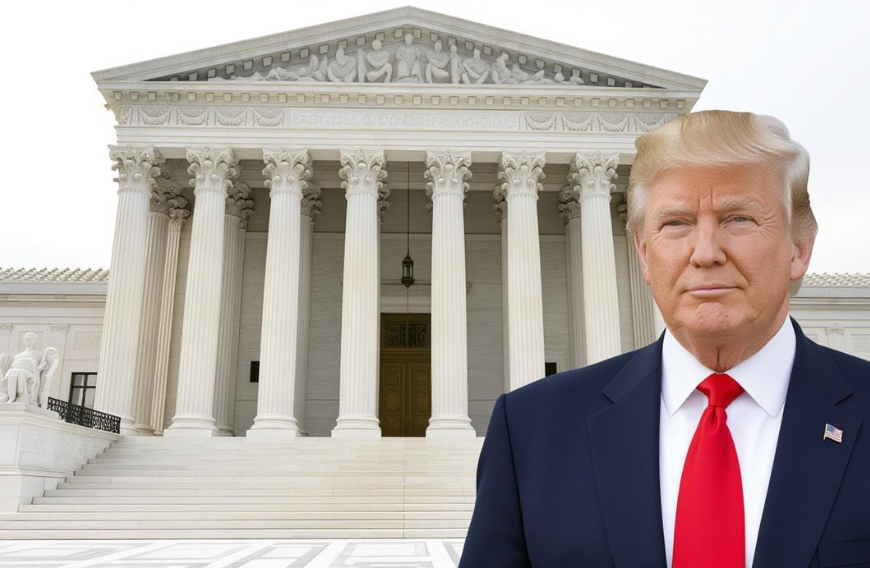
It looks like President Donald Trump may have to refund billions of dollars in tariffs if the Supreme Court does not rule in his favor. On Sunday, Treasury Secretary Scott Bessent acknowledged that the government could be forced to return tens of billions collected since the start of Trump’s second term should the Court deem the tariffs illegal.
“We would have to give a refund on about half the tariffs, which would be terrible for the Treasury,” Bessent said in an interview on NBC’s “Meet the Press.”
Pressed by anchor Kristen Welker on whether the administration was prepared to issue those refunds, Bessent replied, “If the court says it, we’d have to do it.” He added, however, that he was confident Trump would ultimately prevail in the case.
Bessent’s remarks come on the heels of two lower-court rulings that found Trump lacked authority to impose tariffs on nearly every country under a 1970s-era emergency statute, the International Emergency Economic Powers Act (IEEPA). Last week, Trump formally asked the Supreme Court to take up the case on an expedited basis and hear arguments in early November.
READ: Trump still wants to trade with India despite tariff threats? (
The administration had relied on IEEPA to justify sweeping tariffs on imports from countries including China, Mexico, and Canada, citing national security concerns tied to fentanyl trafficking and illegal immigration. But those arguments have faced stiff judicial scrutiny. The U.S. Court of Appeals for the Federal Circuit, in a 7–4 ruling, determined that the president had overstepped constitutional bounds by invoking IEEPA for trade tariffs. That decision temporarily halted enforcement while the administration appealed to the Supreme Court.
The high-stakes case underscores an enduring debate over the scope of presidential power in shaping trade policy, and the delicate balance between national security objectives and legislative oversight. The Supreme Court’s ruling will likely establish a precedent for how future administrations impose tariffs and define the boundaries of executive authority in economic matters.
So far, U.S. Customs and Border Protection has collected more than $70 billion in tariff revenue from Trump’s emergency measures. That represents less than half of the more than \$180 billion the government has taken in through August of this year.
READ: Who lost India? Trump’s tariff approach puts a generation of U.S.-India progress at risk (
The dispute, therefore, is not just about money—it represents a broader clash over governance. At its core, the case illustrates the challenge of balancing swift executive action with adherence to constitutional and statutory limits. Whatever the outcome, the Court’s decision will shape the framework for collaboration between the executive branch and Congress in safeguarding both national security and economic stability. It also marks a pivotal test of constitutional boundaries with potentially lasting consequences for U.S. trade relations and presidential power in economic affairs.
Beyond the immediate legal and fiscal stakes, the controversy carries wide-ranging geopolitical and economic implications. Because the tariffs specifically targeted major U.S. trading partners such as China, Mexico, and Canada, the case reverberates through global supply chains and sensitive diplomatic ties. Prolonged uncertainty over tariff policy could unsettle investors, complicate trade negotiations, and disrupt markets. More broadly, it highlights the growing difficulty governments face in reconciling domestic security priorities with the complexities of global commerce.
As the Supreme Court prepares to hear the case, its ruling will resonate far beyond Washington. The decision will not only shape U.S. domestic economic policy but also influence America’s role in the global trading system at a time of rising economic nationalism and shifting international alliances.