



By Soumoshree Mukherjee
Editor’s note: This article is based on insights from a podcast series. The views expressed in the podcast reflect the speakers’ perspectives and do not necessarily represent those of this publication. Readers are encouraged to explore the full podcast for additional context.
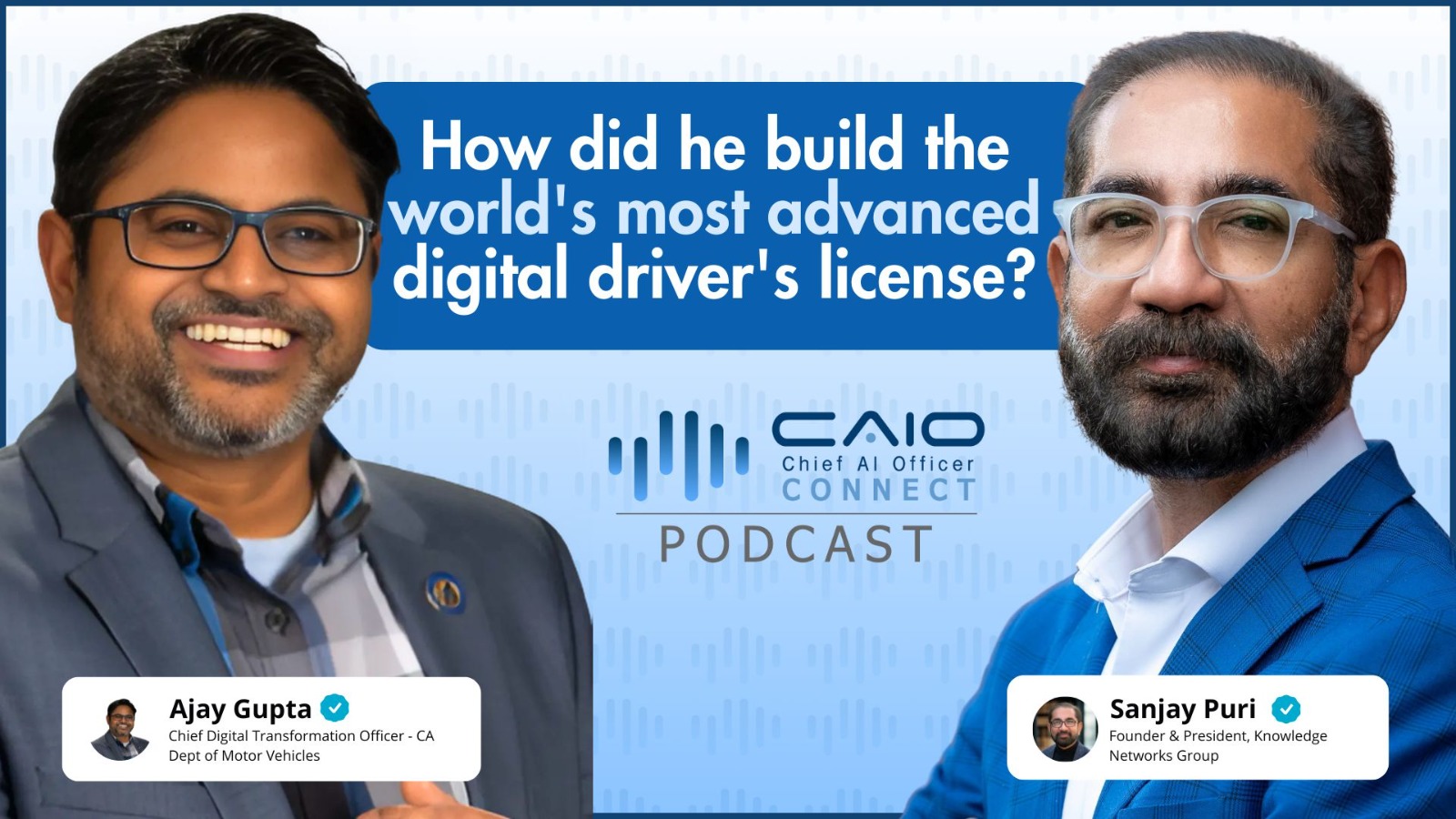
In a world where government services are often dismissed as slow and bureaucratic, California is challenging the stereotype. At the heart of this transformation is Ajay Gupta, a digital innovator who has led the integration of artificial intelligence (AI) into public services, particularly through the mobile driver’s license program. Speaking with host Sanjay Puri in a recent episode of CAIO Connect podcast, Gupta shared insights into how technology, when carefully aligned with real business problems, can radically reshape governance.
Gupta stressed at how identifying a business problem is crucial before selecting technology solutions, including AI, “we always start with business problem definition. We always start with what type of quick things and I get with the tools and technologies and processes that are available… more important thing is to stay as aware as possible the pros and the cons, the good and the bad and the ugly of the technologies that are out there.”
He emphasized that the focus should be on effective applications rather than simply adopting new tools. This principle has guided California’s rollout of AI initiatives at the Department of Motor Vehicles (DMV), where decision-making times have been cut from minutes to seconds without compromising oversight.
READ: ‘Health for all, hunger for none’: Dr. Bijoy Sagar on responsible AI in pharma and agriculture (
Gupta’s journey from private consulting to spearheading public sector digital reforms illustrates his commitment. He recalled that the rapid pace of change within California’s government demonstrates that innovation is achievable despite common perceptions of bureaucracy.
Highlighting how collaborative leadership has driven these reforms he said, “we together were able to change the pace of change, the pace of change that we wanted at the DMV and also within the state as well… we make the right decision, we take the right level of risk, but go at a pace that’s unprecedented.”
A flagship example is the mobile driver’s license, which leverages biometric technology and real-time data matching for secure identity verification. Gupta noted that identity verification is evolving to include mobile solutions that enhance accessibility and security, streamlining processes for both in-person and online services. The program has also expanded inclusivity by ensuring equitable biometric testing across diverse demographics and enabling remote issuance for people with urgent needs or disabilities.
Beyond licensing, AI has been deployed to automate specialized services. Gupta explained that hyper automation is helping technicians process requests faster and more accurately. Large Language Models (LLMs), for instance, are being used to flag profanity or culturally sensitive content. “The generative nature of the LLM that we were first interested in… with all this information of the world in it, including other languages, it was able to give us an explainable score,” he said, underscoring the balance between efficiency and accountability.
Gupta sees agentic AI as a game-changer, “With the advent of Gen AI, getting the answer, getting to the right solution that’s already available and take that particular action has been much easier.”
He defined agentic AI as an outcome-driven system capable of making autonomous decisions towards specific goals which is already being piloted in California. Specialized bots are assisting technicians, while governance guardrails ensure compliance and data security.
Yet, Gupta is cautious about hype cycles. Drawing parallels with blockchain and mobile tech, he insists on measured implementation: “When we are making the decision, every single new innovation concept that they’re bringing in, we actually start with this thing called a concept commitment. We commit to that concept in that we talk about what the cost of doing business as is, and what we believe the cost would be once we have taken a particular action.”
For Gupta, the key to sustained success lies in people as much as technology. He believes, a strong attitude paired with an aptitude for learning is critical for success in any role. “It’s really everything, but more importantly, the aptitude, to be curious, to learn, and to put in your 100 % has always been my preference for my team members,” he said, encouraging professionals to embrace adaptability, curiosity, and collaboration.
As the podcast concluded, Gupta highlighted an often-overlooked truth that some of the most impact and challenging AI work is happening in the public sector. People don’t realize it, but it is truly happening, he said, adding that California’s journey shows that when guided by thoughtful leadership, technology can turn bureaucracy into a beacon of innovation.