




From Wisconsin’s dairy heartland to India’s vast network of smallholder farms, Everse.AI is reimagining the role of artificial intelligence in one of the world’s oldest industries such as dairy and livestock. In an exclusive interview with The American Bazaar, the company’s founder Ashish Sonkusare shared how his journey from Amazon Web Services to building a bootstrapped AgriTech startup is driving innovation for farmers across India and beyond.
What began as an idea to apply high-tech solutions from industries like automotive and manufacturing to agriculture, has since evolved into a movement transforming rural livelihoods. By partnering with cooperatives like Amul and Mother Dairy, Everse.AI has developed innovations such as wearable devices for cows, the farmer-friendly CowGPT platform, and one of the world’s largest methane reduction projects.
From its base in central India—spanning Maharashtra, Chhattisgarh, Madhya Pradesh, Telangana, and Gujarat—the startup has already begun charting a path beyond regional borders. Talks are underway with states like Uttar Pradesh and Jharkhand, while international interest is quickly gathering momentum.
After showcasing its work in California and receiving an invitation to present at the UN’s Food and Agriculture Organization, Everse.AI has caught the eye of the World Bank and global climate funds, drawn by its focus on cutting greenhouse gas emissions. Within the next six months, the company plans to export its solutions from India to New Zealand, Bangladesh, the U.S., and the Netherlands, with further global expansion on the horizon in the coming years.
As the company accelerates its growth, Sonkusare is preparing to relocate to India, where most of its projects are based. At the same time, he is laying the groundwork for a U.S. presence, starting with a part-time sales and marketing hire and plans to expand once exports to the American market begin. While India remains the core focus, maintaining ties in the U.S. ensures global visibility and access to international opportunities.
The American Bazaar: Can you tell us a bit about your background and how you got into this space?
Ashish Sonkusare: I come from a technology background, specifically artificial intelligence and machine learning. My last role was with Amazon Web Services, where I worked across industries such as automotive, high tech, industrials, and manufacturing.
I live in the Wisconsin–Minnesota region, which is a global hub for the dairy and livestock industry. A couple of my friends owned farms, and as I observed the sector closely, I realized there was significant scope to bring in technology solutions. Unlike other industries, dairy and livestock haven’t seen much innovation in this area. That’s what sparked the idea of launching a startup.
Initially, our plan was to develop solutions for the U.S. dairy industry, and we even won a few competitions along the way. But things took a turn when the National Dairy Development Board (NDDB) of India visited the U.S. and learned about our work. They told us, “Why don’t you do something for the Indian market? We don’t have any solutions like this in India, and what you’ve developed could be very beneficial here.” That’s when we started working with them.
When you were asked to bring your solutions to the Indian market, did NDDB provide funding support?
No, they did not provide funding. We invested our own money, so the company has been completely bootstrapped. We have received some grants through competitions, but we haven’t raised capital from VCs or outside investors so far.
Right now, we are in that phase. We’re already in discussions with several VCs in India and globally, and we expect to secure funding soon. But for the most part, we remain self-funded. A large share of our revenue is customer-driven, which has made us profitable, and we reinvest all profits back into the business.
READ: Indian American Naureen Hassan named President of UBS Americas, CEO of UBS Americas Holding (July 12, 2022)
Do you have a personal connection with farming or the dairy sector that influenced this startup?
Yes. Even in the U.S., I had—and still have—friends in the business. Beyond that, I come from the Gwala community in Maharashtra, which traditionally keeps animals and produces milk. My grandfather still has cows and buffaloes.
Growing up, I was already familiar with that environment—being around cows, dealing with milk-related issues, and figuring out how to sell it. So while I hadn’t worked in the dairy industry professionally, I had a lot of personal exposure, which helped me connect with farmers in a meaningful way.
What is the mission of Everse.AI going forward?
There are two basic problems in the dairy industry, not just in India but worldwide.
First, farmers are not making enough money because costs have gone up while milk prices remain low. It’s important to use technology to reduce costs and improve productivity. When I say productivity, I mean the per liter milk yield per cow per day. In India, it is just six or seven liters, while countries like the U.S., Israel, and Brazil have reached 50 liters through modern practices and technologies. Our plan is to double farmers’ income every two years until they reach a good standard—about 25 to 30 liters. States like Punjab are doing well, but most others are lagging behind.
Second, as milk yield increases, the quality of milk improves, which depends on the health and nutrition of the animal. We have launched several solutions to support farmers on this front.
Alongside productivity, how is Everse.AI addressing climate change?
Climate change is driven by greenhouse gases, the most important being carbon dioxide and methane. Around 40% of methane comes from dairy and livestock animals, and there is real potential to reduce that.
We are working on some of the world’s largest projects to reduce methane emissions from cows and buffaloes. If reductions are achieved credibly with proper evidence, measurements, and audits—farmers can earn carbon credits. These credits function like currency and can be sold in international markets, creating an additional income source.
For example, if we reduce methane by 30% through interventions, we can apply for carbon credits. Farmers then receive extra income. In one project, each cow generates around 7,000 rupees per year in additional income from carbon credits. So, a farmer with five cows could earn 35,000 rupees annually just by participating.
READ: Building the future of learning: In conversation with EdTech pioneer Saurabh Saxena (September 5, 2025)
Can you share more about these methane projects?
We just signed an agreement with Amul, India’s largest dairy cooperative and the second largest in the world, and we are also working with the Maharashtra government, which oversees two crore cows and buffaloes. This is the largest project of its kind in the world.
We registered the project with Vera, a carbon registry company. It has already been validated and approved, making ours the 23rd project globally, the first in India, and the largest in the world. If you exclude New Zealand and Australia, it’s also the first of its kind across the Global South.
Through these projects, we help farmers generate additional income, either by boosting milk productivity and quality or through carbon credits while also contributing to climate action by reducing emissions from dairy animals.
Farmers often complain that much of their earnings go to middlemen. How does Everse.AI address this issue?
We work directly with farmers and dairy cooperatives. For example, cooperatives like Mother Dairy operate collection points in every village. A farmer with five cows might keep one or two liters of milk for personal use and then supply the remaining 35 liters to Mother Dairy. The cooperative collects milk from multiple farmers in the village, transports it to a district center, and then to a factory where it is processed into ice cream, paneer, cheese, butter, and other products.
We partner with cooperatives to ensure farmers get fair value. Alongside that, we also directly educate and support farmers. For instance, we launched a device often called a “Fitbit for cows,” which is worn around the animal’s neck. It tracks pregnancy cycles, health, and potential issues. With timely interventions, farmers can keep their cows healthier, which directly increases milk yield.
What other AI-based solutions have you introduced for farmers?
We have launched a range of AI-driven tools, including mobile apps that send alerts based on the data farmers input. For example, when milk production declines or a cow shows signs of sickness, the app suggests interventions.
One of our most impactful solutions is CowGPT, launched two years ago. It went viral and has won awards, including recognition from [Indian] Prime Minister [Narendra] Modi at Startup Mahakumbh. Today, more than one million farmers in Maharashtra and Gujarat use it. CowGPT works through both a mobile app and WhatsApp. Farmers can ask questions in Marathi, Hindi, or Gujarati—either by typing or recording voice messages—and receive accurate advice. The bot uses data about each cow to provide personalized insights on health, nutrition, vaccinations, and productivity. It also connects farmers to veterinary doctors when needed.
This is especially valuable in rural India, where veterinary services are scarce. Tools like CowGPT make advanced advisory services as accessible as a simple chat, teaching farmers how to better manage their animals and increase yields.
How does the Connected Cow platform and biometric ID system work?
The Connected Cow platform is both a web and mobile app, available free on iOS and Android. Farmers can register themselves and their animals, record milk yields, vaccinations, medical issues, and fertility data. If they use our devices, data is automatically integrated into the platform. Today, more than 2.2 million farmers have registered and are using it at no cost.
Biometric identification works much like Aadhaar for humans. Traditionally, cows are tagged with plastic ear tags, but those often fall off or are not used consistently. We developed a computer vision and deep learning system that uses the unique muzzle pattern of each cow like a fingerprint for animals to identify them.
India has about 350 million cows and buffaloes, and our platform can uniquely identify them all. The Government of India awarded us a contract to deploy this solution over the next seven years. It ensures accurate identification, improves record-keeping, and enables better delivery of services to farmers.
Do you plan to partner with organizations for these global expansions?
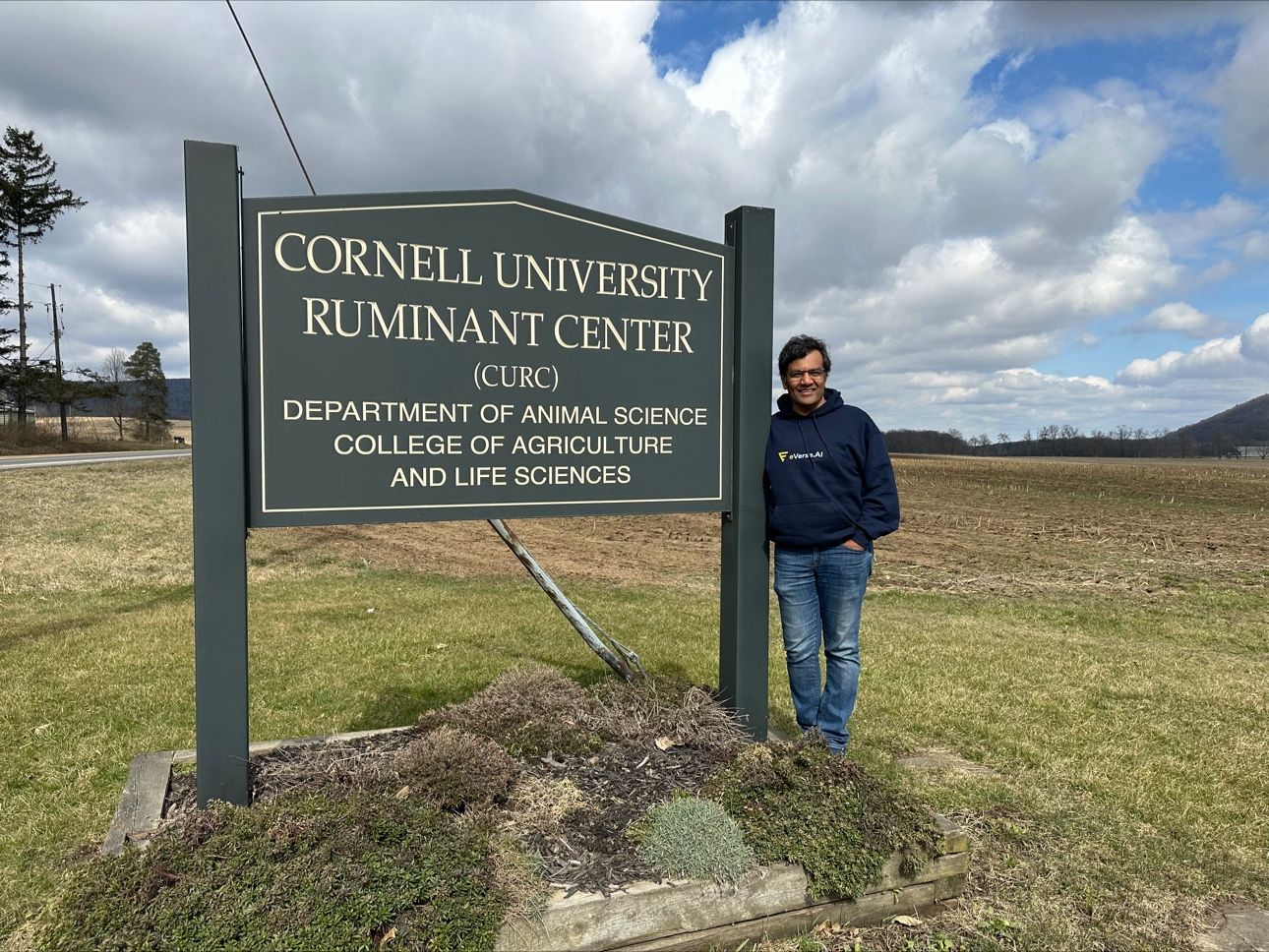
Yes. Our primary collaboration in India has been with NDDB, since it is a central government body. On the private side, we have partnered with Cornell University in the U.S., and with Indian cooperatives like Amul and Mother Dairy. These are not just partnerships but long-term customer relationships, with 15- to 20-year projects worth thousands of crores through carbon credits.
We are also working with IIT Bombay on R&D and research publications. Additionally, we have our own manufacturing facility in Nagpur, where we produce and assemble our devices.
What has been your revenue growth so far, and what are your targets?
Last year, we generated revenues of ₹3.3 crore (about $400,000) with a profit of ₹70 lakh (around $85,000). This year, we are targeting revenues of ₹16.3 crore (approximately $2 million) with a profit of ₹2 crore (about $240,000). Over the next one to two years, we project revenues of ₹200 crore (more than $24 million), driven in large part by significant income from carbon credits.
What does your team look like today? How do you manage your team in India?
We currently have about 53 people on our team in India, while I am the only one based in the U.S. Of the 53, roughly 38 are full-time employees and about 15 work part-time as consultants. Our team is spread across Nagpur, Bangalore, Hyderabad, and Gujarat, with the majority concentrated in Nagpur.
I mostly operate in the Indian time zone, supported by a strong team in India that manages our carbon projects. Next year, I plan to relocate to India once my daughter goes to college. Being on the ground will allow us to do much more, though my presence in the U.S. has been valuable as well. It has given us visibility with global players in the climate space, enabling partnerships with organizations such as the Environmental Defense Fund, Sequoia Climate Foundation, Cornell University, and the Global Methane Hub.
Who do you see as competitors in this space?
In India, we don’t have any competition because this is such a new space. Globally, there are companies in New Zealand and the U.S. working on similar areas, but they are large, established players.
Our advantage as a startup is that we have developed an innovative solution that reduces the cost of achieving outcomes by one-tenth. For example, what others achieve at $100, we can do for $10, with even better results. That cost–quality advantage has helped us gain visibility and invitations to major events and conferences worldwide.
How do you ensure data security and regulatory compliance for farmers using your platforms?
All our apps and platforms are secure and encrypted. We don’t share farmer data with outside parties. Everything remains confidential within our system.
We are fully on the Amazon Web Services ecosystem, and Indian data stays within India. Data is only shared after official approvals from cooperatives. Safeguarding farmers’ data is a top priority.
Do you see trade tensions between India and the U.S. affecting your U.S. expansion?
Yes, to some extent. Tariffs have increased device costs in the U.S., so we delayed exports. We are still working on pricing strategies. However, I see this as a temporary disruption that should normalize within six months. Long-term, it won’t affect our expansion.
Are there any upcoming product launches?
Yes. We have a pipeline of six or seven products at various stages—some already launched, others in testing or trials.
One major launch is MethaneGPT, which we will officially unveil at a United Nations conference in Rome in the coming weeks. It’s an exclusive global launch. Additionally, we recently signed an MoU with Amul for a methane reduction project, which has not yet been made public.