


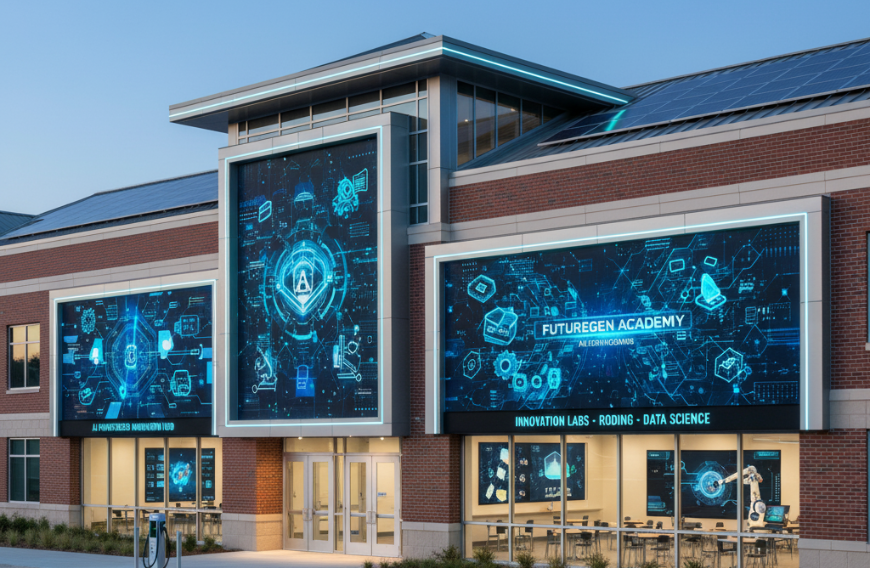
The American education system needs a desperate makeover. Our approach to educating children, which remains stubbornly rooted in 19th-century principles, has produced increasingly troubling results. American students consistently underperform their international peers across key academic metrics and our education system has not innovated in a meaningful way since the Industrial Revolution. But, the future can still be bright for our students if policymakers reimagine our education system entirely.
Today, we have an opportunity to take advantage of an unprecedented inflection point: artificial intelligence can both reform education and completely reconfigure it around the needs of individual learners rather than the constraints of industrial-age systems.

The old is still new blueprint
The modern American school system, which emerged in the mid-1800s, mirrors factory production during the industrial era: standardized curricula, age-based grade levels, batch processing of students, and rigid time schedules. This system made sense during the Industrial Revolution because the industry back then valued conformity, punctuality, and basic literacy over creativity or critical thinking. The structure favored efficiency, organizing students by age rather than ability, moving them through predetermined sequences of learning, and measuring success through standardized assessments. Teachers were akin to factory supervisors, responsible for maintaining order and ensuring uniform output.
This approach successfully transformed a largely agricultural society into an educated workforce capable of operating in increasingly complex manufacturing environments. By the early 20th century, American public education was considered a model for the world, producing the skilled labor force that powered unprecedented economic growth.
The Review by Ajay Raju: Are you prepared to live a longer and healthier life? (September 29, 2025)
The problem
What worked brilliantly in 1850 has become increasingly obsolete in the 21st century, yet the fundamental structures remain largely unchanged. Today’s classrooms still feature rows of desks facing a teacher who delivers information to passive recipients. Students still move through subjects in predetermined sequences, regardless of individual mastery levels or interests. The school day still revolves around rigid time blocks that prioritize coverage over depth of understanding. Teacher training programs continue to emphasize classroom management and curriculum delivery rather than facilitating individualized learning or fostering innovation.
Meanwhile, virtually every other sector of the economy has undergone radical transformation. Healthcare has moved from one-size-fits-all treatments to personalized medicine. Business has shifted from hierarchical command structures to collaborative networks. Technology has enabled customization and individualization across industries from entertainment to retail. Yet schools continue to operate on the assumption that all children learn the same way, at the same pace, using the same methods.
The performance crisis
The consequences of this stagnation are evident in international comparisons. The Programme for International Student Assessment (PISA), administered every three years to 15-year-old students worldwide, consistently reveals American underperformance. In the 2022 PISA results, the United States ranked 34th out of 81 countries and economies in mathematics, 16th in reading, and 21st in science. These rankings represent a continuation of mediocre performance that has persisted for decades.
The Review by Ajay Raju: Architects of mass political mobilization(September 22, 2025)
The Trends in International Mathematics and Science Study (TIMSS) tells a similar story. In 2019, American fourth-graders ranked 15th in mathematics and 8th in science among participating countries, while eighth-graders ranked 12th in mathematics and 8th in science. While these scores show some improvement from previous years, they still place the United States well behind educational leaders like Singapore, South Korea, Taiwan, and several European nations.
Perhaps most troubling is the lack of progress over time. Despite increased spending and numerous reform initiatives, American students’ performance has remained essentially flat for decades. The National Assessment of Educational Progress (NAEP), often called the “Nation’s Report Card,” shows that reading and mathematics scores for American students have barely budged since the 1970s, despite per-pupil spending more than doubling in inflation-adjusted terms.
Economic and social consequences
This educational underperformance has profound implications for American competitiveness in an AI-driven economy. The skills required for future success are rapidly shifting from routine cognitive tasks, that are now automated, to uniquely human capabilities like creativity, emotional intelligence, complex problem-solving, and adaptability. Yet our education system continues to emphasize exactly the kinds of rote learning and standardized responses that artificial intelligence can now perform more efficiently than humans.
The Review by Ajay Raju: Humanity’s meaning crisis (September 15, 2025)
The World Economic Forum predicts that 50% of all employees will need reskilling by 2026 as AI and automation reshape the job market. Students graduating from today’s industrial-age schools are fundamentally unprepared for this reality. They lack experience with AI collaboration, have limited exposure to interdisciplinary problem-solving, and often graduate without the critical thinking skills needed to work alongside intelligent machines.
An upgrade of our education system will yield significant economic benefits to the nation. According to Stanford economist Eric Hanushek, if the United States raises its students’ performance to match that of top-performing countries, we could increase GDP by $75 trillion over the next 80 years. In an AI-powered economy, these gains could be even more substantial as human capital becomes the primary differentiator between nations.
A new paradigm
The time for incremental reforms of our education system has passed. With artificial intelligence, we can create an entirely new educational paradigm. Unlike previous educational technologies that were essentially retrofitted onto existing structures, AI has the potential to eliminate the fundamental constraints that created the industrial model in the first place.
The Review by Ajay Raju: The next five years will reshape everything (September 8, 2025)
The core limitation of traditional education has always been the impossibility of providing truly individualized instruction at scale. One teacher cannot simultaneously deliver customized lessons to 25 students with different learning styles, interests, knowledge levels, and pacing needs. But AI systems can provide exactly this kind of individualization to every student simultaneously.
Modern AI tutoring systems can assess a student’s current knowledge state in real-time, identify gaps in understanding, adapt explanations to their preferred learning modality, and adjust pacing to their optimal challenge level. These systems never get tired, frustrated, or distracted. They can provide unlimited practice opportunities, instant feedback, and patient re-explanation of concepts as many times as needed.
Personalized learning
Imagine schools reimagined as innovation hubs where AI serves as the foundation for completely personalized learning experiences. Instead of age-based grade levels, students would progress through competency-based pathways tailored to their individual development. An AI learning companion would know each student’s learning history, preferences, strengths, and areas for growth – probably better than any human teacher ever could.
These AI systems would continuously analyze student interactions, identifying not just what they know but how they learn best. Some students might excel with visual representations, others with hands-on experimentation, still others with storytelling approaches. The AI would automatically adjust its teaching methods for each individual while maintaining detailed records of what works best for different types of learners.
Rather than following rigid curricula, students would pursue interest-driven projects that integrate multiple disciplines naturally. An AI system could identify connections between a student’s passion for video games and opportunities to learn programming, mathematics, art, storytelling, and psychology. It could scaffold these connections in ways that feel organic and engaging while ensuring comprehensive skill development.
Read more columns from The Review by Ajay Raju
The AI would also serve as an intelligent tutor available 24/7, capable of answering questions, providing explanations, generating practice problems, and offering encouragement. Unlike human teachers who must divide attention among many students, each learner would have access to unlimited, patient, personalized instruction precisely when they need it.
Teachers as learning architects
In this AI-powered environment, the role of human teachers would transform dramatically. Rather than serving as information deliverers and classroom managers, teachers would become learning architects, designing experiences that develop uniquely human capabilities that AI cannot replicate.
Teachers would focus on fostering creativity, emotional intelligence, ethical reasoning, and collaborative problem-solving. They would guide students in asking better questions rather than memorizing predetermined answers. They would help students develop metacognitive skills, teaching them how to learn, how to evaluate information, and how to work effectively with AI systems.
Human teachers would also serve as mentors and coaches, providing the emotional support, motivation, and guidance that AI cannot yet offer. They would help students navigate complex social dynamics, develop leadership skills, and make connections between their learning and their personal goals and values.
The teacher’s expertise would shift from content knowledge to understanding how humans learn, grow, and develop. They would interpret the rich data provided by AI systems to make informed decisions about student needs and design experiences that promote holistic development.
Immersive and experiential learning
AI-powered schools would leverage virtual and augmented reality to create immersive learning experiences impossible in traditional classrooms. Students could walk through ancient Rome, manipulate molecular structures in three-dimensional space, or collaborate with peers from around the world on real-world problems.
These immersive environments would make abstract concepts concrete and engaging. Physics students could visualize wave functions, history students could experience historical events, and literature students could explore the settings of novels they’re reading. AI would adapt these experiences to each student’s learning style and current understanding level.
Project-based learning would become the norm rather than the exception. Students might work on solving actual problems facing their communities, with AI helping them access relevant information, connect with experts, and understand the interdisciplinary nature of real-world challenges. They might collaborate with students from other schools or even other countries, breaking down the artificial isolation of traditional classrooms.
Continuous assessment and feedback
The industrial model’s reliance on periodic standardized tests could be replaced by continuous, authentic assessment integrated into the learning process. AI systems can constantly evaluate student understanding through their interactions, providing immediate feedback and adjusting instruction in real-time.
Rather than measuring recall of isolated facts, assessment would focus on students’ ability to apply knowledge, think critically, and solve complex problems. Students would receive detailed, actionable feedback on their work, with AI identifying specific areas for improvement and suggesting personalized strategies for growth. This feedback would be immediate rather than delayed, allowing students to adjust their approach while the learning is still fresh.
Portfolio-based assessment would document student growth over time, showcasing not just final products but the learning process itself. AI could analyze these portfolios to identify patterns and insights that inform future instruction and help students understand their own learning journeys.
Breaking down artificial boundaries
AI-powered education would eliminate many of the artificial boundaries that constrain traditional schools. The distinction between subjects would blur as students engage in interdisciplinary projects that reflect the interconnected nature of real-world challenges. The boundary between school and home would become more fluid, with learning continuing seamlessly across environments.
Age-based groupings would give way to flexible, purpose-driven learning communities. Students might work with peers of different ages on shared interests or complementary skills. Advanced students could serve as mentors while receiving support in their own areas of challenge.
The boundary between local and global would dissolve as students collaborate with peers worldwide, access expert knowledge from anywhere, and engage with real problems that transcend geographic limitations. AI translation capabilities would further break down language barriers, enabling truly global collaboration.
READ: Building the future of learning: In conversation with EdTech pioneer Saurabh Saxena (
Preparing students for an AI world
Perhaps most importantly, AI-powered schools would prepare students to thrive in a world where artificial intelligence is ubiquitous. Students would learn to work alongside AI systems as collaborators rather than competitors. They would understand AI’s capabilities and limitations, enabling them to leverage these tools effectively while developing uniquely human skills that remain valuable.
Students would engage in AI ethics discussions, learning to grapple with questions about privacy, bias, and the appropriate use of artificial intelligence. They would develop critical thinking skills needed to evaluate AI-generated content and make informed decisions about when and how to rely on AI assistance.
Career preparation would focus on developing skills that are likely to remain uniquely human: creativity, emotional intelligence, ethical reasoning, and the ability to work with and through others. Students would also develop meta-skills like learning how to learn, adapting to change, and thinking systemically about complex problems.
Warning: Children left behind
American education system has yet to fully embrace the AI revolution and there is ample evidence that we are not leading in AI innovation. Several countries are already experimenting with AI-powered educational approaches, potentially gaining competitive advantages over the United States. China has invested heavily in AI education platforms and is using these systems to provide personalized instruction to millions of students. Estonia has integrated AI and programming into its curriculum from elementary school onward. Finland, already known for educational innovation, is exploring how AI can support its student-centered approach to learning. Singapore has launched national initiatives to integrate AI throughout its education system while maintaining its high performance standards.
Of course, transforming American education system around AI will require overcoming significant challenges. Privacy concerns about student data must be addressed through robust security measures and transparent policies. The digital divide must be bridged to ensure equitable access to AI-powered learning tools. Teacher preparation programs must be completely reimagined to prepare educators for their new roles. Schools must invest in robust technology infrastructure and ongoing professional development to support AI integration. Regulatory frameworks will need updating to accommodate flexible, competency-based progression rather than seat-time requirements. Assessment systems must evolve beyond standardized testing to measure the complex skills students will need in an AI-powered world. Funding models may need to shift to support technology infrastructure and ongoing AI system development.
Notwithstanding these challenges, we must focus on the immense opportunities that we can unlock by making the bold decision to radically transform the education system. Early adopters are already seeing promising results from AI-powered learning platforms. Companies like Carnegie Learning and DreamBox have demonstrated that adaptive AI tutoring can significantly improve student outcomes. Schools experimenting with AI-supported personalized learning report higher engagement and achievement levels. The COVID-19 pandemic accelerated adoption of educational technology and highlighted both the possibilities and limitations of traditional approaches. Parents and students experienced firsthand how technology could enable more flexible and personalized learning, creating demand for continued innovation. It is now time to do a complete overhaul rather than spend additional effort on incremental reforms.
Last word
The choice is not between tradition and technology, but between stagnation and transformation. We must move beyond preserving past practices and become innovation centers that pioneer future approaches to human development. AI offers the opportunity to fulfill education’s fundamental promise: developing each individual’s unique potential while preparing them to contribute meaningfully to society.
Our students deserve better than an educational system designed for a world that no longer exists. They deserve schools that prepare them not just to use AI, but to shape it, direct it, and ensure it serves human flourishing. The future of American education, and perhaps American society itself, depends on our willingness to embrace this transformation.