



Back in the spring of 2018, Amar Shah wrote a Twitter (now X) thread that quickly went viral. Reacting to the backlash surrounding the character of Apu from “The Simpsons,” Shah argued that despite the stereotypes, Apu spotlighted the reality of countless kids like him — children who grew up finishing their homework behind the candy racks and smoke-stained aisles of small-town convenience stores owned by their parents.
These kids watched their immigrant parents build lives from scratch in a new country while battling loneliness, racism, and freezing winters — all at once. Describing his own childhood helping out at his father’s gas station mini-mart in rural America, Shah wrote:
“There was also the fear of working behind the counter — the fear of someone stealing candy or cigarettes and running out the door, or worse, the fear of being held up at gunpoint for a few dollars in the register.”
READ: Building the future of learning: In conversation with EdTech pioneer Saurabh Saxena (September 5, 2025)
The post became the seed for a viral Washington Post essay about his gas station life. Shah later won the Harvardwood Writers Competition for his screenplay Gas-N-Shop, based on the same experience.
While Shah’s career has since taken him far from the gritty hum of gas station life, he never lost sight of the stories hidden behind those dusty highway neon signs and the dull clink of outdated cash registers — stories of resilience, endurance, and quiet reinvention.
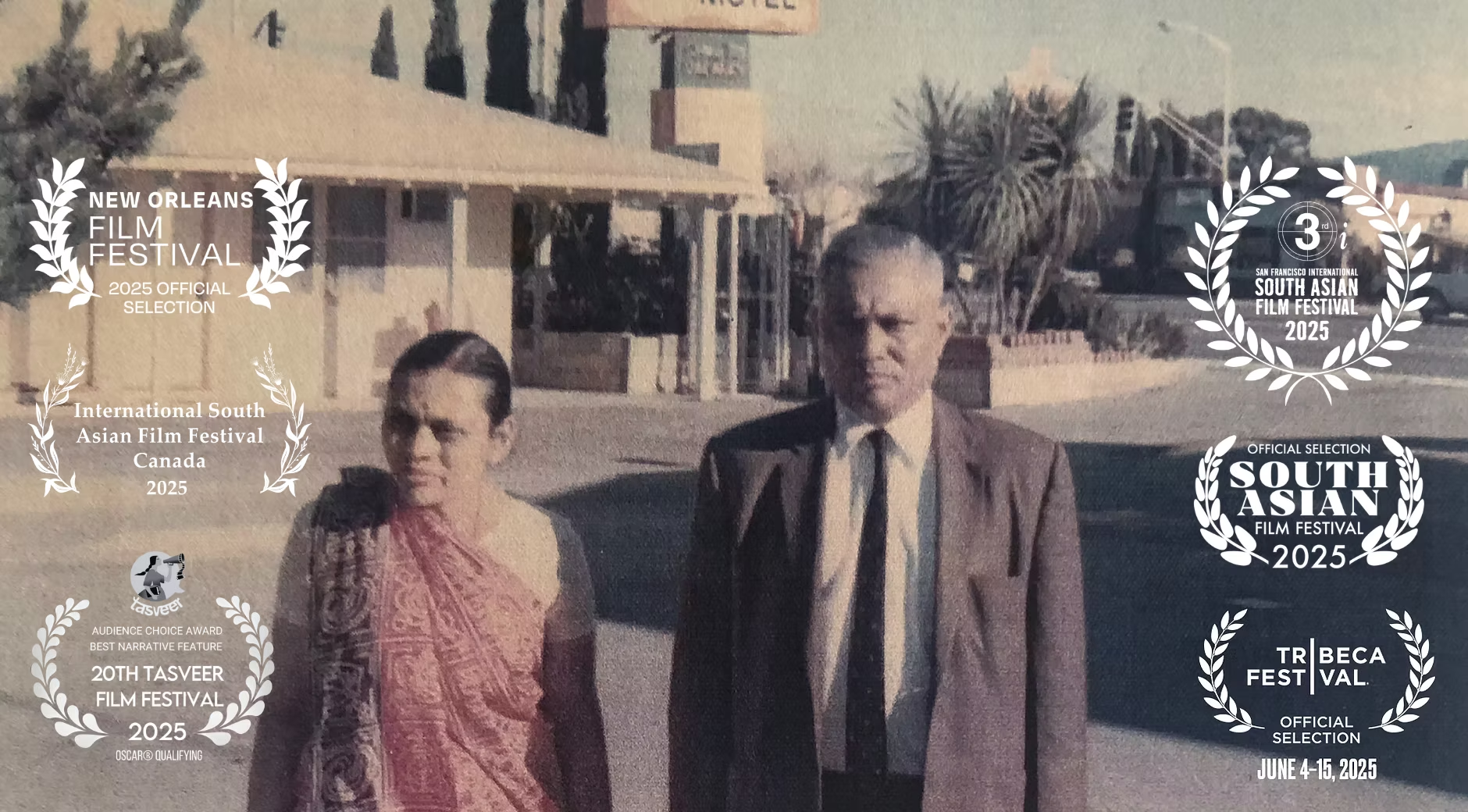
In his new short film “The Patel Motel Story,” co-directed with Rahul Rohtagi, Shah turns the lens on these untold narratives. The 13-minute docu-feature, which premiered at the Tribeca Festival in New York and is currently on the festival circuit, explores how a generation of Indian immigrants — many from small towns and coastal villages of Gujarat — quietly transformed the American hospitality landscape.
In a conversation with The American Bazaar, producer-directors Amar Shah and Rahul Rohtagi share a fascinating statistic: Indian Americans today despite being about just 1 percent of the entire population, own more than 40 percent of all motels in the United States, a legacy rooted in the determination of the earliest “Patel motel” pioneers.
Both Shah and Rohtagi had one thing in common – growing up, they saw their first-generation immigrant parents make many small and big sacrifices, working long hours just trying to find a foothold in a country they now called their home. While Rohtagi grew up in a different setting than Shah, his parents were both doctors, he confirms that across immigrant families the stories of hard work, determination and sacrifices run parallel and it was these early impressions of immigrant lives that fueled both of their passions to bring out those stories that set the framework for unprecedented success.
Talking about their inspiration for the film and how the two got together, Rohtagi says, “Both of us grew up watching, family friends and acquaintances who would have stories of their families coming from parts of India, often owning small businesses, gas stops or donut shops.” While the two were fascinated by the success stories of many Indians who came with almost nothing and went on to build businesses often starting from a small, seedy motel, the idea of turning their memories into a documentary came much later.
Rohtagi says, “Amar and I met dozens of years ago in our professional lives as directors and producers.” Amar says, “The idea of this documentary was marinating in my mind for quite some time but it wasn’t until much later that I thought of giving it life.”
Shah grew up in a world surrounded by this quite revolution. Scores of Indians, mostly from Gujarat were making America their homes, they would run small motels, face racism, their kids often grew up playing in the corridors – life was simple. While it was in 1960s that according to some records the earliest immigrants from Gujarat began coming and working in motels, it was by the 1980s when Shah was growing up that they had started owning motels.
While both Shah and Rohtagi realized that behind the hospitality empire in America was a fascinating story of how Patels built the business, the two struggled to put the pieces together. Apparently, says, Rohtagi, “The earlier arrivals were so busy building their lives, working hard trying to find a footing in America, they hardly documented anything. Also, they were so focused on survival, they scarcely knew that a history was being built.”
Back in 2021, the two decided to build the story but they knew they had to piece the story without a lot of documentation, and rely also on anecdotes. But it was a historian by the name of Mahendra K. Doshi who provided the first vital clue. Shah says, “Doshi was working on a book – ‘Surat to San Francisco’, and was documenting how the Patels from Gujarat began building the hotel empire in America with the earliest Patels arriving as early as 1940s.”
It is in Doshi’s work, that the duo also discovered the protagonist behind this revolution – a guy named Kanji Manchu Desai. Shah says, “According to many earliest records, Kanji Manchu lay the foundation of what became a multi-generational business for scores of families mostly from Gujarat.”
Shah adds, “As the story goes, Kanji Manchu came to the U.S. in the mid 1930’s from Trinidad. He worked in the fields but then went on to own the first motel ever owned by an Indian.”
Like a true visionary, Kanji Manchu doled an advice to most Indians arriving to America – lease a motel. Rohtagi says, “Kanji Manchu played such a vital role that he did not just show them the way, but at a time when racism was playing a part as many White owned motels would write ‘American owned’ on a billboard outside and no formal bank loans were being given out to the arriving Patel, Manchu helped many with handshake loans to start their first motel enterprise.”
READ: Indian American Naureen Hassan named President of UBS Americas, CEO of UBS Americas Holding (July 12, 2022)
Rohtagi adds, “As the story goes, at some point Kanji Manchu who arrived on a business visa became undocumented as he stayed way past his visa expired and presumably someone ratted him out and he had to be deported.” But the man showed the way to hundreds of families who till today have not just kept the tradition but have turned it into million-dollar enterprises.
The 13-minute documentary, the film makers say, is just a start of what can be a longer series. Shah says, “We are taking the film to festival circuits and we are open to raise the funding and turn it into a feature or even a series.” The film was screened last month at the International South Asian Film Festival of Canada. It was also shown at Tasveer South Asian Film Festival in Seattle, South Asian Film Festival of Orlando and 3rdi film festival at San Francisco.
Since then, Shah says, “A number of motel owners have come forward with their own compelling stories.” There are great stories to be told and the two cannot wait to unravel this enigmatic enterprise – one journey at a time. For Shah and Rohtagi, The Patel Motel Story isn’t just a film, it’s a reclamation of a legacy that quietly reimagined what the American dream could look like.”