



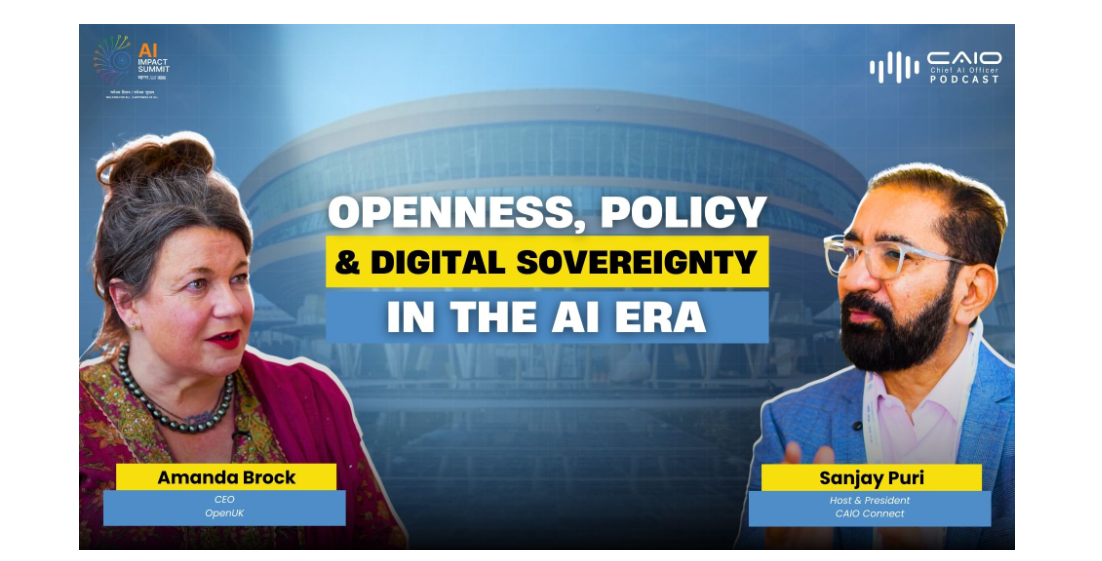
Why open source AI is about transparency — that was the central question explored when Amanda Brock, CEO of OpenUK, joined host Sanjay Puri live at the India AI Impact Summit on the “CAIO Connect” podcast. In a wide-ranging and candid discussion, Brock challenged some of the biggest assumptions policymakers and Fortune 500 executives make about AI, security, and openness.
Her message was clear, “the security issues are not about open source, the security issues are about software… they’re universal.”
Brock pushed back on the common claim that open source introduces more security risk. In her view, both open and proprietary systems contain vulnerabilities. The difference lies in visibility.
In open source environments, she explained, “We wash our dirty linen in public, right? Everybody sees when there’s a problem. There’s no doubt about it. But the response is also that many eyes make bugs shallow and the whole community gets behind fixing it. When you look at a black box situation, when you look at a closed AI of any sort, what you don’t know is what’s going wrong inside. And the obligations to make people aware of that are limited.”
Closed systems operate like black boxes. Users often have limited insight into how models function internally or how quickly vulnerabilities are disclosed. The obligation to inform customers can be slower and less transparent.
READ: How did the role of Chief AI Officer evolve? EY’s Hari Balaji on AI leadership (May 22, 2026)
A key takeaway from Brock’s conversation was that security is not a function of openness. Rather, it is a function of accountability.
Brock also reflected on why Meta’s release of Llama 2 in July 2023 marked a turning point. OpenUK partnered on the launch because it was framed as “open innovation,” though not fully open source.
Llama 2 opened model weights but not training data, and its license imposed certain restrictions. Even so, it represented a significant shift. For the first time, the broader developer community had meaningful access to a powerful large language model.
She said, “I think there are two really significant events. One of those is the release of Lama 2 as open innovation. And then the second one is the DeepSeek release on January 25.”
The reason? Open access accelerates iteration. When developers can inspect, test, and adapt models, innovation moves faster.
One of Brock’s most important clarifications was about terminology. Rather than using the phrase “open source AI,” she says, “I tend to use AI openness because it covers a multitude of sins.”
It includes model weights, training data, algorithms, and licenses. Each element can be open, partially open, or closed.
Equally critical is how something is licensed. A model may appear open, but restrictive commercial terms can significantly limit real-world use. Policymakers and business leaders must examine both what is open and how it is governed.
READ: Google DeepMind’s Owen Larter discusses trust, access and governance in the AI era (May 20, 2026)
The conversation also touched on China’s open-source trajectory. DeepSeek’s open-weight model, released under an MIT license, demonstrated how community-driven iteration can rapidly enhance performance. Within days, developers retrained versions using alternative datasets.
Brock noted that Chinese engineers tend to build lightweight, compute-efficient systems, an approach that could benefit emerging markets and the Global South, where access to large-scale compute is limited.
Smaller, edge-based models may ultimately prove more sustainable and more accessible worldwide.
Closing the conversation, she delivered a simple but powerful message to policymakers: if you want to shape AI’s future responsibly, engage directly with open-source communities.
Openness is not a slogan. It is a practice grounded in licensing, governance, and collaboration.
Brock clarifies, “I think the message is quite a simple one. Everybody is talking about open source. We need to be very clear what that means and how you do it. And you’re not going to work that out by talking to a small group of CEOs. You’re going to work that out by engaging the open source communities and their leadership across the planet.”
As Brock emphasizes, the real question is not whether AI will be open or closed. It is whether it will be transparent enough to earn trust.