



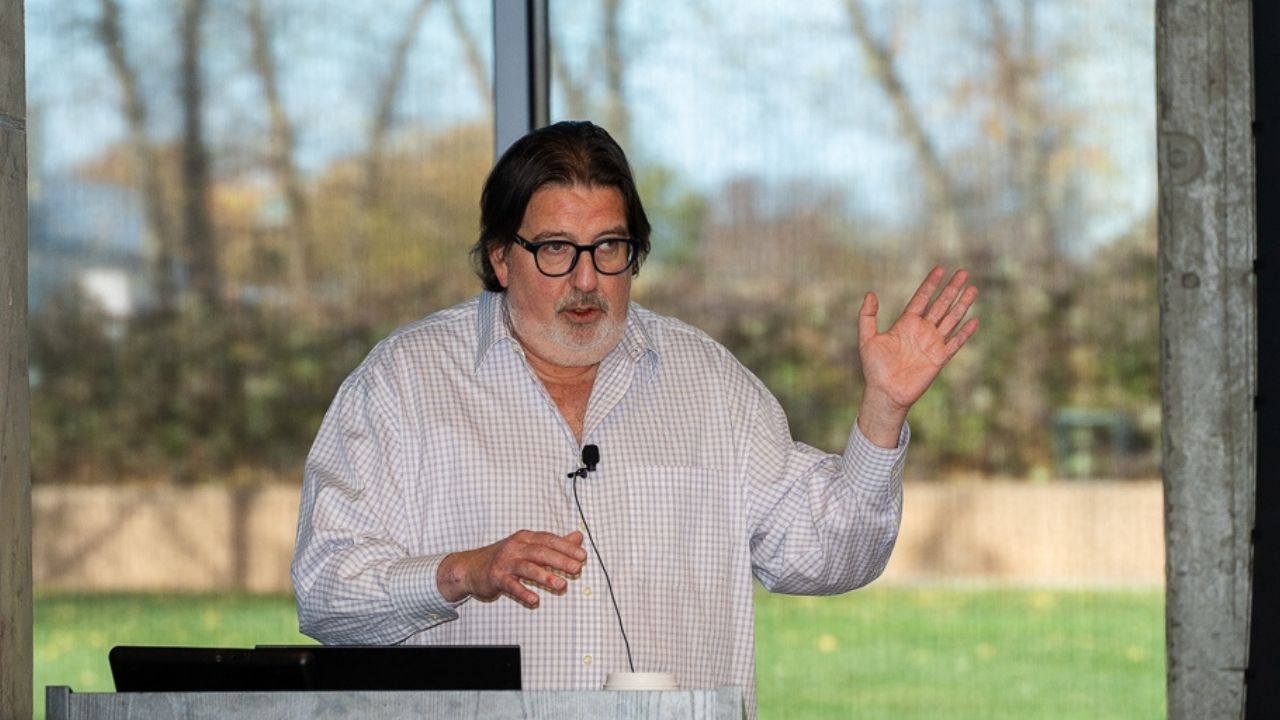
At the American Bazaar’s Leadership @ Inflection Points conference, the Brown Rudnick partner challenged leaders to stop chasing “bright shiny objects” and start uncovering the unseen assets that already hold their organization’s value.
When attorney, author, and strategist Andrew J. Sherman took the stage at the American Bazaar’s Leadership @ Inflection Points conference in Vienna, Virginia, on November 14, he didn’t start with a story about success. He started with a warning.
“An inflection point,” Sherman told the audience of executives and entrepreneurs, “is not a time to freeze, or to chase the next shiny thing. It’s a time to look within—to lift up the sofa cushion, and see what hidden coins you already have.”
That metaphor — simple but vivid — captured the essence of Sherman’s keynote address: that organizations often overlook their most valuable assets precisely when change demands clarity.
Watch the video
Sherman, a partner at Brown Rudnick LLP and a leading expert on business growth and intellectual property, framed the discussion around a deceptively complex idea: how leaders behave at moments of transformation.
Every enterprise, he said — whether a Fortune 500 company, a university, or even a football team — hits a turning point. “It’s a natural evolution,” he said. “The question is not if the inflection point comes, but how leaders respond when it does.”
READ: ‘It’s not how you start, it’s how you finish’: Inside a C-Suite conversation with Charles Mann and Anjali Ramakumaran (November 20, 2025)
Too often, he noted, leaders become paralyzed, struck by what he called “deer-in-the-headlights syndrome,” frozen in indecision until opportunity passes them by. Others mistake motion for progress, “spending money on consultants and transformation plans, but not actually moving even three feet.”
The wiser path, Sherman suggested, begins not with chasing external fixes but with inventorying internal strength — a practice most organizations fail to do.
Hidden wealth beneath the surface
In his talk, Sherman drew on ideas from his influential book Harvesting Intangible Assets, which explores how companies can unlock the unseen value in their intellectual property, systems, and culture.
Most companies, he said, can tell you “exactly how many desks and chairs and laptops they have.” Yet few can quantify their intangible assets — their data, processes, customer relationships, distribution networks, or brand equity.
“We’re still living in the 1950s when it comes to accounting,” Sherman said. “Look at public companies today. The physical assets on their balance sheets are a fraction of their market value.”
He cited Nvidia as an example. The chipmaker’s market capitalization recently surpassed $4 trillion, yet, Sherman observed, “maybe half a trillion of that is in physical assets. That means three and a half trillion dollars of value isn’t accounted for on the balance sheet — except under ‘goodwill.’”
What was once a rounding error in the 1980s, he explained, now represents as much as 88 percent of enterprise value. In 1975, tangible assets made up about 83 percent of corporate value; today, intangible assets account for nearly nine-tenths.
The danger of “Bright Shiny Object Syndrome”
Sherman warned that organizations often chase new ventures or technologies — “the bright shiny objects” — instead of looking inward at what’s already working.
He recalled advice from a fishing guide during a trip to Canada with his son: “Don’t leave fish to find fish.”
“In business,” Sherman said, “leaders leave what’s working to chase the next big thing — when the real opportunities are right there under their nose.”
The couch-cushion metaphor captured this perfectly. “Yes, when you lift it up, you’ll find some Cheerios and dust,” he joked. “But you’ll also find coins. Those coins are your hidden assets — things you already own but haven’t leveraged.”
For Sherman, the challenge isn’t lack of innovation, but lack of awareness. “Too many leaders are surrounded by people saying, ‘We’re great, we just need small changes.’ But what if the assets you need are already there — you’re just not managing them?”
From “goodwill” to global value
Sherman recounted a story from early in his legal career in the 1980s, when he was working on a $500,000 business acquisition and noticed the math didn’t add up — the tangible assets totaled only $490,000.
Panicked, he went to his senior partner, who told him simply to “add a line item called goodwill.”
Sherman’s keynote at Leadership @ Inflection Points set the tone for the conference — a day devoted to examining how leaders navigate change. His challenge to the room was both practical and philosophical: in an era obsessed with disruption, true innovation might not lie in the next big thing, but in recognizing the quiet power of what we already have.
“I had never heard of the word except from the charity that picks up used clothes,” he said, laughing. “But that $10,000 represented brand, reputation, culture — all the things that didn’t fit neatly into accounting categories. Today, that’s where the real value lies.”
Lessons from Walmart — and the Munchkin Effect
As a longtime advisor to Fortune 500 companies, Sherman shared anecdotes from his work with Walmart, a company whose supply chain and distribution system he called “a treasure chest of intangible value.”
“I once showed them how they could create $50 or $100 million in new revenue through underutilized assets,” he said. “They told me, ‘That’s like a fly on an elephant’s rear end — we only get excited when the number starts with a B.’ But from a shareholder perspective, that’s still real value. If you don’t use it, someone else will.”
To illustrate how small, overlooked ideas can generate immense returns, Sherman invoked the story of Dunkin’ Donuts’ “Munchkins.”
“For years, the holes from the doughnut machine were just thrown away,” he said. “Then someone asked, ‘Why not sell them?’ And now it’s a hugely profitable product — made from what was once trash.”
He challenged the audience: “What’s the ‘Dunkin’ Munchkin’ in your organization? I guarantee you have one — probably several.”
A $40 trillion blind spot
Sherman argued that poor management of intangible assets has become a global issue — one that wastes enormous potential wealth.
He cited estimates suggesting $40 trillion worth of unused or underutilized intangible assets worldwide — ideas, technologies, and systems that languish in archives, academic labs, and corporate backrooms.
“Whether you’re in government, academia, or the private sector,” he said, “we waste resources and innovation because we don’t know what we have.”
The problem extends to universities and research institutions. “Stanford converts about 5% of its R&D spending into income,” Sherman noted. “At the University of Maryland, where I teach, it’s 0.75%. That means for every $100 spent, the return is 75 cents. That’s embarrassing.”
He called for stronger partnerships between entrepreneurs and academics to commercialize discoveries that otherwise sit idle. “If professors are too busy being academics, that’s fine,” he said, “but let entrepreneurs in to build something with those ideas.”
The real work of leadership
Throughout his address, Sherman returned to a central message: that inflection points are not moments for panic or reckless reinvention — they are invitations to reflection and reinvention from within.
“Inflection points,” he said, “are not a time for the deer-in-the-headlights syndrome, or for the hamster-on-a-wheel response, or to spend a fortune on consultants. They’re a time to ask: What assets do we already have that could create new revenue, new markets, new opportunities?”
His message struck a chord with the audience of founders, executives, and innovators — many of whom are navigating their own organizational crossroads in a rapidly changing economy.
“The assets already exist,” Sherman concluded. “They’re just under your seat, under the sofa cushion. The question is: are you willing to look?”
The event was curated by Rohit Tripathi.