



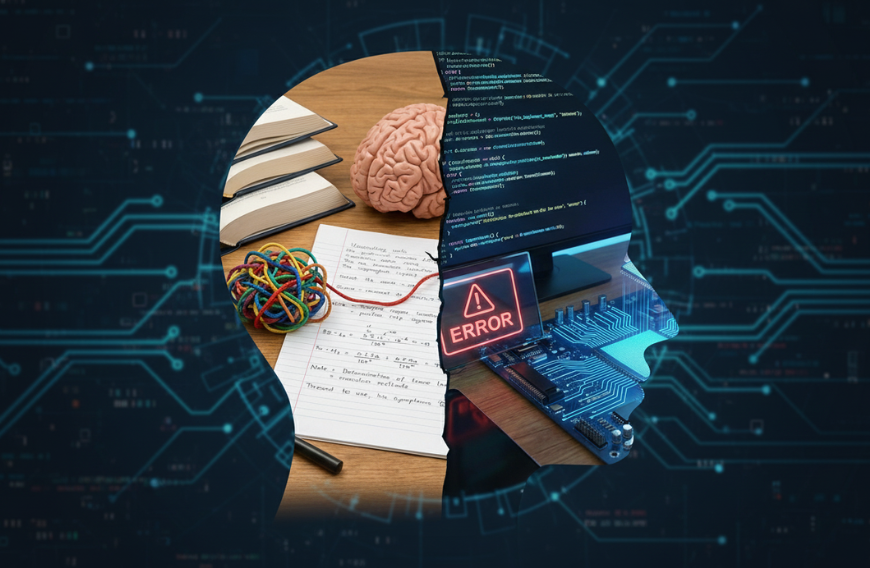
It’s the end of the year, and the time we hit rewind to reflect on successes, failures, and regrets. But sometimes that reflection gets stuck in replay, and we ruminate on the negative in never-ending cycles. If we were to ask AI to review our year, it would approach the same events differently, offering a more contained, structured assessment.
A “loop” is the pattern by which past decisions are reviewed, reinforced, or corrected. The process is very different for humans and machines. Machines have externally imposed boundaries, and we can have boundaries, but often don’t apply them to reflection.
What might we learn from this difference?
In Humans vs. AI: Thinking in epochs (Part 1), we looked at epochs as a span of time in which a stable set of conditions shapes decisions. If an epoch is the period in which decisions are made, a loop is the way a mind or system returns to prior experience (an epoch) to shape what comes next by updating understanding through intentional review. Loops operate within minds, between people, and across systems. When reflection lacks structure, those loops remain open, risking that we spin into rumination rather than learning.
Triggers hijack the loop
We have all sent a text that was met with silence. That pause can trigger a loop: “Did I say too much? Maybe I’m not important. Did they even get it? This is how it always goes.” The mind does not wait for evidence; it reacts. One delayed reply can rapidly harden into a story about worth, belonging, or rejection.
At that point, the looping human brain is not trying nor even able to learn. It is trying to protect the self from uncertainty and defending our own version of reality.
A machine would register the same delay without urgency or emotion. It would log the response time, compare it to prior patterns, and withhold judgment until more information arrived. The silence would also register, but as a signal to be analyzed without emotional noise.
That contrast is uncomfortable because it exposes something human: we do not just process signals, we personalize them. Our loops activate not when information is wrong, but when identity feels threatened. Until we learn to pause our emotional triggers the way machines pause their updates, we risk getting stuck in the endless “what if” loops.
Potarazu and Knoop: Humans vs. AI: Thinking in epochs (Part 1) (
Open and closed loops
Neuroscience explains why our spiraling loops feel so compelling but often unproductive. Unstructured repetitive thought disproportionately activates a part of the brain called the default mode network (DMN), a system associated with inward narrative, emotional amplification, and anxiety. In the DMN, the past is not processed as information but as a threat. Because there is no resolution to the trigger, the loop remains open, feeding itself rather than updating understanding.
In machine learning, a loop is deliberately bounded. The system revisits prior data, measures errors, adjusts parameters, and moves forward. There is no attachment to being right and no identity at stake. Each loop exists for one purpose: updating performance.
This distinction matters because the issue is not the loop itself but its structure. Loops that are bounded and update-driven lead to learning if the underlying algorithms are sound.
The lesson is not that humans should think like machines, but that learning improves when reflection has boundaries and an endpoint.
Reels on repeat
In humans, loops often begin as momentary reactions or habits; they become loops only when the same interpretation is replayed without updating what comes next or reconsidering what comes before.
In the age of social media, many of our cognitive loops are framed against what is essentially someone’s highlight reel—so our loops are not just open, they are literally fed with infinite content. We are repeatedly exposed to the most curated moments of other people’s lives, such as promotions, vacations, and celebrations. When our internal loops replay this contrast, reflection turns into comparison. As we explored in our earlier work on the R-code—rationality, rationale, and rationalization—these moments are when emotional self-protection can override accurate interpretation.
The mind shudders from asking “what is relevant to why am I not so lucky?” Over time, these comparison-based loops can foster shame, fear of inadequacy, and a sense of loneliness, not because our lives are lacking, but because we are measuring them against an image rather than a complete narrative.
Research in psychology and neuroscience shows that these social comparisons are associated with increased self-rumination and negative emotions, reinforcing loops that amplify anxiety rather than insight.
When loops collide
As we get older, our loops don’t just evolve; they collide with others’, as changing priorities alter how we communicate, show care, and set boundaries. How we resolve those collisions determines whether relationships adapt or slowly break down. When these loops collide, misunderstanding follows. A parent notices fewer calls and feels triggered: “we’re drifting, something is wrong.”
The response is to reach out more, ask more questions, and press for reassurance. The child, experiencing this as an intrusion, pulls back further. Both sides are acting logically within their own loop, yet the interaction produces distance.
An AI-style loop would detect the changed baseline and update the rule for connection. Humans often don’t, because we interpret reduced contact through the emotional lens. We loop on what closeness used to look like, not on what it has become.
In a broader sense, this helps explain why family estrangement and adult loneliness have become more visible, not as failures of care, but as signals that relational loops may not have kept pace with change. AI offers a lesson here where systems improve when they periodically retrain, incorporating new data rather than relying on outdated assumptions. Human relationships can benefit from the same openness by revisiting the past with context, allowing roles to evolve, and designing loops that foster connection rather than repetition as families move through different epochs together.
Visibility vs. Output: Competing work loops
Similarly, many leaders came of age in work loops where commitment was demonstrated through visibility. You stayed late, answered emails immediately, and equated responsiveness with reliability. Opportunity flowed through proximity.
Younger employees often operate in a different loop. Productivity is measured by output, not by being seen. Focused blocks of work, delayed responses, and flexible hours are not signs of disengagement for more recent generations. Silence often means work is getting done.
Potarazu and Knoop: Reclaiming agency before becoming semi-conscious humans (
A manager might notice slower email replies and assume a decline in commitment. The response is tighter oversight and informal check-ins, an informal pressure to “be available.” The employee experiences mistrust and disengages further. Each side reinforces the very pattern they fear. Again, the issue is not motivation, but an outdated loop running in a changed environment.
As the year ends and we pause to reflect, it becomes harder to ignore the loops that guide our choices, our relationships, and even our sense of self. Too often, we replay moments through old patterns and call it reflection, even as those same unexamined loops reinforce distance, misunderstanding, and frustration.
If we want better outcomes, we must learn to update our loops intentionally, to recognize when they no longer fit the context of our lives, our children, our workplaces, and even our democracies. The solution is not to suppress emotion or erase the past, but to create disciplined moments of review, observing patterns without judgment, adjusting expectations, and letting go of what no longer serves us. When you feel an emotion in an interaction, ask: Is this a moment, a habit, a reaction, or a loop?
Imagine entering the next chapter with loops that support connection rather than conflict, growth rather than repetition, insight rather than rumination. When the reference point becomes a highlight reel instead of a whole story, the loop no longer guides growth but gets us lost.
Writing our own code
At a human level, the discipline we borrow from machines is not emotional detachment but a methodical process.
Machines learn by revisiting the past with discipline; we can learn to do that too — preemptively. Put another way, we can write our “code” by deciding, in advance, how we will respond when a loop is triggered. When that moment comes, three questions can help:
First, how will we slow the emotional surge before it hijacks the loop (the inner storm)?
Second, what evidence will we trust (the anchor)? What will guide our interpretation? What core values will guide interpretation (the compass)? What signal did we underweight, and what noise distracted us? Are we using rules from an earlier period of our lives, careers, or relationships?
Finally, what are we trying to learn? Is this a pattern or an exception? What is consistent across similar situations?
Algorithms bound machines. Humans are bound—when they are healthy—by other humans. Who are your humans?
Sreedhar Potarazu, MD, MBA, is an ophthalmologist, healthcare entrepreneur and author with more than two decades of experience at the intersection of medicine, business, and technology.
Carin Isabel Knoop founded and leads the Case Research & Writing Group at Harvard Business School and is an author whose work focuses on human behavior, leadership, and organizational life. She is the co-author of Compassionate Management of Mental Health in the Modern Workplace (Springer).