



By Soumoshree Mukherjee
Editor’s note: This article is based on insights from a podcast series. The views expressed in the podcast reflect the speakers’ perspectives and do not necessarily represent those of this publication. Readers are encouraged to explore the full podcast for additional context.
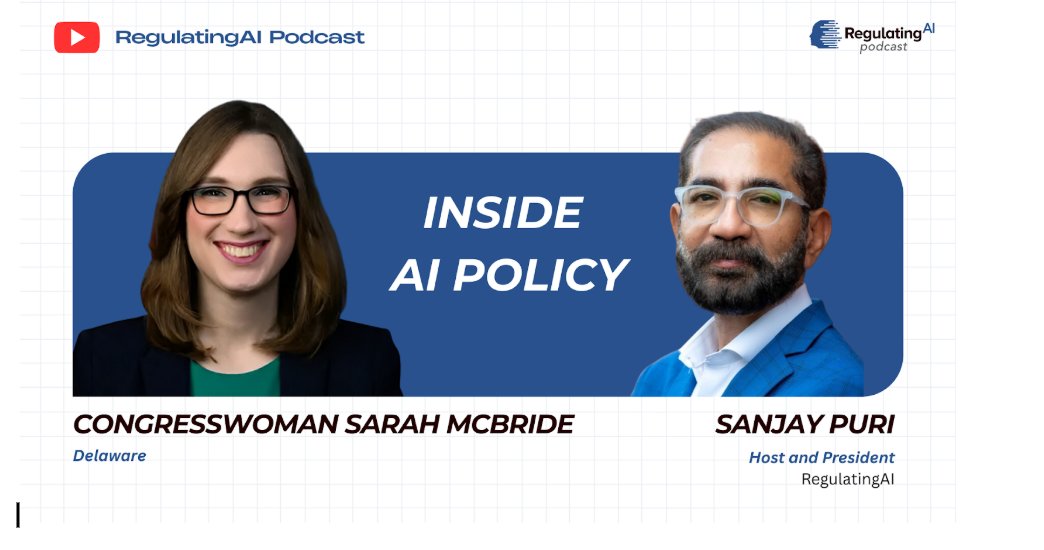
In a recent “RegulatingAI Podcast” conversation hosted by Sanjay Puri, Congresswoman Sarah McBride offered one of the most grounded and forward-looking perspectives on how the U.S. should shape the future of AI. Their discussion tackled some of the most urgent questions in AI governance—from regulation and innovation to workforce impact and global competition.
McBride emphasized the need for a regulatory framework that is protective yet innovation-friendly. In her words, the U.S. must pursue a “Goldilocks solution”—rules strong enough to provide guardrails but not so restrictive that they slow down American competitiveness.
She stressed that AI governance must remain human-centered, a departure from what she viewed as previous policies that prioritized corporate interests over people. McBride also made a strong case for federal leadership, noting that a patchwork of state regulations can harm small businesses and emerging innovators. Still, she acknowledged that states like Delaware should retain the ability to act when federal action falls short.
Read: Steve Wilson on building real value in the age of intelligent enterprises (
A major theme in the discussion was the challenge small businesses face when adopting AI. McBride highlighted how AI integration is capital-intensive, often placing smaller players at a disadvantage. She believes the U.S. government should use its spending power and funding programs to level the playing field.
Institutions like NIST and the National Science Foundation are critical to this mission. McBride underscored the need to protect and fully fund these agencies, as they fuel research, innovation, and public-good technology. She also sees significant potential for bipartisan cooperation, especially in healthcare, education, and regulatory safeguards.
According to McBride, AI isn’t just a technological competition—it’s a value competition. She framed AI leadership as central to the global struggle between democracy and authoritarianism. If democratic nations lead, AI can be built around privacy, fairness, and accountability. If authoritarian regimes set the standards, AI risks becoming a tool of surveillance and control.
McBride also pointed to the EU as a “laboratory of democracy” in AI, offering a place for the U.S. to learn—adopting what works and discarding overly burdensome rules.
READ: Armenia’s finance minister on using AI to drive economic growth (
McBride called for a realistic and people-first understanding of AI’s impact on jobs. AI should enhance human abilities, especially in high-stakes decisions, not replace workers entirely. But she also warned of widening inequality and the potential displacement of white-collar roles.
This shift, she argued, demands serious policy conversations—from strengthening the social safety net to exploring Universal Basic Income (UBI) and portable benefits.
AI offers major opportunities to make the government more efficient by reducing delays and clearing backlogs. However, McBride drew a clear line: AI must never make high-stakes decisions alone. Areas like criminal justice, immigration, or public benefits require human judgment to avoid bias and harmful outcomes.
Finally, McBride highlighted how Delaware’s small size gives it a unique advantage. Leaders can easily bring together businesses, consumers, and innovators to shape policy and create regulatory sandboxes that encourage responsible experimentation.