



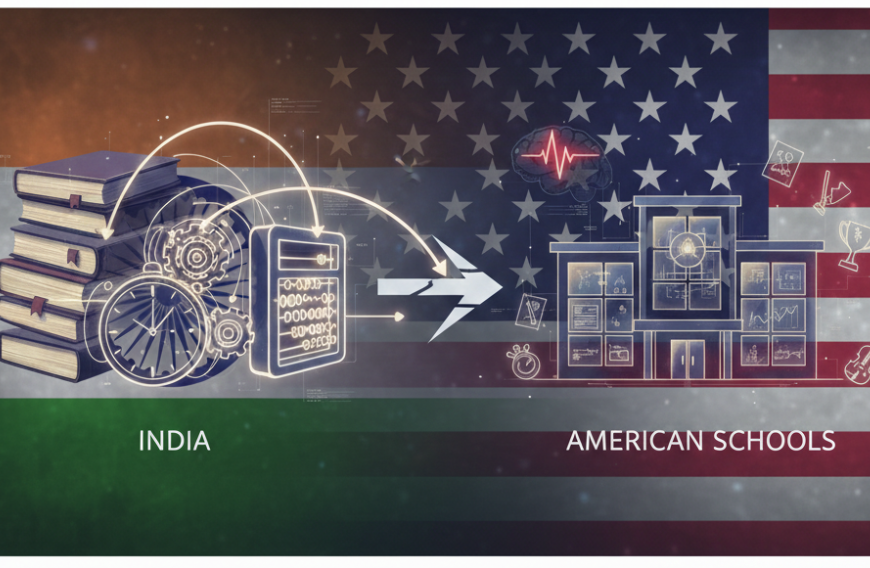
From being thrown of the bus to bussing
The bus has always been a universal symbol of one’s place in society especially in the days of desegregation in schools. The bus is where a country admits who belongs and who does not. It was where Rosa Parks staged her historic protest.
My father was thrown off buses in Washington DC for not being white. I was put on a bus and sent to an all-Black high school in the name of desegregation in the ‘70’s. The idea then was to merge black and non -black children into a common forum. Most people in my school did not know where India was and assumed we lived in a “teepee”.
Many Indians, now, in the US are not familiar with the challenges of race decades from decades ago. Despite those struggles, the Indian diaspora has endured and excelled in most areas of professional life. Most people know where India is now and no longer think we live in teepees.
Our success has not been silent by any means. And now maybe so much so that there is a sense of resentment or anxiety created by that integration later that’s starting to show up in schools decades later.
Sreedhar Potarazu: Healthcare cracking, lawmakers scrambling, consumers falling: The demise of US healthcare as we know it (January 30, 2026)
Do White kids resent Indian kids?
Helen Andrews, a conservative writer recently put the tension plainly in a tweet
“Asian immigrants are often openly contemptuous of American education norms-like that Vivek tweet—because they think the only reason someone would opt out of grind culture is because they’re lazy and stupid. Actually, American education is traditionally quite demanding, it just tells you to find your passion first and then push yourself to the limit of your talents, as opposed to indiscriminately maximizing test scores and then picking a high-status career. Personally I think our way yields better results, but grind culture is absolutely going to kill it off soon if immigration continues.”
What makes her observation uncomfortable is not the politics but the reality of the tension that we are not aware of. She isn’t accusing Indian (Asian) students of working too hard; she’s pointing out that when one culture treats effort as an end in itself and another treats effort as a means toward self-development, coexistence becomes unstable. Indians may see Americans’ interest in exploration as laziness; Americans may see relentless grit by Indians as obsessive and narrowly focused.
It’s no secret that Indian homes tend to focus on hard work with very little room for play, not because pleasure is unimportant, but because it is deferred. In an Indian household sitting idle is considered a waste of time, especially since the children of their friends may be high achievers. The Indian mindset is straightforward: work first, secure your future, enjoy life later. Delay gratification.
American homes also care deeply about academics, but they deliberately pair schoolwork with sports, music, clubs, and independence. Athletics in this country isn’t optional or ornamental; it’s considered a vital part of the childhood experience. Band, theater, debate, summer camps- these are seen as essential to growing up, not distractions from success.
Indian parents also allow these activities, but almost never if they threaten academic performance and more for resume building than emotional maturity. There is always a line, and academics almost always come first. There is of course nothing wrong with this but for Indian parents, and perhaps other cultures as well, there is a relentless pursuit of perfection and academics at all cost. It’s the “grind” culture.
The grind
For uncles and aunties, “grinding” meant crushing spices or rice by hand, the literal labor of daily chores. For professionals, it means working hard, paying dues, putting in the hours. For people on the street, it means something “else” entirely. The modern phrase grind culture is none of those things.
It refers to a belief system where constant effort, constant productivity, and constant optimization are treated not as tools, but as virtues in themselves. Rest becomes weakness and anything that doesn’t translate into measurable output is suspect.
Go to any Indian social event and the first question you are asked is about where your kids are studying, where they are working and what they have accomplished.
That mindset didn’t come from Indian or American classrooms. It emerged from a modern mix of credential worship, hyper-competition, and a constant fear of falling behind.
Indian households absorbed it easily because many parents came from places where effort was survival and failure carried real consequences. When you grow up believing there is no safety net, you don’t experiment “you grind”.
Sreedhar Potarazu: AI sovereignty race: US and China lead, India watches (
Letting go
Those differences show up most clearly around the independence we give our kids. Indian parents are reluctant to give up that independence quickly for fear of being distracted by “bad company” and being “influenced”. Sleep-away camps, co-ed dorms, living together before marriage are ordinary milestones in American life but not widely accepted in Indian households.
In Indian homes, especially among families newly arrived, these situations trigger anxiety. And kids are kept under close watch. But this does not always produce adults who are comfortable navigating social uncertainty, ambiguity, or independence. American kids often pick up street smarts early. They learn how to deal with different personalities, handle conflict, recover from mistakes, and figure things out without adults hovering.
Many American children often grow up in a family structure, with a single parent, that is not as we knew it decades ago and is quickly evaporating.
Indian kids, on the other hand, are usually very strong academically but are weaker in navigating problems of everyday life that affect those less fortunate. They know how to study, follow rules, and succeed in structured school settings. What they get less practice with is navigating situations where there are no clear instructions or right answers. These are different kinds of skills, and when schools reward only book smarts, kids who excel academically can still struggle when life gets unpredictable.
To be clear there are many families that have assimilated these cultural differences very well and are an example to be emulated.
Resegregation
Indian students now cluster with other Indians, not out of hostility, but out of sheer numbers and familiarity. When I was in high school, that option didn’t exist. I was the only Indian kid in an all-Black school. There was no cultural safe place and no one who shared my background.
I had to learn how to come home smelling like weed even when I was not smoking it. I didn’t learn how to assimilate with black kids in a textbook, it was a lived experience.
When people talk about re-segregation now, they don’t mean court orders or forced busing. They mean the preference of families quietly deciding that certain schools feel too intense because of the Indians raising the bar too high.
As Indian parents often obsess over competitions like spelling bees, math Olympiads, science fairs, internships, there is a silent wave of anxiety and fear being created that we may not be aware of.
These are visible, measurable markers of success, and children are drilled relentlessly to excel at them. But winning a spelling bee does not teach a kid how to handle a family crisis, deal with peer pressure, navigate failure, or manage an unexpected setback. If schools become dominated by a single definition of success grades, scores, rankings then everything else is pushed to the side and it is making others resent it.
Sreedhar Potarazu: What it will take for doctors to transform US healthcare in a widening gap (
The need for balance
There is another side, of course, to this crisis. American kids and their parents also don’t have the luxury of staying in their comfort zones. The country’s identity is changing, and schools reflect that change. To thrive, they have to learn to navigate a mix of cultures, expectations, and values to assimilate in the sense of understanding the new fabric of American society. There is no running away. That is what it means to be American today.
By 2037, projections show that non-Hispanic whites will no longer be the majority in the United States. The new norm will be a country where Asian, Hispanic, Black, and multiracial populations form the majority of children in classrooms.
The minority in the next generation won’t just be defined by skin color, it will be defined by adaptability, by who can function socially, academically, and culturally in this increasingly diverse environment. Those who cling only to old definitions of success risk being left behind, not just socially, but in shaping the country itself.
What Indian and American kids can learn from each other is simple but often overlooked. Hard work and academic success matter- no one can deny that. But so do life skills, knowing how to handle failure, mental health struggles, conflict, and unexpected crises with perspective and resilience.
American students can teach the value of independence, creativity, and adaptability, while Indian students can teach the discipline, focus, and persistence that comes from generations of effort.
The real opportunity lies in blending the best of both: a child who studies diligently, but also knows how to navigate life’s uncertainties; a student who strives for excellence, but understands that character, empathy, and judgment matter as much as test scores.
That synthesis, an Indian-American approach to growing up, is what will prepare the next generation not just to succeed, but to thrive in a world that demands both intelligence and wisdom.