



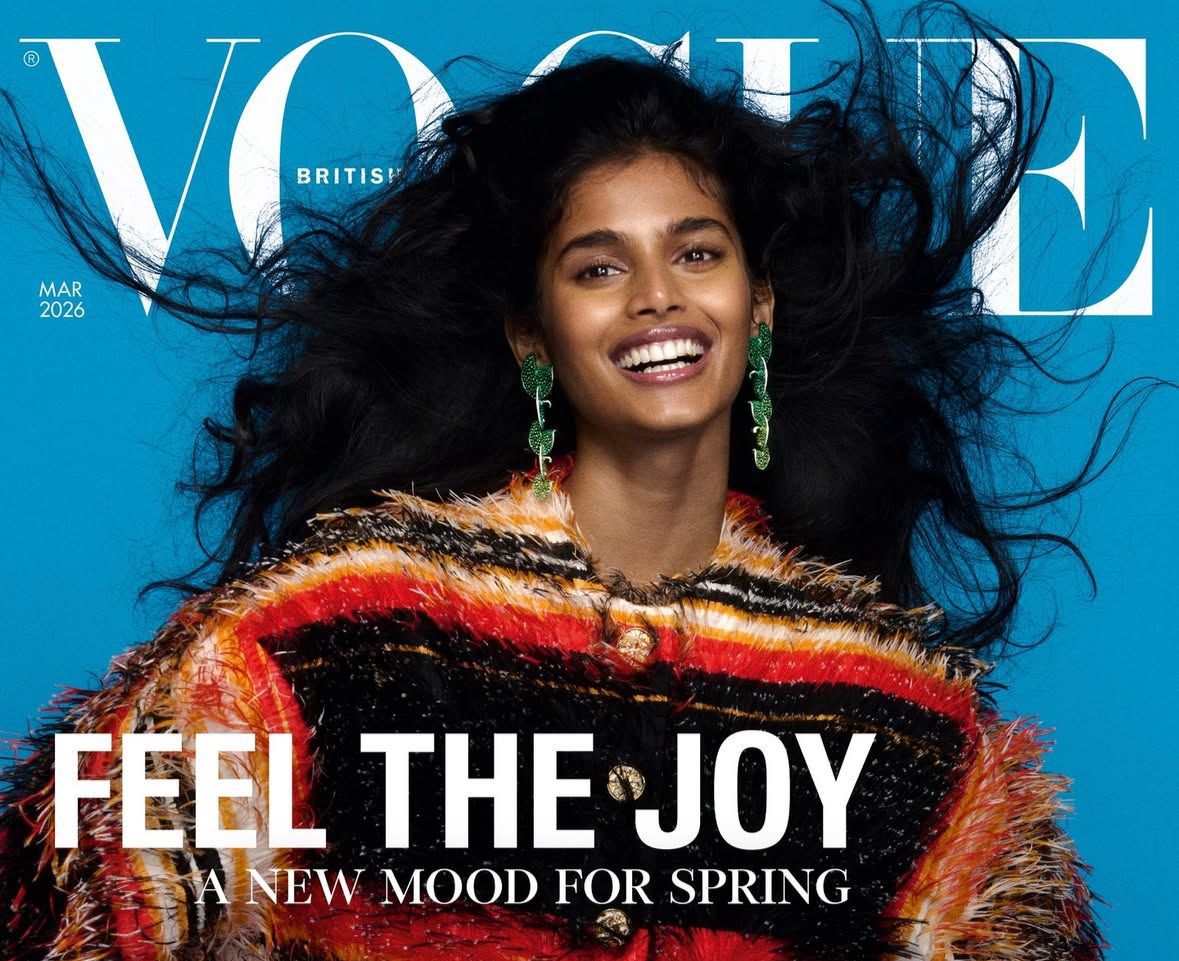
Indian model Bhavitha Mandava is drawing international attention after making history in 2025 as the first Indian woman to open a show for Chanel at its Métiers d’Art Show 2026. The milestone moment put her firmly on the global fashion map.
Now, Mandava is back in the spotlight for a different reason. In a recent conversation with British Vogue during her cover shoot, she spoke candidly about colorism in India, sharing her personal experiences and calling out the deep-rooted bias around skin tone that continues to shape the country’s beauty standards.
Asked what it meant to become the first South Asian model to open a Chanel show, Mandava admitted the moment still feels surreal. “I just never thought this could be a reality. So I’m quite overwhelmed in a nice way,” she said, reflecting on the scale of the achievement and what it represents for broader South Asian visibility in luxury fashion.
But she also noted that the milestone sparked a complicated online reaction. “For me, opening the Chanel show, open this discourse of who is considered beautiful. The Internet was divided into two where one of them didn’t even realize Indian women are beautiful. And that was the strangest thing I’ve ever heard. Of course, there are a lot of racist comments, and I knew that would come, but them being like, Oh, shit, Indian women are actually beautiful. It’s not the compliment that they think it is.”
READ Indian immigrant Bhavitha Mandava’s Chanel debut becomes a viral celebration for desi community (December 11, 2025)
Her comments underscore how a single runway moment can expose deeply embedded biases about race and beauty, even as it marks progress on one of fashion’s biggest stages.
Mandava also turned the lens inward, speaking about the deeply entrenched colorism she says still shapes beauty standards in India.
For decades, lighter skin has been widely upheld in mainstream advertising, cinema and even in everyday social attitudes as the preferred ideal, while darker or dusky complexions are often marginalized or treated as less aspirational.
Reflecting on the backlash she received from some in her own country, she said, “The second one being people from my own country, just the colorism back home is so prevalent that they just cannot accept a dusky skin tone being in the global runway. They’re like, Oh, she looks like any other girl. I don’t understand why that’s a problem when representation essentially is something that needs to represent the masses.”
When Mandava says representation should “represent the masses,” she is pointing to a simple but powerful truth: the average Indian woman does not fit into the narrow, fairness-driven beauty mold that has long dominated advertising and cinema.
India is a country of vast diversity, with a wide spectrum of skin tones, facial features and regional identities. Yet for decades, mainstream fashion and media have disproportionately elevated lighter-skinned faces as aspirational.
By questioning why, a dusky model on a global runway is seen as unusual, Mandava is arguing that true representation should mirror the reality of the population itself. In other words, if most women look a certain way, then global stages, luxury brands and magazine covers should reflect that majority rather than a filtered, exclusionary ideal.
Her remarks highlight a persistent tension in India’s fashion and beauty ecosystem, where global milestones for darker-skinned models can still collide with long-standing biases about what is considered marketable or beautiful.
Mandava’s comments are part of a much larger and ongoing reckoning within India’s entertainment or fashion industry. Actor and activist Nandita Das has for years challenged the country’s fixation on fairness, even spearheading the Dark Is Beautiful campaign to question why lighter skin continues to be treated as the default standard of beauty.
Actress Sayani Gupta has spoken publicly about being told she was “too dark” to play romantic leads, a reflection of how casting decisions have often been shaped by complexion rather than craft.
In the South Indian film industry, Sai Pallavi made headlines when she declined a lucrative fairness cream endorsement, signaling her refusal to promote the idea that lighter skin is more desirable. Television actor Sumbul Touqeer has also described facing rejection early in her career because of her skin tone.
All these accounts reinforce what Mandava is pointing to: that colorism is not an isolated experience but a deeply embedded bias that continues to influence how beauty and success are defined in India.
She is now set to appear on the cover of British Vogue’s March 2026 issue, a milestone that further cements her growing global presence. Following Priyanka Chopra Jonas’ January 2023 cover, Mandava becomes only the second Indian to earn that spotlight, marking another significant step for Indian representation in international fashion.