



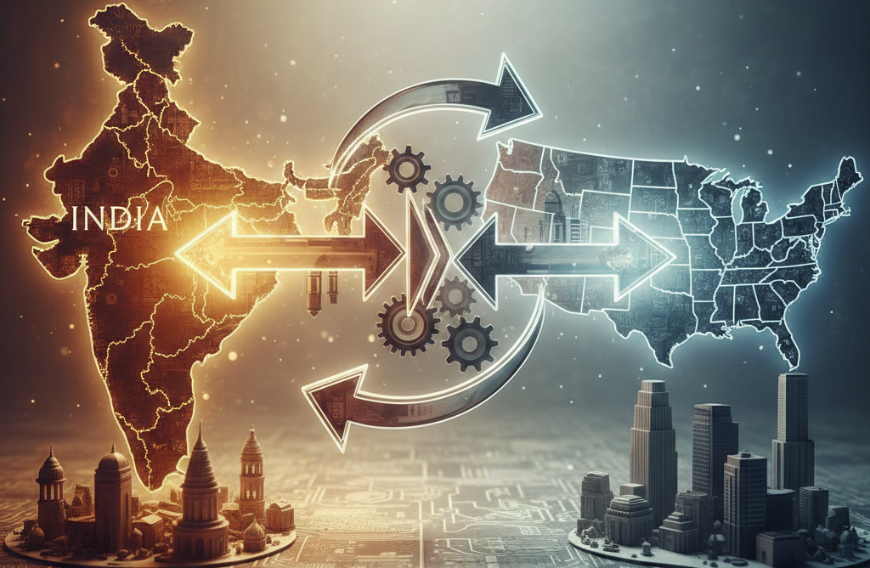
Indian startups are pausing their plans to “reverse-flip” as they assess the viability of shifting back to India. Factors such as moderating valuations, a sell-off in IT stocks, and tax uncertainties are causing hesitation, particularly among SaaS companies.
The term “reverse flip” indicates a reversal of the “flip” structure adopted by many Indian startups. The flip structure involves incorporating offshore holding companies (commonly in jurisdictions like the U.S. or Singapore) to facilitate fundraising, align with investor preferences, and enable listings on global exchanges such as NASDAQ.
These structures typically involve a non-operating foreign holding company owning a wholly-owned Indian subsidiary that houses the operational business. While this has been the common practice for a long time, of late there has been a rise in “reverse-flips” where Indian startups restructure so that investors and founders hold shares directly in the Indian company. This is usually driven by stronger domestic capital markets, deepening pools of domestic risk capital, and an increasing number of successful Indian IPOs.
READ: Workday co-founder Aneel Bhusri returns as CEO amid stock slump (
However, it looks like the reverse-flip trend is being put on pause for several startups, including PhonePe, Meesho, Razorpay, Pine Labs, Udaan and KreditBee, according to Business Standard.
“A lot of companies that were intuitively inclined to return, driven by the buoyancy in Indian public markets, have put plans on hold due to costs, income considerations, and execution challenges,” says Sanjay Khan Nagra, partner at Khaitan & Co.
Experts say that SaaS firms, particularly those valued above $500 million, are now reassessing timing amid a sell-off in Indian IT stocks and weaker investor appetite for software.
“Globally, SaaS has seen compression in price-earnings multiples and a broad selloff. Uncertainty around valuations and investor appetite for software is pushing startups into a wait-and-watch mode. The recent sell-off in Indian IT stocks is also concerning, as it signals weaker investor appetite. Companies may prefer to rework their narratives and flip back later,” says Siddarth Pai, founding partner at 3one4 Capital.
There has also been a significant funding gap, with Indian AI companies raising $300 million across 98 rounds in 2025, compared with $122.5 billion raised by U.S. firms across 849 rounds, the report says further. Tax uncertainty has also risen with the Supreme Court verdict involving Tiger Global, making startups more cautious about reverse flips. Employee stock option changes and investor concerns around tax exposure, rights and IPO exits are adding to the delay.
“There can be tax implications from cancelling and re-issuing stock options, as well as challenges in aligning ESOP structures with Indian law,” says Ipsita Agarwalla, Leader for International Tax and Investment Funds at Nishith Desai Associates.