



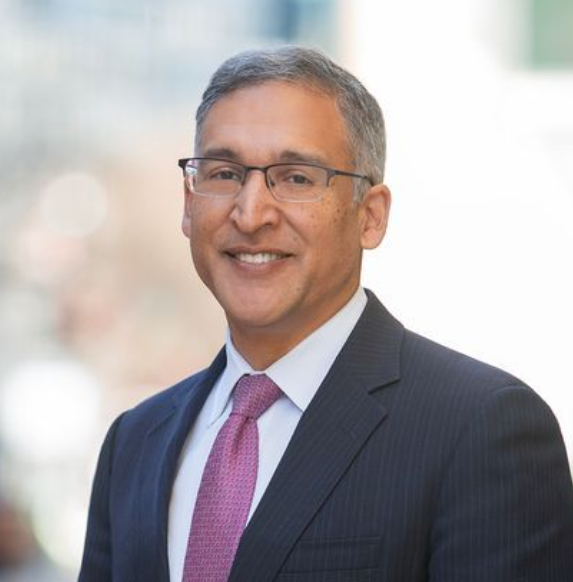
Neal Katyal, who once served as the nation’s top courtroom advocate before the Supreme Court, has emerged as a central figure in a landmark ruling that invalidated President Donald Trump’s broad tariff plan.
Katyal, the former Acting Solicitor General of the United States, argued that Trump overstepped his authority by invoking the 1977 International Emergency Economic Powers Act to levy sweeping tariffs on imports from nearly every major trading partner. He described the tariffs as “unjust, unconstitutional taxes” that Congress never authorized the president to impose.
“Oftentimes in these high-profile cases, there are 5 to 4. But this one was 6 to 3. And notably with two of President Trump’s three appointees voting against him,” as per Katyal in a CNN interview.
The legal challenge was brought by a group of small businesses that argued the tariffs were hurting their operations and driving up costs. The lawsuit was backed by the Liberty Justice Center, which contended that the president had exceeded his statutory authority.
Trump, for his part, defended the sweeping import duties as essential to protecting national security and strengthening the economy. He cited persistent trade deficits and the surge in fentanyl overdoses as national emergencies that, in his view, justified invoking emergency powers.
READ: Trump retaliates with 10% global tariffs on US Supreme Court’s ruling (
Katyal, who previously served as Acting Solicitor General and represented the small businesses contesting the tariffs, said the administration’s strategy undercut its own position in court.
He suggested the outcome might have been different had the White House taken a narrower and more constitutionally grounded approach. “Acting in a constitutional way instead of this ridiculous ‘I am the president I can do whatever I want’ stuff,” he said, when asked what could have been different.
“It is really hard to win a case against the US President in the Supreme Court but we managed to do that because the President took such an extreme position. We only cared about one thing — Constitution,” Katyal added.
In the immediate aftermath of the decision, Katyal described the ruling as a clear line drawn around presidential power and a reaffirmation of constitutional boundaries.
“Today, the United States Supreme Court stood up for the rule of law, and Americans everywhere. Its message was simple: Presidents are powerful, but our Constitution is more powerful still. In America, only Congress can impose taxes on the American people,” Katyal said.
Who is Neal Katyal?
Born in Chicago to Indian immigrant parents, Neal Katyal is the Paul Saunders Professor at Georgetown University and previously served as Acting Solicitor General of the United States. His academic and legal work focuses on constitutional law, criminal law, and intellectual property, and he is also a New York Times bestselling author.
In recent years, he took on a high profile public role as Special Prosecutor for the State of Minnesota in the murder case of George Floyd, a case that drew national attention and intensified debates over policing and justice in America.
At 54, Katyal has argued more cases before the Supreme Court than any other minority attorney in U.S. history, surpassing the record once held by Thurgood Marshall. In all, he has presented 51 cases before the Supreme Court of the United States, according to Georgetown University.
From 2010 to 2011, he served as Acting Solicitor General, representing the federal government in some of the court’s most closely watched disputes. During that time, he successfully defended the constitutionality of the Voting Rights Act of 1965, represented former Attorney General John Ashcroft in litigation stemming from post 9/11 detention policies, and secured a unanimous decision in a case brought by several states seeking to hold major power plants accountable for global warming.
Katyal was appointed Acting Solicitor General in 2010 by Barack Obama. In that role, he argued on behalf of the federal government before the Supreme Court and in appellate courts nationwide, serving as one of the administration’s top legal voices.
Over the years, he has received the Justice Department’s highest civilian honor, the Edmund Randolph Award. He was named Litigator of the Year by The American Lawyer in 2017 and again in 2023. Forbes also included him among the top 200 lawyers in the United States in 2024 and 2025.