


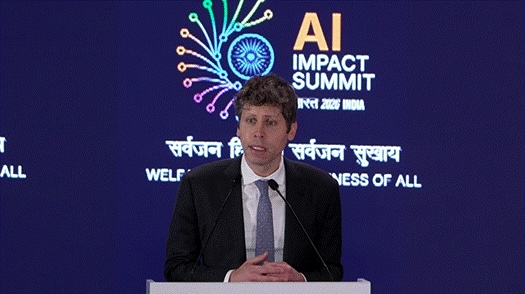
At every technological turning point, nations face a quiet test. Not whether they can adopt the tool — but whether they possess the institutions to survive what the tool will become. Artificial intelligence is that test for India.
This week’s summit at Bharat Mandapam was large, confident, and symbolically global. India positioned itself as a participant in shaping the AI century. That ambition is justified. India has scale, talent, linguistic diversity, digital public infrastructure, and one of the world’s most complex democratic societies. It cannot afford to be absent from this transformation.
But artificial intelligence does not reward participation. It rewards structure. The uncomfortable truth is that AI magnifies the character of the system in which it is embedded. It does not correct institutional weakness. It encodes it. It does not dilute hierarchy. It scales it. It does not soften opacity. It automates it.

India’s AI future, therefore, will not be determined by the number of conferences it convenes or the prominence of executives it hosts. It will be determined by whether its institutions can withstand amplification.
India believes in the myth of scale and is accustomed to thinking in magnitude: population, market size, digital transactions, data generation. In the industrial era, scale conferred power. In the AI era, scale without depth can create dependency.
A country that produces vast amounts of data but limited foundational research risks becoming a training ground for systems built elsewhere. A country that consumes frontier models but does not shape their architecture becomes a market, not a maker. India must decide what it wants to be in this hierarchy.
Leadership in artificial intelligence is not measured in adoption rates. It is measured in who defines standards, who controls compute, who funds frontier science, and who writes the governance rules others must follow. At present, India excels at application. It has not yet committed at sufficient depth to origination.
In a democracy, institutions are the real infrastructure.
READ: Satish Jha | A Summit to follow, not lead (February 20, 2026)
Artificial intelligence compounds research ecosystems. It compounds regulatory credibility. It compounds educational quality. It compounds trust.
Where universities are autonomous and well-funded, AI research flourishes. Where regulators are predictable, capital commits long-term. Where dissent is tolerated, design improves. Where courts are independent, innovation is de-risked. Where these are fragile, AI exposes the fragility.
India’s research spending remains modest relative to its ambitions. Public universities struggle with autonomy and resources. Faculty recruitment too often reflects affiliation over scholarship. Regulatory processes are evolving but not yet consistently predictable. None of these is a fatal weakness. But AI is unforgiving to partial reform.
The question is not whether India has talent. It does. The question is whether it will build institutions that retain, challenge, and multiply that talent domestically.
Artificial intelligence is not infrastructure like highways or ports. It is recursive infrastructure. It improves itself. If the base system is strong, it accelerates strength. If the base system is uneven, it accelerates unevenness.
No AI strategy can outrun the classroom. India produces exceptional engineers at the top tier. But the median school experience remains uneven in quality, digital access, and critical reasoning. AI will not wait for that gap to close. It will widen it.
The future economy will not reward rote proficiency. It will reward abstraction, interdisciplinary thinking, and ethical judgment — the ability to question outputs rather than merely use them. These are institutional outcomes, not software features.
If India wishes to shape AI, it must reform teacher training, expand research grants, insulate universities from politicization, and align curricula with inquiry rather than memorization. The dividends of that shift will compound more powerfully than any summit declaration. There is no shortcut around this.
In the global AI race, ethics is often framed as a constraint. It is not. It is strategy. It is a competitive advantage.
READ: Satish Jha | India’s AI moment, found in the relentless lines (February 18, 2026)
Trust lowers transaction costs. Predictable governance attracts capital. Transparent oversight prevents backlash. In a society as socially layered as India’s, structured by caste, gender, language, and region, algorithmic bias is not a theoretical concern. It is a structural risk.
If India embeds rigorous privacy protections, independent review mechanisms, and enforceable accountability early, it can shape global norms rather than import them. A country that proves AI can coexist with pluralism will exercise disproportionate influence. A country that treats governance as an afterthought will inherit standards written elsewhere.
India stands at a decisive threshold. It can pursue AI as spectacle — visible, confident, rhetorically expansive. Or it can pursue AI as institutional renovation — slower, less theatrical, but structurally transformative. One path produces headlines. The other produces durability.
The AI century will not be won by the country that announces ambition most loudly. It will be won by the country that builds systems sturdy enough to absorb acceleration.
Artificial intelligence is not India’s opportunity to impress the world. It is India’s opportunity to strengthen itself.
If India builds institutions equal to its demographic weight and intellectual potential, it will not need to declare leadership in AI. Leadership will become an outcome, not a slogan.
READ: Satish Jha | India’s technology illusion: Why capability, not rhetoric, determines power (February 7, 2026)
In this century, power will belong to societies that understand a simple principle: Technology scales what already exists.
The future, therefore, will belong not to those who host the revolution — but to those who are prepared for what the revolution magnifies.
(Satish Jha is a journalist, co-founder of Hindi national daily Jansatta for the Indian Express Group, formerly Editor of newsweekly Dinamaan of The Times of India Group, an education advocate, and longtime observer of India’s global role. He served as a technology advisor to The South Commission with Dr Manmohan Singh, has invested in, mentored or lead a portfolio of tech startups in the US and India and was one of the youngest global CIOs at Fortune 100 firms.)