



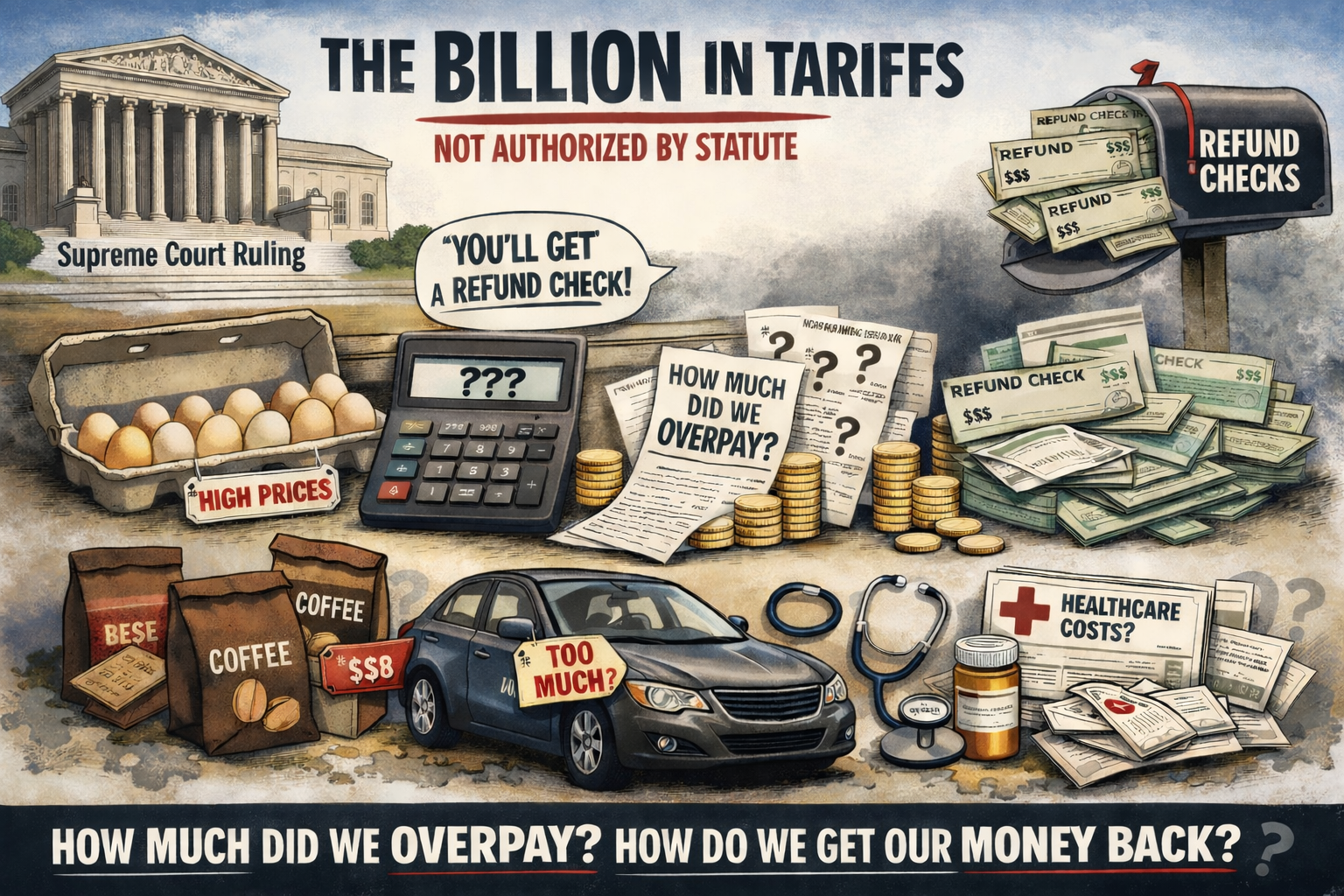
Imagine paying more for your utility bill that was never supposed to be charged. To make matters worse, you don’t know how much you were overcharged and you have no idea how to get a refund. That is precisely what happened yesterday when the Supreme Court struck down the tariffs.
The estimate of $134 billion reflects the total tariff revenue collected under the policy framework that the Supreme Court ruled was not authorized by statute. Trump said people would be getting refunds checks for the savings from the tariffs but what about the overpayments?
We have been paying more for everything from eggs, to coffee to cars and healthcare and have no idea how much we should have paid, how much we overpaid and how we get our money back
The affordability crisis has become the central financial stress for American families, not because of political debate but because of what people see every time they shop for groceries, fill a prescription, or review a monthly bill. Prices have not simply increased; they have become unpredictable. Families are budgeting in an environment where the starting point keeps shifting, and there is little clarity about why.
Affordability is the issue hitting the wallets of consumers every day and now it turns out they are due a refund for having overpaid
At the grocery store, eggs became the symbol of that instability because their price spikes were dramatic and visible. But eggs were not the only example. Meat, dairy, packaged foods, and household goods followed the same pattern.
Consumers were told that supply chains and global markets were responsible, and many of those explanations were valid. What was not clear at the time was that part of those increases was tied to tariffs that the Supreme Court has now ruled were imposed without proper legal authority.
Tariffs may sound like distant trade policy tools, but in practice they are simple. They are taxes placed on imported goods. Companies pay those taxes at the border and then build that cost into the price of the product. The added expense moves through the system until it shows up on the shelf. Consumers ultimately pay it. Now we know that more than $134 billion was collected under authority that the Court has said did not lawfully exist.
That number is not theoretical but represents real dollars taken from the economy and embedded in everyday purchases. When a tax is imposed without proper authority, the principle is straightforward. Money that was not lawfully owed should not remain collected simply because the process of returning it is complicated.
The impact did not stop at groceries. Healthcare, already one of the largest expenses for American households, was also affected. Many medical supplies, equipment parts, and pharmaceutical components are part of global supply chains. When tariffs increased the cost of those imports, providers and insurers faced higher expenses. Those higher costs were reflected in premiums, deductibles, and billing structures that patients paid directly.
But the financial effect did not end there. Rising healthcare costs do not stay contained within hospitals and insurance statements. Employers who pay more for health coverage adjust their overall cost structures. Small businesses facing higher benefit expenses raise the prices of their goods and services.
Manufacturers absorbing higher insurance and supply costs incorporate those increases into product pricing. Consumers therefore paid once through higher premiums and out-of-pocket healthcare expenses, and then paid again when those same healthcare cost increases were built into the prices of everyday goods.
In other words, the burden compounded. Tariffs increased input costs. Healthcare costs rose in parallel. Businesses adjusted pricing to protect margins. The consumer absorbed the cumulative effect at the checkout counter and in monthly insurance deductions. What felt like general inflation was, in part, policy-driven cost layering.
Now that the Supreme Court has ruled the tariffs unlawful, a basic question follows. If the legal authority for the tax was invalid, can the money collected under that authority simply remain untouched? In any other setting, the answer would be clear. If a store charged an improper fee and lost in court, the expectation would be repayment.
READ: Sreedhar Potarazu | The Supreme Court reframes ‘The Art of the Deal’ by striking down tariffs (February 20, 2026)
There is discussion that importers, who initially paid the tariffs, may seek refunds. That may be legally correct, but it does not reflect economic reality. Those importers largely passed the cost through to consumers. If corporations recover funds while households receive no relief, then families will have paid the unlawful tax while others receive the reimbursement. That outcome would not restore fairness.
Beyond the financial impact, there is the issue of trust. Consumers accept taxes and price increases when they believe they are lawful and necessary. Discovering that part of the affordability crisis was fueled by tariffs imposed beyond statutory limits weakens that trust. The rule of law requires that the government follow the same boundaries it expects citizens to respect.
The $134 billion collected under these tariffs represents millions of small transactions across the country. It represents grocery receipts, medical bills, hardware purchases, school supplies, and everyday necessities. Families adjusted their budgets. Small businesses adjusted their pricing. Retirees stretched fixed incomes. All under the assumption that the costs built into those prices were legally sound.
Stopping unlawful tariffs going forward is not enough. Addressing the money already collected is part of restoring fairness. If the authority was invalid, then the financial consequences cannot simply be ignored.
READ: Sreedhar Potarazu | AI sovereignty race: US and China lead, India watches (
American consumers are not asking for special treatment. They are asking for consistency. From overpriced eggs to rising healthcare premiums and the secondary price increases that followed, families carried the burden more than once.
When money is collected without lawful authority and layered into the cost of living twice over, it should be returned.