



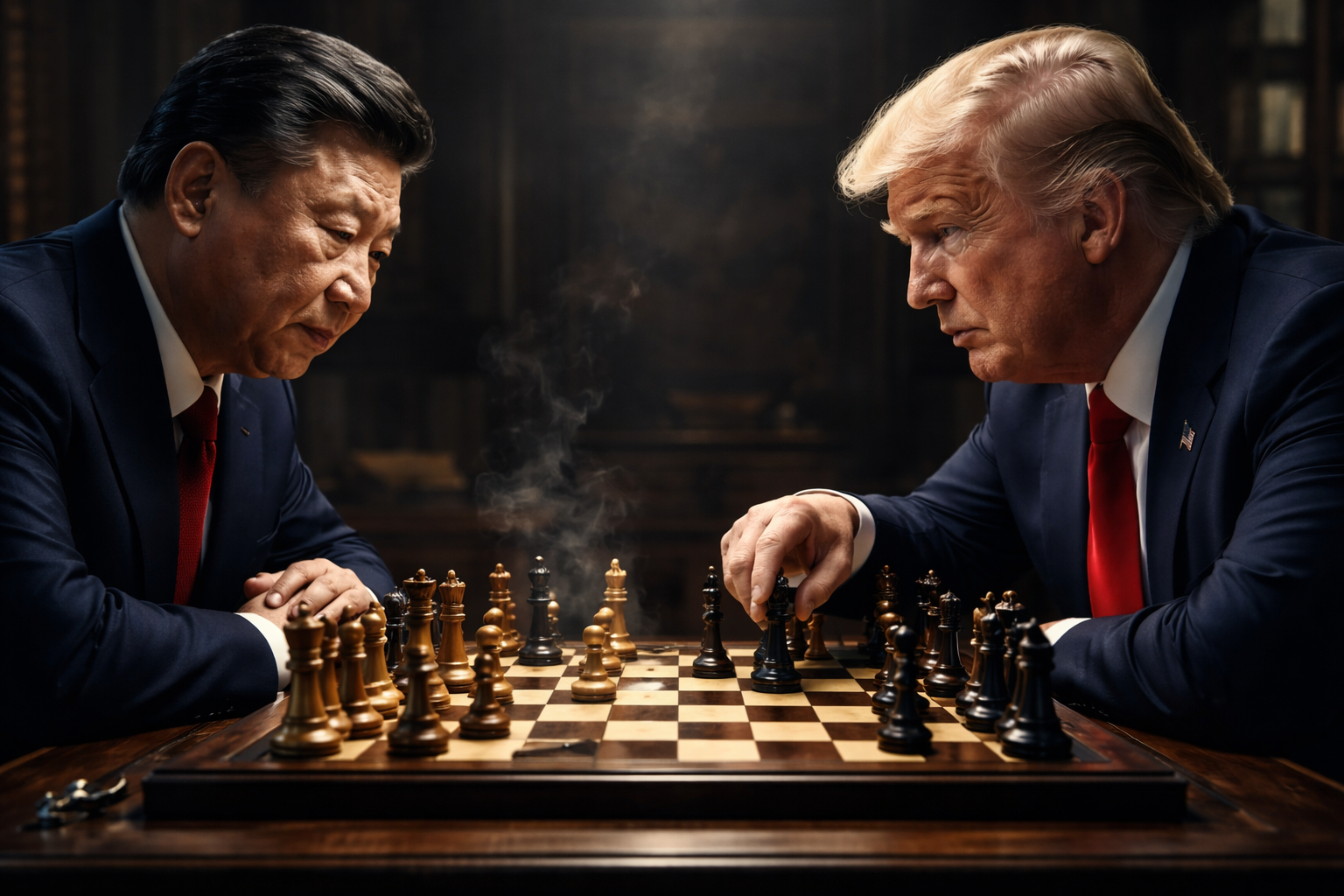
Here is the scene: two powerful men at a chessboard, pieces mid-game, faces visible, the geometry of the board slowly revealing who holds the advantage.
The players are Xi and Trump, two of the most consequential men alive, each convinced of his own historical necessity, each managing an empire of leverage and calculation. When they finally sit across from each other in Beijing on May 14 and 15, a summit postponed once by the very war that has reshaped its agenda, the world that walks into the room with them will be one transformed by fire, oil, rare earth minerals, and the quiet signature of an Indonesian defense minister in a Pentagon conference room. Both sides recognize that their fates are more entangled than either man’s rhetoric has acknowledged.
What neither side’s press conferences will fully say, but what the board itself reveals, is that the contest between these two countries is not primarily about Iran, or tariffs, or even Taiwan. It is a contest over the physical underpinnings of the twenty-first century economy: energy, rare earth minerals, the computing power that both enable, and the chokepoints through which all of it flows. Everything else, the blockade, the summits, the sanctions letters, the papal feuds, is the noise. The chokepoints are the game.
And as of April 17, 2026, one of those chokepoints has just changed hands, not by force, but by deal.
The chain that binds everything
Let’s begin with the chain, because the chain is the strategy.
The AI models that will determine economic and military supremacy in the coming decades require semiconductor chips. Those chips require rare earth elements: neodymium for magnets, ytterbium for fiber optics, europium for display phosphors, holmium and erbium for military lasers. The data centers that train and run those models consume electricity at a scale that is restructuring global energy markets. Energy powers the data centers. Rare earths enable the chips. The chips encode the intelligence. The intelligence, increasingly, is the new economy.
And all of it, the Middle Eastern crude, the Qatari LNG, the Southeast Asian manufacturing supply chains, passes through chokepoints. Those chokepoints are, one by one, coming under the shadow of American strategic positioning.
Hormuz: under U.S. naval blockade since April 13, with more than 10,000 sailors, marines, and airmen enforcing a cordon that turned back thirteen vessels in its first days, and now, as of April 17, the subject of an agreement by Iran to reopen transit in exchange for a Lebanon ceasefire. Malacca: under the shadow of prospective U.S. overflight rights, negotiated through a defense cooperation partnership with Indonesia. Panama: already restructured under American pressure. Venezuela’s oil reserves: redirected under a January 2026 operation that recaptured Maduro. Greenland’s Arctic minerals and Ukraine’s rare earth deposits: both under active discussion for American development partnerships.
These are not separate stories. They are the same story, told in different geographies, about who controls the physical infrastructure of the twenty-first century economy. Every move on the board, every blockade, every sanctions letter, every ceasefire, every quiet Monday afternoon at the Pentagon, traces back to that chain. Energy to data. Data to chips. Chips to intelligence. Intelligence to power. And power, ultimately, to the water through which the crude oil flows.
READ: The Vice President flies to Islamabad (
Xi understands this chain. So does Trump. That is why, on the morning of May 14, when their motorcades pull through the gates of Zhongnanhai, the real negotiation will not be about what either man says at the table, but about who controls more links in the chain and who has quietly moved to sever the other’s.
The race for rare earths and semiconductors
The edifice for the May summit between these two leaders was already under construction long before the first American bomb fell on Iranian soil on February 28, 2026.
In the fifteen months since Trump’s second inauguration, the architecture of his foreign policy had been revealing itself through the accumulating logic of its instruments: tariffs as leverage; defense spending demands as burden-shifting; mineral access as the currency of alliance; the semiconductor supply chain as the contested frontier of civilizational competition. Each element puzzling in isolation, coherent in combination.
But China holds the most structurally powerful card in this competition, and it has held it quietly for decades.
China controls approximately 90 percent of global rare earth processing capacity and around 94 percent of global rare earth magnet manufacturing. Why does this matter? Because these are the elemental preconditions for the modern military-industrial economy: neodymium magnets in fighter jet actuators, ytterbium in the fiber optic networks that carry the world’s data, europium in the phosphors that illuminate display screens, holmium and erbium in the directed-energy weapons that both militaries are racing to deploy. Without rare earth processing, there are no advanced chips. Without advanced chips, there are no competitive AI models. Without AI, there is no economic supremacy in the century ahead.
In April 2025, Beijing began tightening export controls on seven critical rare earth elements. By October 9, five more had been added, holmium, erbium, thulium, europium, and ytterbium, with restrictions extended to refining technologies, equipment, and even foreign-made products containing trace amounts of Chinese-origin materials. And here’s what happened. European prices for controlled heavy rare earths reached up to six times their Chinese equivalents. Carmakers and defense manufacturers cut production rates. TSMC, the Taiwanese chipmaker whose Arizona fab is the centerpiece of America’s semiconductor reshoring strategy, was identified as carrying potentially significant exposure in this supply chain.
By the autumn of 2025, when Trump and Xi met on October 30 in Busan at the margins of the APEC summit, the shape of the contest had come into focus. The Busan truce was a pause, not a resolution. China agreed to suspend its expanded rare earth controls until November 10, 2026. But analysts who visited Beijing since the summit report that Chinese officials understand their rare earth leverage is increasing, not decreasing, as American midterm elections approach and economic pain from energy prices mounts. Beijing believes time in the rare earth competition is on its side. Washington is racing to prove otherwise.
The response on the American side has been to move with unusual urgency on semiconductor manufacturing. Apple committed over $500 billion to American facilities over four years. Nvidia began building its Blackwell AI chips on American soil for the first time, commissioning over one million square feet of manufacturing space at TSMC’s Arizona fab and across two new supercomputer manufacturing plants in Houston and Dallas. The Trump administration’s export controls on advanced AI chips, finalized in January 2026, represent the administration’s most structurally durable long-game: if China cannot access advanced American chips, and cannot yet produce comparable chips domestically, the intelligence layer of the chain remains beyond Beijing’s reach.
READ: Autopsy of a liquidity event. Biopsy results for the crypto trade (
China knows this. It has embarked on what analysts describe as an unprecedented attempt to build a fully domestic semiconductor industry. This is enormously difficult. It takes years, perhaps decades. But China is playing the long game, and the rare earth clock, which expires in November, is the pressure instrument it will carry into the Beijing summit.
Operation epic fury
It was in this context, a competition already defined by chokepoints and supply chains, that the Iran war reshaped the board.
On February 28, 2026, the United States and Israel launched coordinated strikes on Iran, killing Supreme Leader Ali Khamenei and striking military facilities, nuclear sites, and the command architecture of the Revolutionary Guard. What the administration did not fully account for was Iran’s willingness and capacity to close the Strait of Hormuz. The IEA described what followed as the largest oil supply disruption in the history of the global oil market. Tanker loadings through the strait fell from more than 20 million barrels per day before the war to approximately 3.8 million barrels per day by early April, a collapse of 80 percent in the energy flow that powers a fifth of the world’s economy.
The human geography of the crisis was, and is, stunning. Asia accounts for roughly 75 percent of oil and 59 percent of LNG exports through Hormuz. China, India, Japan, and South Korea together take nearly 70 percent of the oil. Europe, which derives approximately 75 percent of its imported jet fuel from the Middle East, faced potential flight cancellations within weeks, according to IEA Executive Director Fatih Birol, who on April 16 described the situation as the largest energy crisis the world has ever faced. The IMF cut its global growth forecast to 3.1 percent in 2026 and raised its inflation projection to 4.4 percent.
Against this backdrop, American energy became something qualitatively new, not merely a commodity but a strategic instrument. U.S. LNG export facilities ran at near-peak capacity in March 2026, exporting almost 18 billion cubic feet per day, with Europe taking the majority of shipments. The Venture Global Plaquemines facility received immediate government authorization for a 13 percent increase in export volumes. Into the void left by damaged Qatari infrastructure, American LNG rushed with an urgency that no prior diplomatic communiqué could have manufactured.
The American Gulf Coast, from Sabine Pass to Plaquemines, became the world’s emergency energy reserve.
And then, on April 17, that emergency began to formally resolve, on American terms.
The Hormuz bargain: Lebanon as the price of the Strait
The announcement came with the controlled drama of a deal that both sides had been quietly assembling for days. Iran agreed to reopen the Strait of Hormuz to international transit. The price, formally at least, was the Lebanon ceasefire, the 10-day agreement brokered by Washington that had taken effect on April 16, removing the Lebanon front as one of Iran’s stated preconditions for engagement.
On the surface, this reads as a mutual concession: Iran gets the Lebanon ceasefire it had demanded, and the world gets its oil back. But read the board more carefully, and the geometry looks considerably different.
The Lebanon ceasefire was Washington’s to give. It cost the United States a diplomatic commitment it had every incentive to make anyway. Israel had achieved its primary military objectives in Lebanon, and sustaining the northern front was becoming a domestic and international liability. The ceasefire was not a sacrifice, but a chit that had been sitting in America’s hand since the campaign’s operational logic was complete.
The Strait of Hormuz was Iran’s to relinquish. And Iran’s willingness to do so, after weeks of holding the world’s largest energy market hostage, reveals something important about the actual pressure the country was absorbing. The naval blockade, now in its fifth day when the agreement was reached, had not merely slowed Iranian oil exports. It had placed the entire architecture of Iran’s economic survival under siege, at a moment when the country’s primary patron, China, was itself absorbing the costs of the disruption it had indirectly enabled. The pressure did not come from one direction. It came from the chain.
The result is that the Strait of Hormuz, the chokepoint through which more than half of China’s overall energy supplies flow, has been effectively demonstrated, before the eyes of every energy minister and central bank governor in the world, to be a lever that the United States can close and reopen. Not merely as a theoretical matter, but as a demonstrated operational fact.
The world now knows what the board looked like under live-fire conditions. And it will not forget.
From bombs to banks
On April 15, as Pakistani Field Marshal Asim Munir flew into Tehran and Wall Street rallied on ceasefire hopes, Treasury Secretary Scott Bessent walked to the White House briefing room podium and introduced a new instrument to the contest, one aimed squarely at the financial link in China’s chain.
Bessent announced that the administration had told companies and countries that if they were buying Iranian oil or holding Iranian money in their banks, the United States was now willing to apply secondary sanctions, describing it as the financial equivalent of kinetic military action. Two Chinese banks had already received formal Treasury letters. “We told them,” Bessent said, “if we can prove that Iranian money is flowing through your accounts, then we are willing to put on secondary sanctions.” China’s Foreign Ministry protested that it “opposes illegal unilateral sanctions without authorization of the United Nations Security Council.” The protest was noted, but the letters were not recalled.
China buys approximately 80 percent of Iran’s oil exports, denominated in yuan, through a shadow fleet that the U.S. Treasury has now begun systematically sanctioning. Bessent’s ultimatum made the terms explicit: your Iranian oil discount, or your dollar access. You may not have both.
The Hormuz reopening does not dissolve this ultimatum, but reframes it. Now that the strait is open and the crisis is formally de-escalating, the secondary sanctions letters sitting at Chinese financial institutions do not disappear, but become the baseline condition of normalized commerce. Beijing must choose whether to wind down its Iranian oil purchases in the face of the demonstrated American willingness to enforce consequences, or to absorb the financial isolation that comes from continuing a discount crude relationship that the entire world just watched Washington surgically pressure into submission.
The S&P 500 hit a new all-time high on April 16, completing a nearly 10 percent rally in ten trading sessions. Brent crude settled around $94 to $95 per barrel: well above its pre-war level of approximately $65 to $67, but substantially below its war-peak above $119. As the Hormuz agreement was announced, oil markets moved, but not to pre-war levels. The spread between $95 and $67 has narrowed, but has not closed. The risk premium has not fully dissolved. The world is pricing in not just a reopened strait, but a strait that is now legibly under the shadow of American power.
The de-dollarization project that Venezuela, Iran, Russia, and China had been quietly advancing, selling crude in yuan, building payment channels outside SWIFT, charging Hormuz tolls in Chinese currency, has been materially set back. In a crisis, buyers do not run toward the yuan. They run toward the balance sheet, payment rails, legal infrastructure, and military umbrella of the United States. The petrodollar, which its adversaries spent a decade trying to dismantle, has been reinforced not by diplomacy but by the logic of emergency. And the Hormuz bargain is its latest proof of concept.
Islamabad talks
The ceasefire negotiations convened in Islamabad on April 11. The 300-member U.S. delegation was led by Vice President JD Vance, alongside special envoys Steve Witkoff and Jared Kushner. The 70-member Iranian team was led by parliamentary speaker Mohammad Bagher Ghalibaf and Foreign Minister Abbas Araghchi, with Pakistani Prime Minister Shehbaz Sharif and Field Marshal Asim Munir serving as mediators. After 21 hours, the highest-level direct engagement between Washington and Tehran since 1979, the talks ended without a complete deal, but with a process now visibly in motion.
The unresolved issues were precisely the links in the chain: the Strait of Hormuz, and Iran’s nuclear enrichment program. Iran’s core demands, recognition of its sovereignty over Hormuz transit rights, the ability to charge tolls, and the right to a domestic nuclear program, are demands over physical infrastructure and energy chokepoints. America’s core demands, full denuclearization and unconditional reopening of Hormuz, are demands to permanently surrender those same instruments.
The Lebanon ceasefire, brokered by the United States and celebrated in the streets of Beirut on April 16, removed one of Iran’s stated preconditions for returning to the table. It became, within 24 hours, the currency of the Hormuz reopening. Iran’s agreement to reopen the strait, even partial, even conditional, even with the nuclear question still unresolved, represents a meaningful, if incomplete, American win. The strait is open. The crisis is formally de-escalating. The nuclear question is deferred, not settled. And the leverage that produced the Hormuz reopening, the blockade, the secondary sanctions, the Malacca overflight discussions, the financial ultimatum, did not evaporate with the deal. It has been demonstrated. That is worth more than the deal itself.
A second round of Islamabad talks is expected before the April 21 ceasefire expiration. Vance said publicly he feels “very good” about the prospects. Trump said he might go to Pakistan personally if there is a peace deal to sign. The summit with Xi convenes May 14.
The Malacca maneuver: The quietest move on the board
On April 13, while the blockade headlines consumed every front page in the world, Secretary of War Pete Hegseth quietly executed what may prove to be the most consequential single strategic move of this entire crisis.
At the Pentagon, Hegseth hosted Indonesian Defense Minister Sjafrie Sjamsoeddin for a bilateral meeting that produced the formal establishment of the U.S.-Indonesia Major Defense Cooperation Partnership. Three pillars: military modernization and capacity building; training and professional military education; joint exercises and operational cooperation, with particular emphasis on maritime security, subsurface operations, and autonomous systems. Running parallel, the U.S. advanced a separate Letter of Intent to secure blanket overflight access for U.S. military aircraft through Indonesian airspace.
Indonesia’s defense ministry confirmed the discussions, emphasized that control over Indonesian airspace rests entirely with Indonesia, and described the draft as preliminary and not legally binding. Jakarta maintains its traditional “free and active” foreign policy. What the ministry’s careful language did not deny was the strategic implication: such overflight rights, if formalized, would give the United States surveillance and rapid-response capability over the Strait of Malacca.
Why is this important? Go back to the chain.
Read more columns by Ajay Raju
Malacca is the chokepoint through which roughly 80 percent of China’s imported crude oil must pass, every barrel that powers the factories, the data centers, the rare earth processing facilities, the entire industrial metabolism of the world’s second-largest economy. Each year, $3.5 trillion worth of trade, equivalent to one-third of global GDP, transits the strait. At its narrowest point, it is 1.5 miles wide. The term “Malacca Dilemma” was coined by General Secretary Hu Jintao in 2003. China’s own leadership named its greatest vulnerability and has spent twenty-three years and hundreds of billions of dollars trying to solve it: Belt and Road pipelines from Central Asia, Russia, Pakistan, and Myanmar; the China-Pakistan Economic Corridor through Gwadar; the Kra Canal concept in Thailand.
None of it has closed the gap. And now the Hormuz reopening has clarified something important for Beijing’s strategic planners: the United States has demonstrated the operational willingness and capability to close and reopen an energy chokepoint in real time, under live-fire conditions, on a timeline measured in days. Malacca, which has not been closed, not yet been threatened, not yet been made the subject of a public ultimatum, sits in Beijing’s strategic imagination as the next demonstration that might one day be required.
The Indonesian defense partnership, signed on the same afternoon the Hormuz blockade began, was not an accident of scheduling, but a message, delivered quietly, about which chokepoint would be legible next if the contest required it.
Xi’s pregame moves
Against this backdrop, Xi’s public performance since April 14 has been a masterclass in the politics of contrast.
Meeting with Spanish Prime Minister Pedro Sánchez in Beijing on April 14, Xi declared that “the international order is crumbling into disarray,” calling on both countries to reject any backslide into the law of the jungle and jointly uphold true multilateralism. Sánchez, who declared the Iran war illegal, closed Spain’s airspace to American military aircraft, and signed 19 bilateral agreements with China on his visit, is the latest in a procession that has included leaders from Britain, Canada, Finland, and Ireland. Both U.S. allies and rivals have rebalanced toward China in response to Washington’s conduct.
The contrast with Washington’s diplomatic posture is revealing. While Xi received heads of state with composed four-point frameworks, Trump engaged in open combat with the first American-born Pope. Italian Prime Minister Giorgia Meloni, the essential bridge between Trump and European conservatives, condemned his attacks on Pope Leo XIV as “unacceptable.” Trump slammed her directly. The alliance architecture that made American primacy the default framework for global order is fraying in ways that no tariff can repair.
But, importantly, the Hormuz deal was not brokered by Xi. It was not brokered by Sánchez. It was not announced from Beijing with multilateral fanfare. It was extracted through a naval blockade, a secondary sanctions ultimatum, a Lebanon ceasefire token, and twenty-one hours of direct talks in Islamabad, none of which Xi’s framework of civilizational stability had produced, because civilizational stability does not close or open the Strait of Hormuz. Leverage does.
Xi’s composure is shadowed by a convergence of pressures that his rhetoric cannot dissolve. U.S. intelligence concluded Beijing was preparing to ship MANPAD anti-air missile systems to Iran. The Chinese Embassy denied it. Bessent’s secondary sanctions letters have since arrived at Chinese financial institutions. And on the same day the Hormuz blockade went into effect, Hegseth signed the Indonesia defense cooperation agreement, placing the shadow of American overflight rights over the one strait that China’s own leadership has called its most dangerous vulnerability for two decades.
Beijing holds the rare earth expiration clock. Washington holds the Malacca overflight discussion, the demonstrated Hormuz playbook, and the secondary sanctions letters. Both are watching the same energy crisis, now formally beginning to resolve, with their own vulnerabilities freshly exposed.
The paradox
Analysts have argued that China enters the Beijing summit with the stronger hand. Trump arrives having alienated Meloni, Sánchez, and the Pope; having expended diplomatic capital on a war that produced no peace agreement on the nuclear question; having generated energy prices that slow the American consumer economy he depends on for political survival.
That reading is correct on the surface and incomplete underneath.
Yes, Xi holds the rare earth expiration clock and the optics of civilizational stability. But rare earths expire in November, not at the summit. And the expiration clock cuts both ways: Beijing needs the summit to produce enough diplomatic goodwill to justify extending the suspension. Trump arrives with the Hormuz reopening in his back pocket, a demonstrated chokepoint victory achieved in days, not decades, with secondary sanctions letters at Chinese banks, and prospective overflight rights over the Strait of Malacca.
More importantly: the Hormuz reopening has changed the evidentiary record of this contest. Before April 17, the American strategy was a theory about leverage. After April 17, it is a demonstrated fact. Iran, with Chinese diplomatic cover, Russian political sympathy, and the structural motivation of every BRICS energy economy behind it, held the world’s most consequential maritime chokepoint for roughly five weeks before agreeing to reopen it in exchange for a Lebanon ceasefire that cost Washington less than it cost Tehran to remain closed.
That demonstration does not disappear from Beijing’s strategic calculus when the cameras leave Islamabad.
Consider, from Beijing’s vantage point, the chain as it now stands. The Strait of Hormuz has been closed and reopened under American pressure, demonstrating operational chokepoint control. Chinese banks face secondary sanctions if Iranian money flows through their accounts. U.S. export controls restrict China’s access to the advanced chips its AI industry requires. The U.S. has formalized a defense cooperation partnership with Indonesia that positions American military aircraft above the Strait of Malacca. Beijing’s strongest card, rare earths, expires in seven months.
The chessboard, link by link
Step back from the news cycle and look at the board as a supply chain competition.
The American position, link by link.
Energy: American LNG at record export volumes, the Gulf Coast the world’s emergency reserve, Hormuz demonstrated as a closeable and reopenable chokepoint, Maduro’s Venezuela redirected.
Chokepoints: Malacca under the shadow of Indonesian overflight discussions, Panama already restructured, Arctic mineral rights under pursuit.
Finance: secondary sanctions ultimatum delivered to Chinese banks, the petrodollar reinforced by the crisis it survived.
Semiconductors: Blackwell chips now produced on Arizona soil, export controls limiting China’s access to the frontier layer of the chain.
Rare earths: vulnerable, but with the November expiration creating a forcing function for Beijing to negotiate.
The Chinese position, link by link.
Read more columns by Ajay Raju
Energy: the shadow Iranian oil economy now under naval and financial pressure, its primary transit point operationally demonstrated as controllable by Washington; strategic reserves bought some time; pipelines from Russia, Central Asia, Pakistan, and Myanmar provide partial alternatives but have not bridged the Malacca gap.
Chokepoints: twenty-three years of infrastructure investment has not solved the Malacca Dilemma; the Indonesian defense partnership announcement is the most direct American move against that vulnerability in the history of the term.
Finance: Beijing can survive dollar pressure longer than most rivals, but not indefinitely, and the choice between Iranian oil discounts and dollar access has just been made considerably starker by the demonstrated consequences of the Hormuz episode.
Semiconductors: China is racing to close the domestic gap but remains years, perhaps a decade, from full independence.
Rare earths: Beijing’s most powerful remaining card, expiring in November, with a summit in May that offers leverage to extend or restrict.
Meanwhile, the diplomatic calendar is filling with world leaders in Beijing’s waiting room; a rhetorical posture framed in the language of international law; and a summit that Xi enters having played his hand with notable public composure, but knowing that the board has been materially altered, by moves he did not fully anticipate, and by a chokepoint demonstration that rewrote the operational vocabulary of this competition.
Last word
The Strait of Hormuz is open as of April 17. The Lebanon ceasefire holds. The nuclear question remains unresolved, and a second Islamabad round is expected before the April 21 deadline. The summit convenes May 14. Between those dates lies the space in which either a historic framework is sketched, or the pressure returns and the board resets into something more dangerous.
The Hormuz reopening is not the end of the contest. It is the end of the contest’s opening phase, and the opening of something harder to navigate. Now that the strait is open, the leverage that produced the deal must be maintained without the crisis that made it legible. That is the harder diplomatic task. Blockades are blunt. Sustained chokepoint management is surgical.
Neither China nor the United States can afford the full expression of its leverage without absorbing consequences that would destabilize its own economy, its own alliances, its own domestic political standing. The restraint on both sides is structural, not sentimental.
But the picture as of April 17 is considerably more clarified than it was a week ago. The competition between these two countries is no longer abstract. It is encoded in tanker cargo manifests, chip fab architectural drawings, sanctions letters at Chinese banks, ceasefire terms exchanged in Islamabad, and the expiration dates on rare earth truces. It is encoded in the airspace above the Strait of Malacca, the one link in the chain that China’s own leaders named their greatest vulnerability twenty-three years ago and have not yet secured. It is encoded now, too, in the operational memory of every energy ministry in the world: the strait that supplies a fifth of global oil was closed for five weeks and reopened through the machinery of American leverage.
Two men, a chessboard, and the chain that connects everything. Can you control the intelligence layer of the century without securing the minerals that enable the chips that run the models? Can you build the data centers without the energy that powers them? Can you hold the energy without the chokepoints through which it flows? And can you spend twenty-three years trying to solve your Malacca Dilemma, only to watch the other player demonstrate, under live-fire conditions, on a five-week timeline, that he can close and reopen the world’s most important maritime chokepoint in exchange for a ceasefire that cost him less than it cost you to watch it happen?
The most consequential moves on this chessboard are encoded in the chain itself, and in who controls each link when the cameras finally leave Beijing.