



From war-shadowed skies to the windswept Welsh island of Anglesey where history, nature, and memory converge
By Leena Mariam Koshy
My husband and I had been visiting the United Kingdom over the past three years, especially since our daughter enrolled in her law degree at the University of York. We would fly in during her university Easter breaks, but this year things seemed uncertain with the Iran War resulting first in airspace closure and later, the cancellation of a large number of flights.
Travelling from the United Arab Emirates, caught in the crosshairs of hostilities, this vacation in the UK felt like a surreal escape from midair missile interceptions and debris falling from the skies.
With an upcoming week of crisscrossing the UK in a rental car, I was determined to keep my mind focused on “the here and now” to shut out overthinking on the personal and professional changes that could be on the horizon once the holiday ended.
As the Emirates flight took a detour flying over Cairo and the Mediterranean Sea, we arrived two hours later than usual at Manchester International Airport.
We found the UK’s second-largest city cold and windy as expected, with intermittent light rain. This period during students’ Easter break is not the ideal time to visit the UK. It was the last leg of winter; in two days, the UK clock would be reset for summer daylight saving.
On the day of arrival, after a visit to the Design and Crafts Centre housed in Manchester’s old fish-market building, where we saw artists at work, we waited inside a small pub near Manchester Piccadilly station for our daughter to arrive by late evening train from York.
While we waited, I marvelled at a young, pretty woman who composedly bought a drink at the counter and sat down to finish it. She was unperturbed by the male visitors, who themselves remained quite absorbed in their own business and conversations. I tried to visualize whether such a scene would be possible at a pub in my home state of Kerala.
READ: A reunion in jungle, seven years later (
Politics and questions of ethics
Reunited with our daughter and having had a good night’s rest, early morning the next day, we set out to meet our dear cousins, who were UK residents living near London. Over a warm and sumptuous Indian lunch at Dishoom restaurant in Shoreditch, we discussed the war, the Reform UK party and the UK’s changing immigration policy, growing Muslim fundamentalism, and the Christian Pentecostal upsurge, among other topics.
Outside, the city of London had intermittent spells of bright sunlight, and after an unusually long winter both young and old seemed impatient to shed their heavy jackets and show up in makeup and brighter colors. The grand multiracial city as usual held out many curious sights. Bidding farewell to our cousins and friends, we returned to our Airbnb in Manchester.
However, the day ended not without regret. Ignorance is not an excuse, especially when you are travelling in a foreign country and an exceptionally vibrant and historic international metropolis such as London. Little did we actively connect this day of the “No Tyrants” rally happening on the other side of the Atlantic, in several US cities. In solidarity, there was a huge turnout of the public in central London as well, on the same day.
Suffice to say that we so narrowly ended up missing an historic opportunity to witness a people’s rally happening in a global capital, pushing back against authoritarian tendencies of rulers and governments across the world — the red-hot concern of the hour.
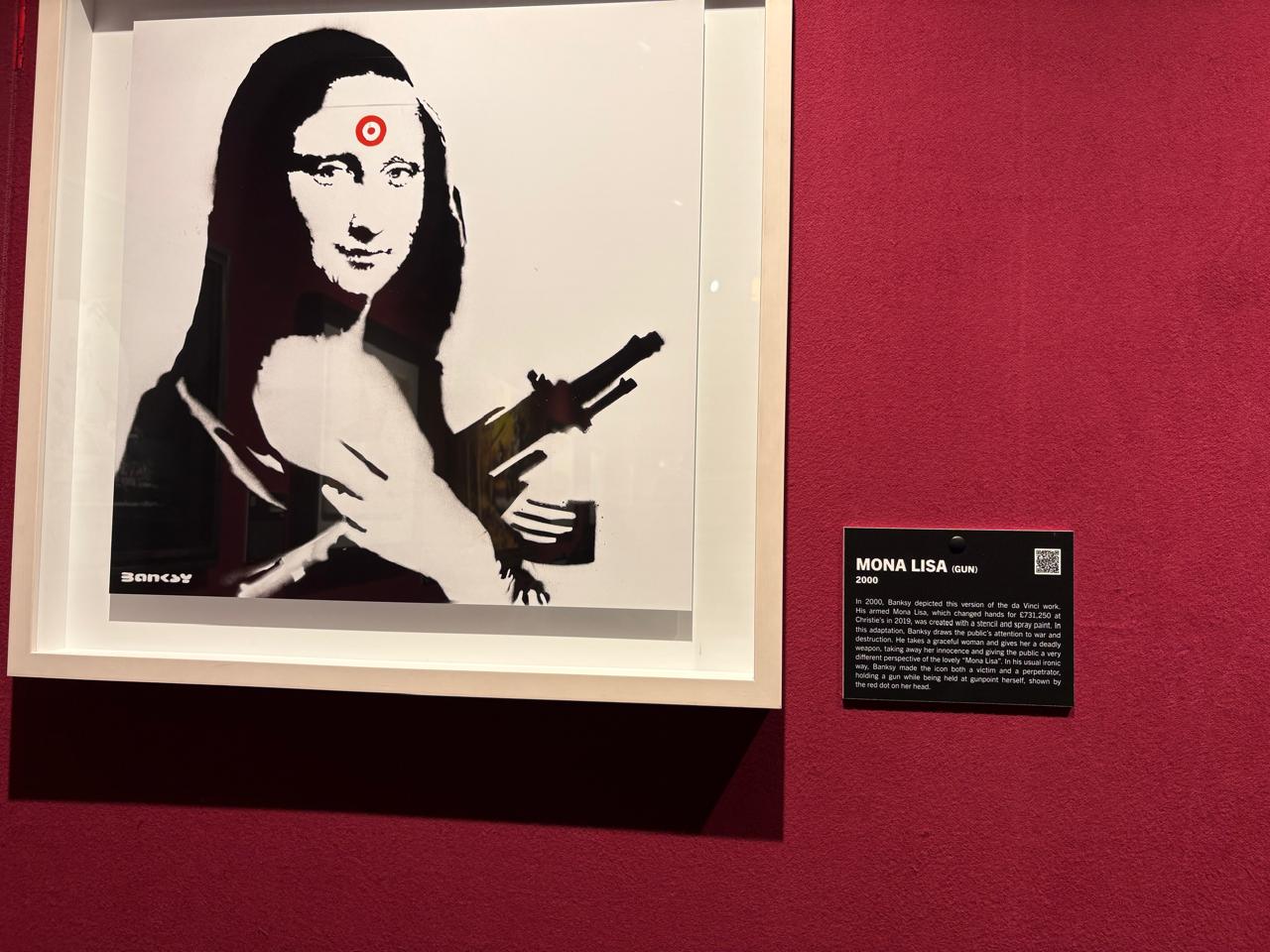
However, this loss was amply made up for in our visit the next day to Manchester’s Northern Quarter to see “The Mystery of Banksy, The Genius Mind” exhibition. Since the irrepressible Banksy did not believe in copyrights which he thought were for losers, the organizers not only included a good number of Banksy replications but also publicized the exhibition as ‘unauthorized’!
The elusive graffiti artist’s works put our minds right back into the bane of our times — rampant consumerism, worldwide poverty which is “the elephant in the room”, and to the forever wars and invasions. Uncomfortable questions of ethics and politics glared at us from every one of his installations and stencil art. Banksy seemed to be speculating like all of us whether we were right now indeed witnessing the veritable end of the American empire.
Isle of Anglesey: Signboards, toponymy, literature
Taking a cue from Banksy, we decided that humankind at large and our own one true escape for the time being would be to turn away from the lethal consumer-capitalist culture of the urban milieu to lose ourselves in nature.
And so, two days before Easter, we drove onto the Isle of Anglesey, an island in North Wales cut off from mainland Wales by the narrow and dangerous Menai Straits.
We drove upon the Britannia Bridge, built in 1850 to reach Llangoed (pronounced Shaankoed) a small historic village in eastern Anglesey where we had booked our accommodation.
READ: Lessons from Dublin cabbies in recession-time nationalism (
The keys to our Airbnb cottage opened into a small, truly elegant and extremely tastefully done up cottage with cork/wood art works reflecting the coastal lifestyle of the locals. Upon entering it, it wasn’t hard to figure out why the Pant y Celin property has consistently been rated among the most favored cottages on travel sites. The hosts (Cathy and Richard) and neighbours were beacons of Welsh hospitality.
The verdure of the walkways near the cottage led us on to an ancient church site, built in honour of the 6th century saint Cawrdaf. Thus, we got some clue of the Welsh toponymy; Llangoed, the place name of our Airbnb village itself was made up of two constituent Welsh words – “llan” and “coed” — which when put together meant “religious enclosure in the woods”.
Llanfairpwll-gwyngyllgogerychwyrndrob-wllllantysiliogogogoch- the agricultural town with one of the longest placenames in the world, is in Anglesey. The composite Welsh placenames carried self-explanatory information about different aspects of the particular places.
The embedded information may reveal the landscape, history, mythology or other important aspects of that particular place.
A Beaumaris café owner proudly informed us that Welsh was spoken natively by a large section of the population, taught in schools, and that there existed a rich tradition of Welsh literature and folklore, with numerous tales of wizards, goblins, giants and other mythical creatures.
Seamless reference to 3000 BC
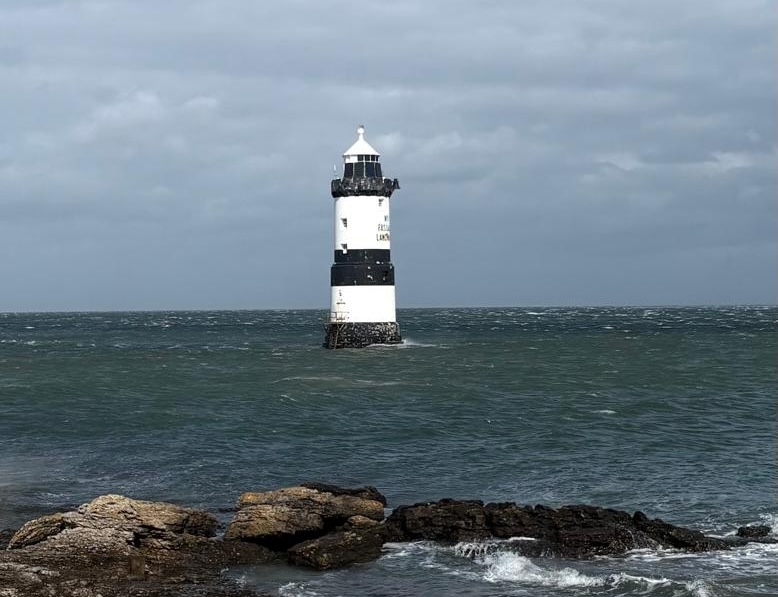
Unlike the genteel mood of the English countryside we had seen so far, the Isle of Anglesey’s scenery together with its climatic conditions could be described variably as beautiful or as confusing, moody and dangerous — every scene literally blowing you away.
Anglesey unfolded a minefield of complex human habitation data from as far back as 3000 BC, which seamlessly connected with the present-day life of its inhabitants.
With ancient tombs and burial chambers, medieval hamlets, forts, ramparts and monastic ruins, pasture lands where sheep and horses have grazed for centuries, long coastlines declared as Area of Outstanding Natural Beauty while still lashed by the winds and water currents, Anglesey turned out to be both a natural as well as historic and archaeological gem.
The alternation of high and low tides in the Menai Straits and its connecting bays, sights of craggy cliffs dropping down into choppy waters, old historic lighthouses jutting out into the sea, shoreside caravans with their ruddy inhabitants determined to brave storms of any kind, and the traditional fishing weirs of Menai designated as scheduled monuments added to its character.
The Puffin Island, the flora and fauna of the island and its surrounding waters became a wild surprise, holding up umpteen aspects worth digging deep into.
Legacy of storm forecasting
There was a yellow storm alert on Day 3 of our visit, which made us contemplate the winds that must have lashed the islands down the ages. Storms are a unique and integral part of the Isle of Anglesey and so it also has a long history of sensational shipwrecks.
The mighty storm, which capsized the Royal Charter clipper in 1859 and took the lives of 450 people, is today referred to as the Royal Charter Gale. Even today, the waters around the isle remain a hot spot for divers seeking to take the gold nuggets that sank to the sea floor in the 1859 Royal Charter clipper-wreck, off the coast of Anglesey.
It is interesting to note that this historic 1859 storm (of hurricane force 12 on the Beaufort Scale) was key to the founding of the first accurate storm warning system by the Meteorological Society of the Board of Trade. At the time it started with information on incoming storms telegraphically relayed to UK’s harbours. Later, the Meteorological Society of the Board of Trade developed into the UK Met Office. With the use of state-of-the-art technology today and the broadening scope of work, the Met Office has become an internationally recognised authority in climate science, broadcasting the day’s weather through the BBC, which is critically useful for planning across industries such as aviation, tourism, agriculture, international trade, infrastructure building and emergency planning worldwide.
Isle of Anglesey was unlike any place we had visited before. Our holiday was done, and it was time to return.
(Leena Mariam Koshy is a writer based in Abu Dhabi.)