



Editor’s note: This article is based on insights from a podcast series. The views expressed in the podcast reflect the speakers’ perspectives and do not necessarily represent those of this publication. Readers are encouraged to explore the full podcast for additional context.
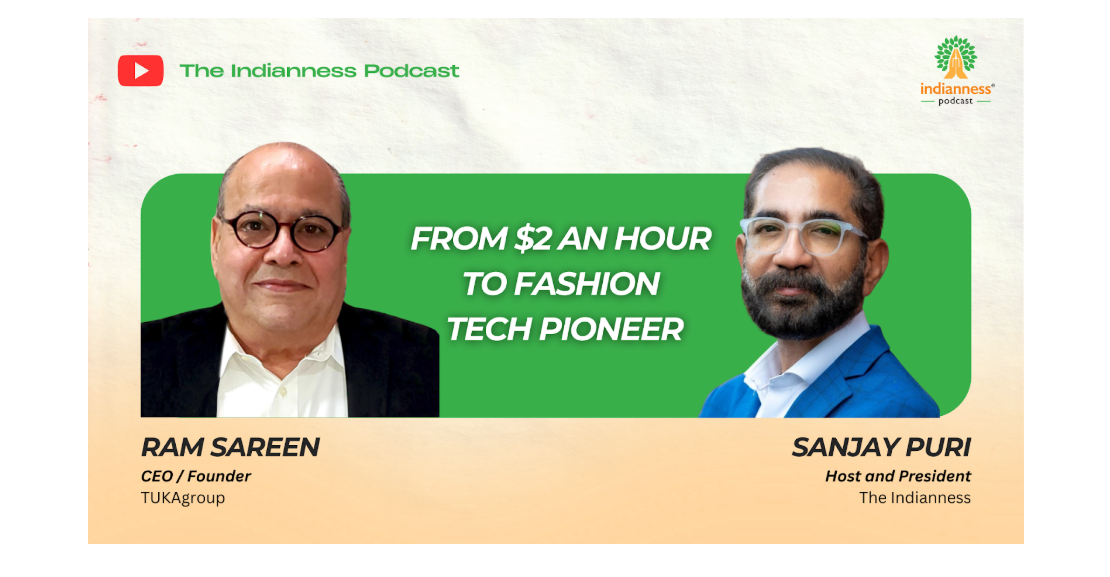
In a compelling episode of “The Indianness Podcast,” host Sanjay Puri sits down with Ram Sareen, founder and CEO of TUKA Group (TUKATECH), to unpack a remarkable journey that blends disruption, humility, and deeply rooted Indian values. More than a success story in global fashion technology, this conversation is a masterclass in human-centered leadership where people are family, work has purpose, and innovation begins with empathy.
From the very start, Sareen challenges conventional corporate language. “None of the employees who work with us are employees. They are all my family members,” he says. In an industry known for speed and scale, Sareen has built a culture anchored in belonging. Many team members have spent decades with the company reflecting loyalty earned through respect, not hierarchy.
One of the most powerful symbols of this culture is deceptively simple: shared meals. Every office had a kitchen and a cook. From peon to president, everyone sat together to eat, talk, and connect. These daily rituals dissolved titles and reinforced dignity. Leadership, Ram explains, is not about authority, it’s about proximity.
READ: Dr. Soumitra Dutta on navigating risk, leadership, and life (
Long before he became a tech pioneer, Sareen was labeled “too disruptive.” Bored in classrooms, impatient with slow systems, he wanted to do things differently. What once looked like rebellion later became innovation. That restlessness is his refusal to accept “the way it’s always been done”—eventually powered breakthroughs in CAD/CAM and 3D fashion technology that transformed garment design worldwide.
At 45, a cardiac arrest on a dentist’s chair forced Sareen to confront mortality. That near-death experience became a turning point. Lying in recovery, he took inventory of his life relationships strained, words spoken in haste, moments of ego. In the months that followed, he personally apologized to everyone he felt he had wronged. Success, he realized, meant nothing without peace.
Ram Sareen’s entrepreneurial journey was never linear. From quitting a job on the first day to securing his first garment order with little more than confidence and speed, he learned by doing. He delivered early, exceeded expectations, and built credibility the hard way. Execution mattered more than perfection and courage more than capital.
READ: Treating AI like ‘a junior employee’: Lessons from Marc Kermish (
After family conflicts and business setbacks, Sareen left India with barely any money. In North America, he washed dishes and worked for $2 an hour. It was humbling and formative. Reinvention, he learned, often begins at the bottom. Those experiences shaped the leader he would become: grounded, grateful, and resilient.
Throughout the journey, partnership mattered. His wife left behind status and security to start anew with him. Together, they faced financial hardship, education barriers, and uncertainty. Success, Sareen emphasizes, is never a solo act, it’s built on shared sacrifice.
Grateful for the opportunities he received, Ram remains committed to giving back especially to institutions that supported him in his hardest moments. He also champions cultural pride, urging people to keep their names, identities, and roots intact. “Indianness,” he believes, is not geography, it’s values.
This episode with Ram Sareen reminds us that the strongest organizations are built on humanity. Disruption fuels progress, but compassion sustains it. And when leaders choose purpose over ego, they don’t just build companies, they build legacies.