



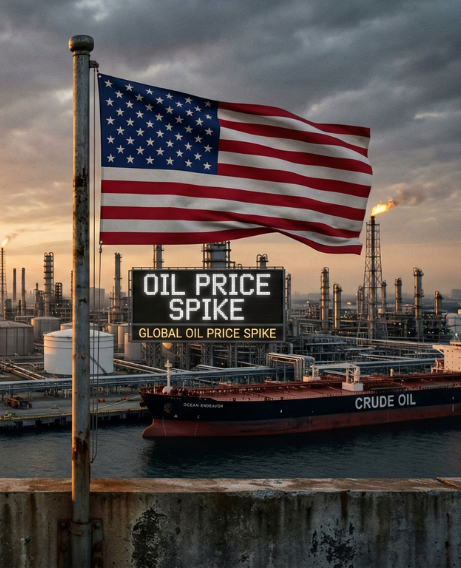
The U.S.-Israel attack on Iran is causing oil prices to go up. Oil prices rose nearly 10 percent on Monday, underscoring the economic risks of the widening conflict in the Middle East.
“The biggest question is what, if any, oil installations get damaged,” said Amy Myers Jaffe, director of the Energy, Climate Justice and Sustainability Lab at New York University. “If the answer to that is none, my opinion is the price of oil will come back down.”
The U.S.-Israeli attacks on Iran could severely restrict supplies from a key oil and gas-producing region, even if the disruption is brief, it will almost certainly make energy more expensive worldwide.
READ: Iran conflict threatens global oil supply, crude prices on edge (
“Americans will see some impact at the gasoline pump,” said Jason Bordoff, the founding director of the Center on Global Energy Policy at Columbia University. “But even with a massive strike on Iran that killed the leader of the country, at this point we’re still talking about oil prices that are well within historical norms — and much less than one would have ever expected with a strike of this magnitude.”
The longer that the war disrupts the energy trade, the bigger the risk that consumers will face higher prices, not just at the gas pump but in a broad array of products, at a time when many people are already worried about the economy.
The escalation of conflict in the Middle East underscores the vulnerability of global energy markets to geopolitical shocks. Even short-term disruptions in oil and gas supplies from the region can have ripple effects far beyond immediate price spikes, influencing transportation, manufacturing, and commodity markets worldwide. Countries dependent on imported energy may face sudden cost pressures, forcing adjustments in budgets, trade balances, and strategic reserves.
READ: Oil and gold prices rise amid heightening US-Iran tensions (
Beyond immediate economic impacts, sustained instability in the region could prompt long-term strategic recalibrations by energy-importing nations. Governments may accelerate investments in alternative energy, diversification of supply sources, and energy efficiency measures to mitigate exposure to volatile markets. Similarly, oil-exporting nations outside the conflict zone could see opportunities to increase production, potentially altering the global balance of energy supply and political influence.
The pace “will really depend on how severe the supply constraint reveals itself to be,” said Ken Medlock, an energy fellow at Rice University’s Baker Institute.