



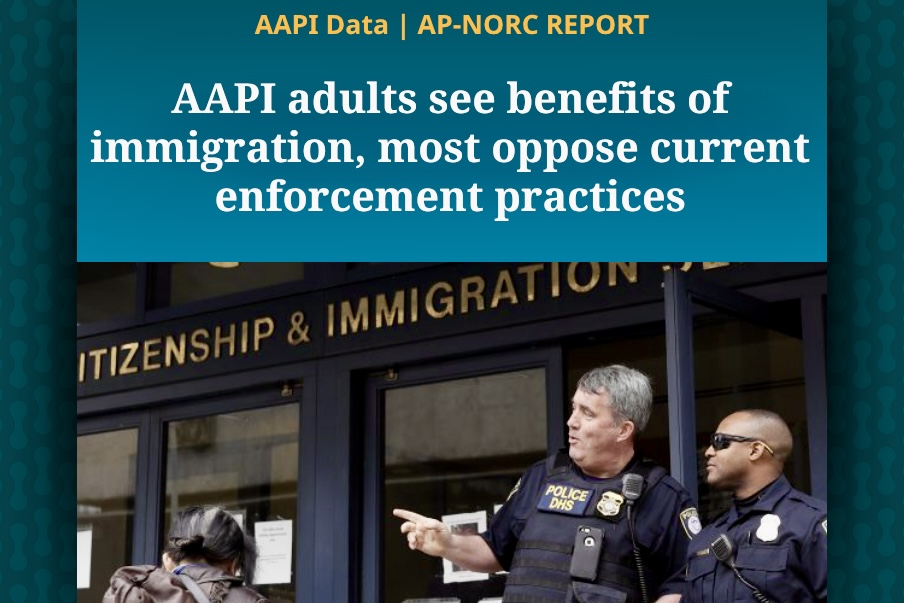
AAPI adults see benefits of immigration, but most oppose current enforcement practices with many suggesting that
President Donald Trump has gone too far with his immigration policies, according to a new AAPI Data/AP-NORC poll.
Amid mass deportation efforts across the country, including highly publicized cases of ICE detaining U.S. citizens, the poll finds 73% of Asian American, Native Hawaiian, and Pacific Islanders (AAPI) adults have unfavourable views of ICE, compared to 60% of the general population.
Among both AAPI adults and the general population, about 9 in 10 Democrats view ICE unfavourably, while 61% of AAPI Republicans and 71% of Republicans overall hold favourable views.
Overall, AAPI adults see both benefits and risks to immigration. A majority say legal immigration provides benefits such as American companies gaining the expertise of skilled workers, enriching American culture and values, contributing to economic growth, and filling jobs that Americans don’t want.
Read: AAPI’s Cancun Summit spotlights young Indian American physicians
AAPI adults are significantly more likely to view each as a major benefit compared to the general population. Many also see major economic benefits when immigrants come to the United States illegally, by taking jobs Americans don’t want (58%) or contributing to economic growth (54%).
And while few AAPI adults see major risks to legal immigration, about half see minor risks such as increased burdens on welfare or safety net programs or limiting the job market, and about 6 in 10 cite crime as a minor risk.
About half are also concerned that immigrants will vote illegally in United States elections. The general population is more likely to consider voting illegally a risk than AAPI adults.
“These findings underscore how distinct AAPI views are when it comes to immigration and immigration enforcement,” says Karthick Ramakrishnan, executive director of AAPI Data and researcher at UC Berkeley.
“AAPI adults are significantly more likely than the general public to hold unfavorable views of ICE, reflecting broader
concerns about recent enforcement actions and their potential impacts on communities.”
Six in ten or 61% of AAPI adults say Trump has hurt rather than helped immigration and border security, and most agree he has gone too far when it comes to deporting immigrants living in the U.S. illegally (67%) and imposing new restrictions on who can enter the country legally (63%).
Only 31% of AAPI adults say increasing security at the U.S.-Mexico border should be a high priority. This is lower than a recent poll of the general population (45%), and lower than it was among AAPI adults a year ago (42%).
Read: Affordability, immigration top concerns for AAPI adults: Poll
Just 9% of AAPI Democrats say this is a high priority, compared to 25% of Democrats overall. Republicans and independents are more supportive and hold similar views across groups.
When it comes to the economy, the cost of living is a key concern for AAPI adults. Most AAPI adults say their financial situation is holding steady, but a majority cite the cost of groceries, health care, and housing as sources of stress, including about half who say each is a major source.
And similar to findings from the April AAPI Data/AP-NORC poll, few are very confident they can keep up with their expenses (25%), pay an unexpected medical expense (21%), have enough savings for retirement (21%), or find a good job if they wanted to (15%).
Just 29% of AAPI adults think it is likely that young people today will have a better standard of living than their parents. Few think that Trump’s policies have helped their economic concerns. A majority say that he has hurt the cost of living (73%), cost of health care (69%), and job creation (62%).
“The findings show that cost of living pressures continue to weigh heavily on AAPI adults,” says Jennifer Benz, director of The AP-NORC Center. “While many describe their financial situation as stable, major expenses like groceries, health care, and housing remain significant sources of stress, and few express strong confidence in their ability to handle unexpected costs or plan for the future.”
The nationwide study was conducted by The AP-NORC Center for Public Affairs Research and AAPI Data from February 2-9, 2026, with 1,197 AAPI adults living in the UnitedStates. The margin of sampling error is +/- 4.6 percentage points.