



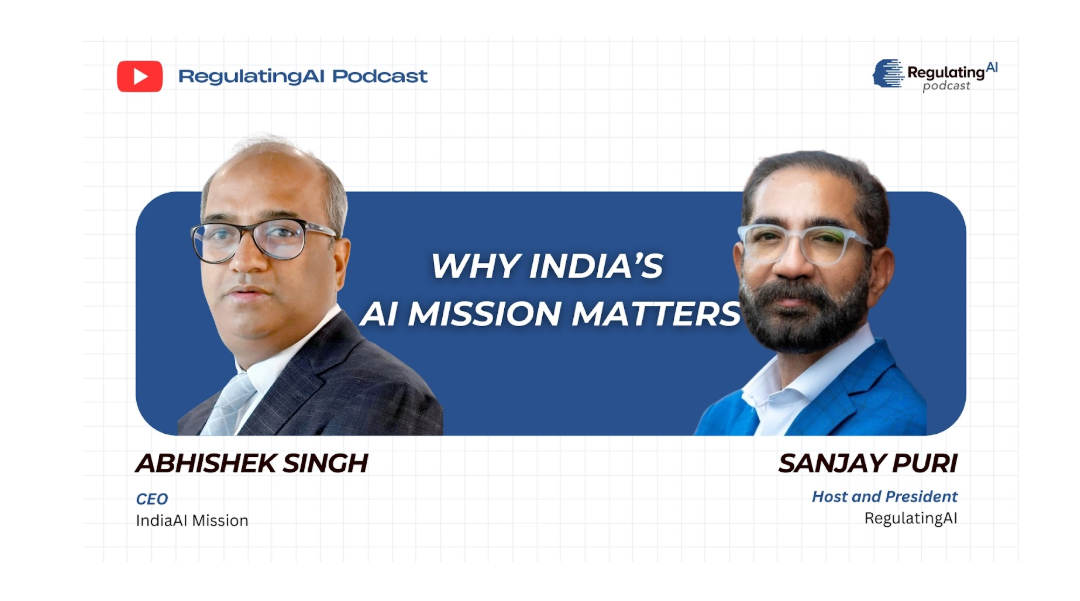
Editor’s note: This article is based on insights from a podcast series. The views expressed in the podcast reflect the speakers’ perspectives and do not necessarily represent those of this publication. Readers are encouraged to explore the full podcast for additional context.
On a special Davos edition of the “Regulating AI” podcast, host Sanjay Puri sat down with Abhishek Singh, CEO of the IndiaAI Mission and Additional Secretary at India’s Ministry of Electronics and Information Technology, to explore how one of the world’s largest democracies is approaching AI governance, innovation, and inclusion.
As AI races ahead globally, India’s strategy stands out, not just for its ambition, but for its focus on people, scale, and equity.
Singh began by situating AI within India’s broader digital journey. India was a pioneer of Digital Public Infrastructure (DPI)—open, interoperable systems like Aadhaar and UPI that transformed identity and payments for over a billion people. Now, that same philosophy is shaping India’s AI mission.
READ: AI will not self-regulate: Roy Austin on why AI needs regulation and oversight urgently (
Rather than focusing only on cutting-edge models, India is building the full AI stack: talent, compute, data sets, foundation models, applications, and regulation. The goal is to create shared, affordable infrastructure so innovation isn’t limited to a few large players.
“Compute should not be a problem that everybody solves. So, we are enabling access to compute at a low cost for everyone who is building that,” Singh explained. By making common layers available, India aims to unlock innovation across startups, enterprises, and public services.
During the conversation, Singh outlined the core framework behind India’s upcoming AI Impact Summit, hosted in February the first such global AI summit held in the developing world.
The summit is structured around three pillars:
- People: Preparing the workforce for AI through skilling, reskilling, and job transitions, while ensuring AI reaches those at the bottom of the pyramid.
- Planet: Balancing AI’s growing energy demands with sustainability, while also using AI to improve climate resilience, energy grids, and efficiency.
- Progress: Driving economic growth and social good—using AI to improve healthcare, education, agriculture, public services, and financial inclusion.
At the heart of all three pillars is a single idea: democratizing AI resources so countries in the Global South can participate on equal footing.
Singh highlighted that nearly 500 million people remain outside the digital economy not because of lack of need, but because of barriers like smartphones, literacy, and connectivity.
India’s answer is voice-first, multilingual AI. Through initiatives like Bhashini, AI-powered language and speech tools allow citizens to access services in their own languages, using voice as the primary interface.
READ: ‘Leaving no one behind’: UNDP’s Robert Opp on using technology for inclusive development (March 25, 2026)
This approach could dramatically expand access to government services, healthcare, education, and financial tools without requiring expensive devices or technical literacy.
Singh was clear that while open models are valuable, countries cannot afford complete dependency on foreign systems especially as geopolitical trust declines, “The foundation model layer is like building our own foundation model, which will be hosted in India or which will have complete explainability and understandability. And on top of that, we are building an agentic AI layer, which will be like a UPI for AI.” India is therefore investing in sovereign AI; models developed, hosted, and governed within its own jurisdiction, particularly for strategic and sensitive use cases.
The message wasn’t isolation, but resilience ensuring nations retain control where it matters most.
As the episode closed, Singh emphasized that AI’s future cannot be shaped by a handful of countries or companies alone.
India’s approach offers a compelling blueprint: AI not just for efficiency or profit, but for empowerment built at scale, governed responsibly, and designed to serve humanity as a whole.