



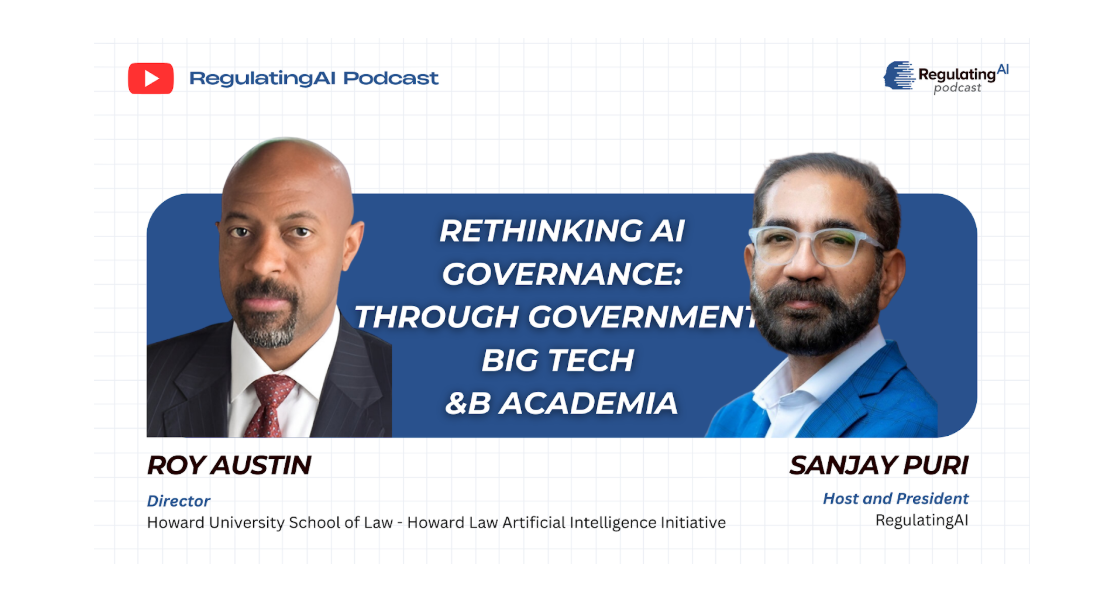
Editor’s note: This article is based on insights from a podcast series. The views expressed in the podcast reflect the speakers’ perspectives and do not necessarily represent those of this publication. Readers are encouraged to explore the full podcast for additional context.
Artificial intelligence is advancing at breakneck speed, transforming every aspect of our lives from how we work to how we learn, communicate, and govern. On the “Regulating AI” podcast hosted by Sanjay Puri, Roy Austin, a leading voice in civil rights, law, and technology, lays out why this rapid innovation is outpacing regulation, creating risks for society, and why real oversight is urgently needed.
Austin, a professor at Howard University School of Law and former deputy assistant to former President Obama, has spent decades confronting systemic inequities. In conversation with Puri, he warns that without effective regulation, AI development risks harming civil rights, democratic processes, and the workforce, all while a small number of tech elites accumulate unprecedented power and influence.
READ: From AI winter to AI action: Lessons from Anne Bouverot (
“We have a technology that’s moving faster than any technology we’ve seen in humankind,” Austin emphasizes. Unlike past innovations, AI evolves daily, scaling globally in ways laws cannot keep up with. Child safety, employment, and civil rights are all at risk, yet governance remains slow and fragmented. According to Austin, the current system is reactive; regulators chase after technology rather than guiding it responsibly.
Big Tech companies often call for “national regulation,” but Austin argues this is largely performative. Federal rules are slow, and in their absence, states try to fill the void. Tech uses this gap strategically, lobbying against state-level laws while claiming to want national frameworks. “They’re playing people for fools by saying let’s get some regulation when they know there will not be regulation,” Austin says, highlighting a pattern of regulatory capture where companies shape rules to favor themselves.
Drawing on his co-authored 2014 Obama administration report on big data, Austin explains, “…garbage in garbage out. If you don’t have good data, if you don’t have disaggregated data, if you don’t have truthful data, you’re going to get bad results.”
AI systems trained on biased or incomplete data replicate inequities. The infamous example of Amazon’s AI hiring tool biased against women and minorities illustrates the danger. Now, with AI systems like ChatGPT reaching hundreds of millions globally, the potential for harm scales exponentially.
READ: Leading with heart and disruption: Fashion tech pioneer Ram Sareen’s success story (
Austin compares the risk-based EU AI Act, which emphasizes transparency and human rights, with the U.S.’s fragmented sector-specific approach. He stresses that regulation does not stifle innovation; instead, it provides trust, accountability, and safety necessary for AI to serve society rather than corporate profit.
Ethics boards and oversight committees are inadequate. Austin notes oversight boards make few decisions annually while companies deploy millions of AI-driven choices daily. Without internal compliance teams and external independent oversight, there’s no accountability. Companies currently prioritize growth and wealth accumulation over public safety and civil rights.
From job displacement to concentrated wealth, AI’s societal impact is profound. Austin warns that tech companies must take moral responsibility for employment disruption and civil rights harms. AI affects democracy, privacy, and even child safety. Without regulation, individuals and communities are left vulnerable.
Austin advocates for:
- Federal regulation complementing state laws, not preempting them.
- Internal company infrastructure for responsible AI.
- Independent external oversight agencies.
- Education to help humans evaluate AI outputs critically.
- Inclusive decision-making centered on civil rights.
Austin’s discussion on “Regulating AI” makes one thing clear: AI will not self-regulate. Without thoughtful oversight, ethical frameworks, and diverse leadership, the technology could widen inequities, harm individuals, and concentrate power in the hands of a few. Responsible AI isn’t just a technical issue, it’s a societal imperative, and the time to act is now.